
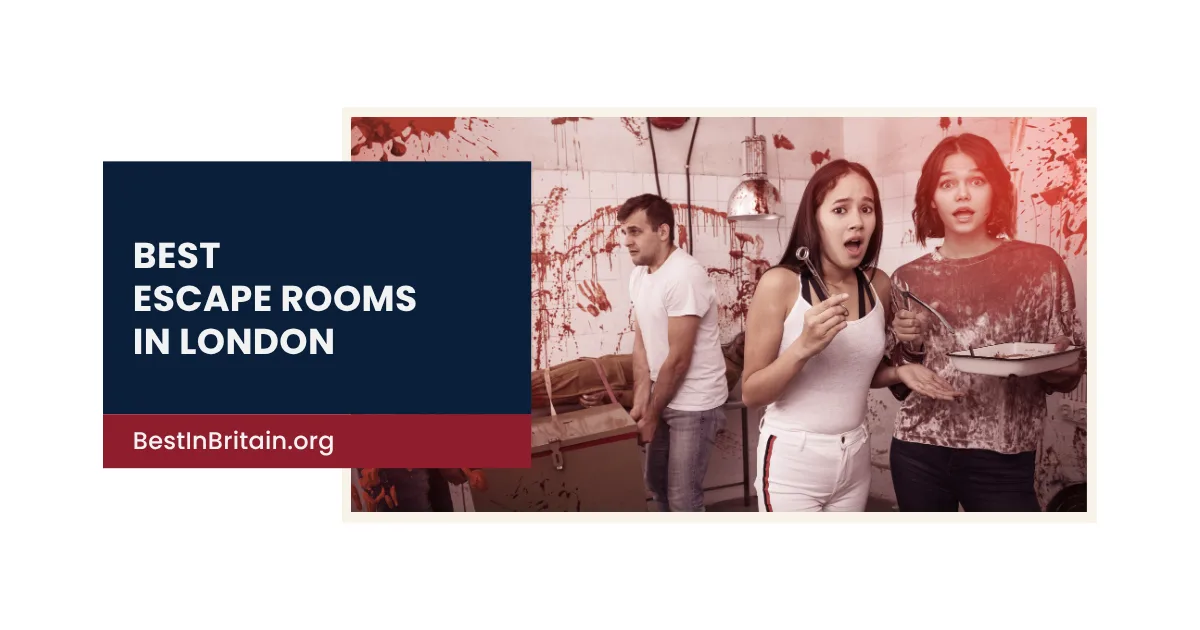
London's escape-room scene now extends well beyond padlocks, keys and a countdown clock. The strongest venues use purpose-built mechanisms, lighting, sound, physical sets, live performers and carefully controlled hints to create an experience that feels closer to interactive theatre than a collection of riddles.
That variety also makes comparison difficult. Some games are puzzle-heavy and best suited to enthusiasts. Others prioritise atmosphere, actors or physical challenges. Prices may be charged per person or per team, and the apparently cheapest ticket can become more expensive when only two people are playing.
The six venues below cover several distinct versions of the format. Some offer conventional private puzzle rooms, while others place greater emphasis on historical settings, live performance, licensed themes or physical team challenges.
The most suitable choice depends on the group's experience, preferred difficulty, tolerance for darkness or actor interaction, mobility requirements and willingness to share the experience with other visitors. A carefully matched game is more important than selecting the venue with the highest headline difficulty or most elaborate marketing.
What distinguishes a strong escape-room experience?
A well-designed game should give the team enough information to make progress without relying on guesswork or excessive force. Puzzles should connect logically to the setting, and the hint system should preserve momentum without removing all sense of discovery.
Practical information matters just as much as theme. Before booking, check the minimum and maximum team size, whether the room is private, the total team price, age restrictions, arrival time, rescheduling policy and whether stairs, darkness, crawling or live performers are involved.
Accessibility varies not only between venues but between individual games. A step-free reception does not necessarily mean every room, puzzle or emergency route is accessible. Groups should discuss specific mobility, sensory, hearing or visual needs with the venue before purchasing non-refundable tickets.
How much do London escape rooms cost?
Most conventional London escape rooms cost roughly £28 to £42 per person, although the structure varies.
Current examples include: - clueQuest: £31.99 per person off peak and £36.99 at peak times; its longer IAMAI experience costs £39.99 - Escape Hunt Oxford Street: £42 each for two players, falling to £31 each for six - Mission: Breakout: from £28 per player, with a minimum charge equivalent to three players - Escape Plan: games from about £25 per person, with prices depending on team size and session - Secret Studio: approximately £38 per player for the Brick Lane game, usually with a minimum group charge - The Crystal Maze LIVE Experience: standard tickets currently advertised from £79, depending on date and ticket type
Look beyond the individual ticket. A two-player booking can cost more per person than a team of five or six, while a team-priced room may offer better value for a full group.
Ask whether the price includes: - VAT - A private room - A live actor - Photographs - Additional time or briefing - Rescheduling protection - Food or meeting space - A minimum team charge
How escape rooms work
A conventional game normally lasts 60 minutes. The team enters a themed space, searches for information, solves connected puzzles and works towards a final objective.
The door should not literally trap players without a safe exit. Venues use emergency-release procedures, monitoring and game masters. Anyone concerned about enclosed spaces should ask whether the room can be left at any time and whether leaving ends the game.
Hints are usually delivered through a screen, radio, telephone, actor or in-world device. Using a hint is normal. A well-timed clue is better than spending 20 minutes stuck on one overlooked detail.
clueQuest
Editorially SelectedBusiness details
Address
169 - 171 Caledonian Road, London N1 0SL
Phone: 07798 772382
Email: escape@cluequest.co.uk
Published prices: - Off peak: £31.99 per person - Peak: £36.99 per person - IAMAI: £39.99 per person
clueQuest is a well-established all-round option for conventional escape-room play. It has operated in London since 2013 and has built a coherent secret-agent universe rather than filling its venue with unrelated licensed themes.
Its current missions include PLAN52, Operation BlackSheep, Revenge of the Sheep and cQ ORIGENES, alongside IAMAI, a longer and more theatrical experience. The rooms vary in difficulty, allowing first-time players and returning enthusiasts to choose something appropriate.
The venue is particularly useful for corporate events and larger groups because several teams can play simultaneously. clueQuest has historically operated duplicate copies of some missions, but organisers should confirm the exact number of rooms and whether direct head-to-head play is available on the chosen date.
The current line-up extends beyond the four core missions, and unsold sessions can disappear from public booking around two hours before the start. A separate same-day hotline may be available for last-minute enquiries.
Pros - Long-running specialist escape-room operator - Coherent original themes - Games for different experience levels - Good capacity for groups and corporate events - Clear per-person pricing
Best for: First-time groups, enthusiasts, birthdays and corporate teams wanting a reliable conventional escape-room format.
Planning tip: Choose the mission by published difficulty rather than selecting only by artwork or availability.
Escape Plan
Editorially SelectedLocation: Shoreditch, close to Liverpool Street station; the booking confirmation provides current arrival details
Published pricing: From approximately £25 per player; exact team prices vary
Escape Plan specialises in historically inspired adventures, especially stories connected with wartime Britain. Its current games include The Adventure Begins, Roll Out the Barrel, The Battle for Britain and Pushed for Time.
This is a strong choice for groups that prefer tactile puzzles and narrative detail over horror or licensed entertainment brands. Most games run for 60 minutes and accommodate small teams, while The Battle for Britain can take a larger group than a typical six-player room.
The venue charges by team or player configuration depending on the booking. Current promotions sometimes reduce a whole-team booking to around £120, but offers are date-limited and should not be treated as the normal price.
Escape Plan also allows some bookings to be made for the minimum team size with additional players paid for on arrival. That flexibility is useful when attendance is uncertain, though the maximum room capacity still applies.
Pros - Distinct historical and wartime themes - Four current games - Suitable for enthusiasts who value puzzle design - Central Shoreditch location - Flexible treatment of uncertain final numbers on some bookings
Best for: Puzzle-focused groups, history enthusiasts and teams seeking an independent operator near Liverpool Street.
What to confirm: Check the exact team capacity, total team price and whether additional players can be added on arrival.
Mission: Breakout
Editorially SelectedBusiness details
Address
141 - 145 Kentish Town Road, London NW1 8PB
Phone: 020 3652 8144
Published price: From £28 per person including VAT
Mission: Breakout has one of London's most memorable locations: part of the disused South Kentish Town Underground station, which closed to passengers in 1924.
Its three current games are Codebreakers, The Lost Passenger and Underground 2099. The Lost Passenger and Underground 2099 use darkness and a spookier atmosphere, while Codebreakers draws on a wartime intelligence story.
Rooms are private and generally designed for three to six players. Two people can play, but the minimum charge is for three. Up to 18 people can participate simultaneously across the three separate rooms.
The venue recommends the experience from age nine. Children under 15 must be accompanied by an adult aged 18 or over. The darker games may not suit every child, even where the formal minimum age is met.
Pros - Unusual disused Underground-station setting - Three distinct games - Private rooms - Competitive starting price - Up to 18 players across simultaneous sessions
Best for: Groups wanting a highly atmospheric London-specific setting.
What to confirm: Discuss mobility, darkness, fear level and any evacuation concerns before booking.
Secret Studio
Editorially SelectedBrick Lane game: Hidden location near Wentworth Street, London E1; exact arrival instructions are supplied after booking
Additional experience: Escape from the Golden Hinde, St Mary Overie Dock, Cathedral Street, London SE1 9DE
Published prices: - Secret Studio's Brick Lane game: approximately £38 per player, subject to booking terms and minimum group charge - Escape from the Golden Hinde: £48 per person before any live offers
Secret Studio provides the most theatrical option among the conventional escape games in this guide. Its original Brick Lane experience is set in a fictional abandoned film studio and blends puzzles, retro production design, character interaction and misdirection.
The exact entrance is deliberately withheld until after booking. This is part of the experience, but every participant should receive the arrival instructions rather than relying on a map pin for Wentworth Street.
Secret Studio also runs Escape from the Golden Hinde on a reconstructed historic ship beside Borough Market. The official site currently describes this as taking place on the last Thursday of each month. It is a separate game rather than an alternative room available continuously at the Brick Lane venue.
The Golden Hinde version accommodates groups from three to 18, splitting larger parties into crews. It has no toilets on the ship, and the historic layout may not suit all mobility requirements.
The core game runs for 60 minutes, with briefing and debriefing increasing the total time spent at the venue.
Pros - Strong immersive-theatre and character elements - Unusual retro studio setting - Separate historic-ship experience - Suitable for groups wanting performance as well as puzzles - Distinctive alternative to a standard chain venue
Best for: Players who enjoy actors, atmosphere and theatrical storytelling.
Planning tip: Tell the venue before arrival if anyone strongly dislikes shocks, darkness or character interaction.
Escape Hunt Oxford Street
Editorially SelectedBusiness details
Address
Ground Floor and Basement, 70 - 88 Oxford Street, London W1D 1BP
Phone: 020 7637 3222
Email: oxfordstreet@escapehunt.com
Location note: Inside Boom Battle Bar, opposite the Tottenham Court Road Elizabeth line entrance
Published indoor-room prices: - Two players: £42 each - Three players: £39 each - Four players: £36 each - Five players: £33 each - Six players: £31 each
Escape Hunt is the most convenient West End option in this guide. The venue currently runs 60-minute rooms including Doctor Who: A Dalek Awakens, Alice in Puzzleland, Aladdin and the Magic Vault, Blackbeard's Treasure, Journey to Atlantis and Escape the Wild West, although game availability can change.
The licensed Doctor Who room is the clearest reason to choose the venue over an independent operator. Other themes offer colourful, accessible adventures that suit social groups and visitors wanting a central activity before dinner, theatre or drinks.
The venue sits inside Boom Battle Bar rather than at a standalone storefront. Security may ask to see proof of the Escape Hunt booking, particularly where younger participants are entering.
Rooms accommodate up to six. Under-16s must be accompanied in the room by a paying adult over 18. Online bookings can cover up to 24 people across multiple rooms; larger groups should contact the venue.
Standard online bookings can cover up to 24 players across multiple rooms. Promotional discounts, including early-session offers, are subject to current booking terms and can change.
Pros - Extremely central location - Licensed Doctor Who game - Wide range of colourful themes - Clear group-size pricing - Suitable for visitors combining the game with other West End plans
Best for: West End visitors, Doctor Who fans and mixed-experience social groups.
What to confirm: Check the current game list, early-bird offer and age-entry arrangements with Boom Battle Bar.
The Crystal Maze LIVE Experience
Editorially SelectedBusiness details
Address
22 - 32 Shaftesbury Avenue, London W1D 7EU
Published ticket pricing: Standard tickets are currently advertised from £79, with the final price depending on date, session and ticket type
The Crystal Maze is not a conventional locked-room game, but it deserves inclusion because it offers London's most substantial large-scale team challenge. Groups move through themed zones with a Maze Master and complete short physical, skill, mental and mystery games to earn time in the Crystal Dome.
The experience lasts around 75 minutes overall and is more active than a typical escape room. Some challenges involve crawling, climbing, balancing or confined spaces, although participants can discuss limitations and choose different team members for individual games.
The minimum age is nine. Bookings involving under-18s require adult participation under the venue's current rules. Family and school requirements should be checked carefully because ticket sellers sometimes summarise the adult-to-child ratio differently.
Teams can contain up to eight people. Smaller parties may be combined with other visitors, unlike the private rooms provided by most operators in this guide.
The ticket price is materially higher than a conventional room, but the format includes a live host, multiple challenge zones and the final Dome rather than one 60-minute puzzle space.
Pros - Large-scale recreation of the television format - Mix of physical, skill and mental challenges - Live Maze Master - Strong option for celebrations and team building - Central Shaftesbury Avenue location
Best for: Energetic groups, corporate outings and fans of the television programme.
What to confirm: Ask about team merging, physical adjustments, age ratios and accessibility before purchasing non-refundable tickets.
Quick comparison
| Venue | Main style | Typical price | Team size | Best for |
|---|---|---|---|---|
| clueQuest | Puzzle-led secret-agent missions | £31.99 - £39.99 pp | Usually small private teams | First-timers and enthusiasts |
| Escape Plan | Historical independent rooms | From about £25 pp | Game-dependent | Puzzle and history fans |
| Mission: Breakout | Underground-station atmosphere | From £28 pp | 3 - 6 per room | London-specific immersion |
| Secret Studio | Live characters and theatrical puzzles | About £38 - £48 pp | 3+ | Immersive-theatre fans |
| Escape Hunt | Licensed and colourful West End rooms | £31 - £42 pp | 2 - 6 | Visitors and mixed groups |
| Crystal Maze | Physical multi-zone challenge | From £79 | Up to 8 | Active teams and corporate events |
Which escape room suits which group?
For first-time players
clueQuest is the clearest starting point because it grades its missions and has extensive experience with new teams. Escape Hunt also offers accessible themes, although a two-person booking is expensive.
For enthusiasts
Escape Plan and clueQuest provide the strongest conventional puzzle focus. Secret Studio is more appropriate when the group values performance and surprise as much as puzzle density.
For a distinctly London setting
Mission: Breakout uses a disused Underground station, while Escape from the Golden Hinde takes place on a reconstructed historic ship. Both are more location-specific than a generic themed room.
For families
Check the individual game rather than the company alone. Escape Hunt requires a paying adult in the room for under-16s. Mission: Breakout starts from age nine but includes dark and spooky themes. The Crystal Maze accepts players from nine but is physical.
For corporate groups
clueQuest has the most conventional large-group escape-room infrastructure. Mission: Breakout can host 18 across three games. Escape Hunt supports multiple simultaneous rooms, while The Crystal Maze works well for active team-building.
For two players
Escape Hunt permits two but charges its highest per-person rate. Mission: Breakout allows two players but charges for three. Check clueQuest and Escape Plan availability carefully, as minimums vary by mission and session.
Difficulty and hint systems
Difficulty ratings are not standardised. A “hard” game at one venue may rely on observation, while another uses complex logic, parallel tasks or minimal prompting.
For a mixed group, choose the room for the least experienced players rather than the strongest enthusiast. A very difficult game can leave new players watching one person solve everything.
Ask how hints are delivered and whether the game master adapts them. Some groups want minimal help; others would rather maintain pace and see the whole story.
Live actors and fear levels
A game with live performers is not automatically a horror game, but actors may enter the space, surprise players or interact closely. Secret Studio uses character performance, while other venues may add actors to selected experiences.
Tell the venue about: - Severe anxiety - Claustrophobia - Photosensitive epilepsy - Hearing or visual requirements - Mobility limitations - Pregnancy - Sensory sensitivities - Strong dislike of touching or jump scares
Do not assume that an age recommendation means every child will enjoy darkness, sound or suspense.
Accessibility
Escape rooms often occupy basements, converted industrial spaces and historic buildings. Accessibility can differ between games at the same venue.
Ask specifically about: - Step-free entrance - Lift dimensions - Narrow doors - Stairs inside the game - Seating - Crawling or climbing - Low lighting - Colour-dependent puzzles - Audio-only clues - Emergency exits - Accessible toilets - Carer or companion tickets
A venue saying it is “accessible” may mean only the reception area, not every puzzle or room.
Choosing a game by difficulty
Difficulty labels are useful only within the same operator. One venue may describe a room as difficult because it contains many parallel tasks, while another uses the term for sparse clues, abstract logic or a lower level of hinting.
First-time groups should normally choose a room designed for mixed experience rather than the hardest available option. A group of six can also be less efficient than a smaller team if communication becomes fragmented or several people miss the same clue.
Experienced players should ask whether the room contains linear or parallel puzzle paths, how hints are delivered and whether the game is intended to be completed without prior knowledge. A strong design should not depend on obscure trivia unless that knowledge is clearly supplied inside the experience.
Private rooms and shared experiences
Most conventional escape rooms sell a private session to one booking group. That means strangers are not added simply because the room has spare capacity.
The Crystal Maze operates differently. Teams are designed for up to eight people, and smaller bookings may be combined with other visitors. Booking in a complete group of eight is the clearest way to avoid team merging, subject to availability and current terms.
For birthdays, proposals, confidential corporate groups or participants with anxiety, confirm privacy explicitly rather than assuming the operating model.
Escape rooms for children and teenagers
Published minimum ages are not a complete measure of suitability. Darkness, loud sound, confined spaces, actor interaction and time pressure can affect children differently.
Ask whether: - An adult must play inside the room - The adult needs a paid ticket - The game includes jump scares or live performers - Hints can be adapted for younger teams - The puzzles require adult reading or numeracy - Birthday food or waiting space is available - Every participant must sign a waiver
For younger groups, choose the theme for the most cautious participant rather than the oldest or most confident child.
Booking advice
Book directly with the venue where possible. Third-party ticket sites may have different cancellation and rescheduling terms. Direct booking also makes it easier to discuss accessibility, age rules and special arrangements with the operator.
Before paying, check: - Date and start time - Required arrival time - Exact address - Minimum and maximum team size - Private or shared experience - Age rules - Cancellation policy - Rescheduling fees - Late-arrival policy - Alcohol restrictions - Accessibility - Whether all players need to sign a waiver
Escape rooms depend on timed staffing. Arriving late can shorten or cancel the game because the following team still has a booked slot. Many venues ask players to arrive 10 to 15 minutes before the booked start for briefing and waivers.
Corporate and large-group planning
Do not divide colleagues randomly without considering accessibility and confidence. Ask whether identical rooms allow direct competition or whether teams will play different games with different difficulty.
Confirm: - Maximum simultaneous capacity - Exclusive venue hire - Meeting room - Catering - Invoice and VAT receipt - Name changes - Last-minute absence - Debriefing - Data or photography policy - Alcohol before play
For formal team development, an escape room is entertainment rather than a validated assessment of leadership, intelligence or workplace potential.
Where several teams play different rooms, avoid comparing completion times as though the games are equivalent. Difficulty, hinting and physical layout can vary significantly.
Claustrophobia and leaving the room
Players should be able to leave through an emergency route without solving the game. Ask how this works before the briefing if enclosed spaces are a concern.
Leaving may pause, shorten or end participation depending on the venue and game design. A person with severe claustrophobia may prefer a larger, brighter or more open challenge rather than a basement or underground setting.
Tell the game master privately before play if a participant may need to step out. This allows the venue to explain the safest route without drawing unnecessary attention to the person during the group briefing.
Safety and conduct
Follow the game master's instructions. Do not climb furniture, force locks, remove fittings or use excessive strength unless explicitly told that a physical action is required.
Phones, smartwatches and photography are commonly prohibited inside rooms to protect puzzles and player privacy.
Anyone can normally leave through an emergency release. Ask before the game if this is not explained during the briefing.
Players who are intoxicated, aggressive or unsafe may be refused entry without a refund.
Frequently asked questions
Are escape rooms genuinely locked?
Players should have an emergency way to leave. The thematic door may appear locked, but safety procedures must allow exit.
Do you need to be highly intelligent?
No. Good teams communicate, share discoveries and try different approaches. Observation is often more important than specialist knowledge.
Can strangers be added to the team?
Most conventional rooms in this guide are private. The Crystal Maze may combine smaller groups. Confirm before booking.
What happens if the team does not escape?
The game master ends the session and normally explains or reveals the remaining sequence. Failing is common and does not mean the experience was wasted.
Are escape rooms suitable after drinking?
Venues can refuse entry to intoxicated players. Alcohol also reduces observation and coordination.
Can pregnant players take part?
Many conventional rooms can be suitable, but physical, horror and historic-venue games need individual discussion.
Are clues available?
Yes. Hint systems differ, but asking for help is a normal part of the format.
Choosing with confidence
London's best escape rooms are not interchangeable. clueQuest offers the strongest all-round conventional experience, Escape Plan focuses on historically themed puzzles, Mission: Breakout provides an unusually authentic Underground setting and Secret Studio leans into immersive performance. Escape Hunt is the most convenient West End choice, while The Crystal Maze provides a larger physical challenge.
Choose according to the group's confidence, mobility, tolerance for darkness and preferred balance between puzzles and theatre. A carefully matched room will produce a better experience than simply booking the hardest or most expensive option.
London Visitor, Culture & Leisure Market Statistics
Annual Visitor Footfall
21.1M
Annual visitors in London
Tourist & Visitor Spend
£14.2B
Annual visitor expenditure
Cultural & Leisure Venues
1,250
Attractions & landmarks
Visitor Stay Profile
52% Day
48% Overnight stays
Primary Attraction & Cultural Hubs in London
- WC2 (West End & Museums Qtr)36% focus
- SE1 (South Bank & London Eye)28% focus
- SW7 (South Kensington Museums)20% focus
- EC3 (Tower of London & City)16% focus
Attraction Types & Category Breakdown
- World-Class Museums & Art Galleries44% of venues
- Royal Parks & Landmark Palaces24% of venues
- West End Theatres & Cultural Shows18% of venues
- Historic Architecture & River Cruises14% of venues
Related articles
Related guides
Things to Do
Best Jazz Clubs in London for Live Music
A current guide to six London jazz clubs and live-music venues, covering ticket prices, seating, food, age rules, accessibility, jam sessions and the different styles each venue presents.
Updated 22 July 2026

Things to Do
Best Ice Skating Rinks in London
A current guide to London's best year-round ice skating rinks, covering public sessions, prices, skate hire, lessons, family rules, accessibility and seasonal rink updates.
Updated 13 July 2026
Things to Do
Best Live Music Venues in London
A current guide to six London live music venues, covering concert formats, standing and seating, accessibility, bag rules, age restrictions, food, ticket fees and choosing the right room.
Updated 13 July 2026

Things to Do
15 of the best walking tours in London for curious wanderers
Discover 15 standout London walking tours, covering royal ceremony, wartime Westminster, women’s history, Harry Potter, Sherlock Holmes, street art, food, pubs and architecture.
Updated 12 July 2026
Things to Do
12 of the best tours in London for memorable city experiences
Discover 12 standout London tours, including Harry Potter, sightseeing buses, Thames cruises, food walks, cycling, theatre history and specialist neighbourhood experiences.
Updated 11 July 2026
Things to Do
30 of the best free things to do in London for locals and visitors
Discover 30 of the best free things to do in London, from major museums and royal parks to historic ceremonies, skyline views, live music and unusual attractions.
Updated 5 July 2026
Know a business we should consider?
Send us the details and our editorial team will review whether it fits a future guide.
Submit businessWriter profile
Gabriela Krumova
Arts, Culture & Performance Contributor
Actor, theatre director and Queen Margaret University Drama graduate with international performance experience across Edinburgh, London, New York, Paris and Venice. Gabriela has performed in and directed Edinburgh Festival Fringe productions and covers theatre, performing arts, cultural venues, live entertainment, festivals and the creative industries for Best in Britain.
Editorial Trust Standard
Independent ReviewIndependent Research
Featured rankings are editorially determined. Commercial partner listings are strictly labeled as Sponsored or Featured.
Public Register Audit
Listings are cross-checked against public regulatory registries, Companies House filings, and published fee schedules.
Regional Directory
Explore Other Verified Services in London
accountants
Top Accountants in London
marketing agencies
Top digital marketing agencies in London
private clinics
Best Home Care Services in London
solicitors
Best Immigration Lawyers in London
things to do
Best Jazz Clubs in London for Live Music
commercial property agents