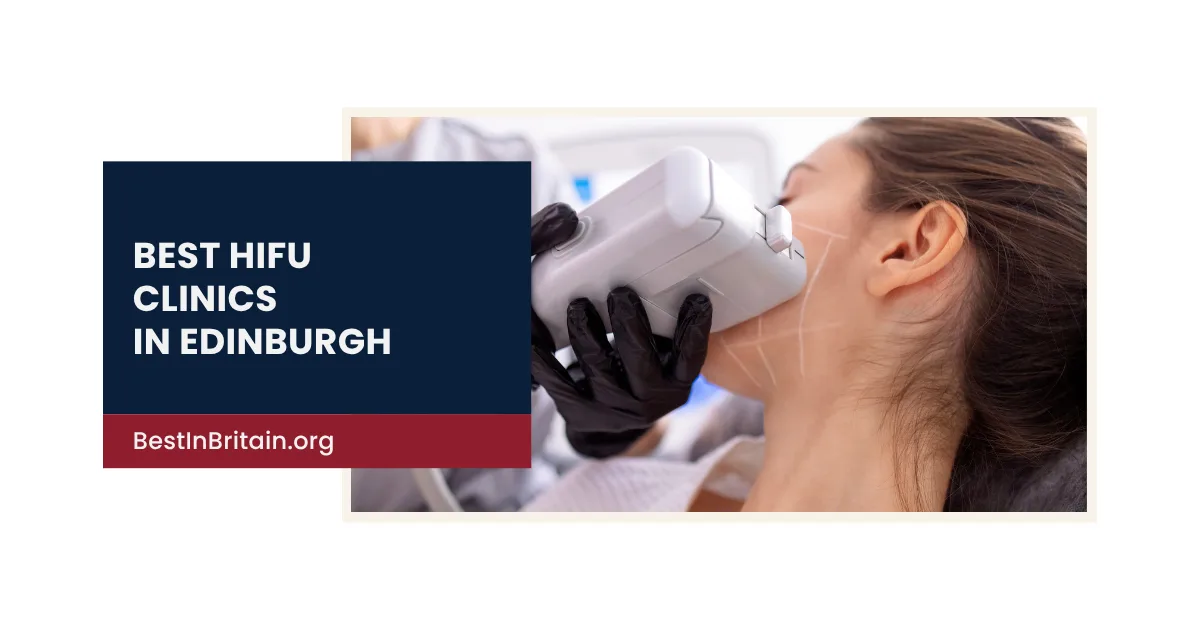
HIFU clinics in Edinburgh for non-surgical facial and body skin tightening
High-intensity focused ultrasound, usually shortened to HIFU, is an aesthetic treatment intended to tighten and firm selected areas of the face or body without surgery.
The treatment delivers focused ultrasound energy beneath the surface of the skin. The controlled thermal effect is intended to stimulate a healing response and the production of new collagen over the following weeks and months.
HIFU is commonly marketed for concerns including:
- Reduced jawline definition
- Mild lower-face laxity
- Loose skin beneath the chin
- Early neck laxity
- A lowered brow
- Fine lines
- Reduced facial firmness
- Loose abdominal skin
- Selected body-contouring concerns
It is not a non-surgical equivalent to a full facelift, and it will not produce the same degree of lifting as an operation. Results are generally more subtle, develop gradually and vary according to age, skin condition, anatomy, treatment settings and the device used.
The quality of the consultation is therefore as important as the treatment itself. A responsible practitioner should determine whether the concern is actually caused by skin laxity and whether HIFU is likely to provide a meaningful improvement.
Reduced jawline definition, for example, may relate to skin laxity, facial fat, muscle activity, bone structure or a combination of these factors. Applying ultrasound without identifying the underlying issue can lead to disappointing results or treatment of an unsuitable area.
Edinburgh has several providers offering HIFU in different clinical environments. These range from doctor-led cosmetic clinics to advanced beauty and aesthetic practices. They do not all use the same device, charge the same prices or operate under the same regulatory structure.
This guide explains the differences and examines four current Edinburgh providers.
How the HIFU clinics were selected
The providers in this guide were considered against factors that matter when choosing an ultrasound-based aesthetic treatment:
- Current HIFU service: The clinic must currently advertise HIFU treatment in Edinburgh.
- Consultation process: Preference is given to providers that assess suitability before treatment rather than presenting HIFU as appropriate for everyone.
- Treatment information: Useful providers explain the intended effect, likely development of results and possible limitations.
- Device transparency: The guide identifies a device only where the clinic publishes its name.
- Practitioner information: Clinics should make it possible to understand who performs treatments and the nature of their professional role.
- Regulatory clarity: HIS registration is referenced only where it is stated by the provider or can be independently confirmed.
- Price transparency: Published prices are included where current figures are available.
- Aftercare: The clinic should provide an identifiable route for advice if unexpected symptoms develop after treatment.
- Location and access: Address, contact information and practical booking details are considered.
- Appropriate expectations: Clinics should distinguish gradual aesthetic improvement from the effects of surgery.
Inclusion is editorial and does not guarantee that HIFU is clinically appropriate for a particular person or that a specific result will be achieved.
What is HIFU?
HIFU uses focused ultrasound energy to heat selected tissue beneath the skin.
The applicator is moved across the treatment area while the device delivers energy at predetermined depths. Different cartridges or settings may be used for different parts of the face or body.
The intention is to create controlled points of thermal injury below the skin surface. The body responds through tissue contraction and a longer collagen-remodelling process.
Depending on the device and treatment plan, energy may be directed towards:
- The deeper dermis
- Subcutaneous tissue
- Fibrous supporting tissue
- Selected fat layers during body treatments
- Deeper structural layers beneath facial skin
Marketing descriptions frequently refer to the superficial musculoaponeurotic system, or SMAS. This is a fibromuscular layer involved in surgical facial lifting.
Consumers should not assume that every device described as HIFU reaches the same depth or delivers energy with equivalent precision. The cartridge, frequency, energy level, treatment pattern and operator technique all matter.
A clinic should be able to explain:
- The device it uses
- The intended treatment depth
- Why that depth is suitable
- How the treatment area will be mapped
- How settings are selected
- What training the practitioner has completed
- What side effects have been discussed
- What aftercare is available
The answer should be specific to the clinic’s equipment rather than a general explanation copied from HIFU marketing material.
What HIFU can realistically achieve
HIFU is most commonly considered by people with mild to moderate laxity who want a gradual change without surgery.
Possible improvements may include:
- A firmer-feeling jawline
- Subtle lifting beneath the chin
- Improved appearance of early neck laxity
- A modest brow-lifting effect
- Smoother-looking skin
- Improved facial definition
- Some tightening of selected body areas
The degree of improvement varies.
A person with substantial loose skin, pronounced jowling or advanced neck laxity may not obtain the result they want from a non-surgical treatment. A consultation should include an honest discussion about whether surgery would be required to achieve a more significant lift.
HIFU also does not restore facial volume. Where the main concern is loss of cheek volume or changes in bone support, tightening the skin may not address the underlying cause.
Equally, reducing facial fat is not always desirable. Excessive or poorly targeted treatment in a naturally lean face could potentially make hollowing more noticeable.
The objective should be a suitable and proportionate treatment, not the highest possible energy or greatest possible number of treatment lines.
When do HIFU results appear?
HIFU results are not normally complete when the appointment ends.
Some people report an initial feeling of tightness, but the intended collagen-remodelling process develops over a longer period.
A typical timeline presented by clinics may include:
- Immediately afterwards: Temporary tightness, redness or mild swelling may be visible.
- Four to six weeks: Early changes in firmness may begin to develop.
- Eight to twelve weeks: The main lifting or tightening effect may become more apparent.
- Three to six months: Collagen remodelling may continue.
- Later maintenance: Some clients consider another treatment when the effect reduces over time.
These stages are estimates rather than guarantees.
Results may be influenced by:
- Age
- Skin thickness
- Degree of laxity
- Facial structure
- Lifestyle
- Smoking
- Sun exposure
- Menopause and hormonal change
- Weight fluctuation
- Treatment settings
- Device quality
- Practitioner technique
- Natural collagen response
Before-and-after photographs should be taken under comparable lighting, camera position and facial expression. Images taken from different angles or with altered lighting can exaggerate apparent improvement.
Is HIFU painful?
Descriptions range from mild tingling to sharp, momentary discomfort.
Sensation may be stronger around:
- The jawbone
- Chin
- Forehead
- Teeth
- Areas with limited soft tissue
- Sites close to superficial nerves
The experience depends on the device, energy settings, treatment depth, number of lines and individual sensitivity.
A clinic should not dismiss concerns by claiming that the procedure is entirely painless for everyone.
Clients should tell the practitioner immediately if they experience:
- Severe or unexpected pain
- An electric-shock sensation
- Persistent shooting pain
- Sudden muscle movement
- Marked burning
- Unusual visual symptoms
- Severe dental pain
- Numbness developing during treatment
The practitioner should be willing to pause, reassess the position and adjust or stop treatment where necessary.
Possible side effects and complications
HIFU is non-surgical, but non-surgical does not mean risk-free.
Temporary effects may include:
- Redness
- Tenderness
- Mild swelling
- Tingling
- Sensitivity
- Bruising
- Temporary numbness
- A tight feeling
- Small raised areas
- Discomfort when touching the skin
Less common or more significant complications can include:
- Burns
- Blistering
- Persistent pain
- Nerve irritation
- Temporary weakness
- Altered sensation
- Uneven results
- Unwanted fat loss
- Facial hollowing
- Pigment changes
- Prolonged swelling
- Failure to achieve the expected result
Therapeutic ultrasound can cause tissue burns and nerve damage when energy is delivered incorrectly or to an unsuitable area.
A practitioner should understand facial anatomy, avoid inappropriate treatment paths and recognise symptoms requiring medical assessment.
The consultation should explain what is considered a normal response, how long it should last and whom to contact if it does not settle.
Who may not be suitable for HIFU?
Suitability depends on the treatment area, medical history and device instructions.
Treatment may be unsuitable or require additional assessment where a person has:
- Open wounds
- Active skin infection
- Significant inflammation
- Severe acne in the treatment area
- Compromised skin
- A pacemaker or active implanted electronic device
- Metal implants in or close to the treatment area
- Recent facial surgery
- Recent injectable treatment
- Significant facial nerve problems
- Unexplained numbness
- Certain neurological conditions
- A bleeding disorder
- Poorly controlled medical conditions
- Pregnancy or breastfeeding
- Unrealistic expectations
- Severe skin laxity better addressed surgically
Dental implants and metal dental work should be disclosed. Their presence does not automatically establish whether treatment can or cannot proceed, but the practitioner needs to understand their location and follow the device manufacturer’s guidance.
Previous treatments should also be disclosed, including:
- Dermal fillers
- Anti-wrinkle injections
- Threads
- Biostimulators
- Radiofrequency procedures
- Laser resurfacing
- Microneedling
- Facial surgery
- Fat-reduction treatments
The clinic should advise on suitable intervals rather than arranging several energy-based treatments without a coordinated plan.
Regulation of HIFU in Scotland
The regulatory position requires careful explanation.
Independent clinics run by specified healthcare professionals and providing independent healthcare services can fall within the registration and inspection system operated by Healthcare Improvement Scotland.
However, not every beauty salon or aesthetic practitioner is automatically an HIS-regulated clinic.
HIFU has also been offered outside traditional healthcare settings by practitioners who are not regulated healthcare professionals.
In March 2026, the Scottish Parliament passed new legislation intended to regulate higher-risk non-surgical procedures more consistently and restrict their provision to appropriate settings involving specified healthcare professionals.
The Scottish Government has stated that businesses will have at least until September 2027 to adapt before the relevant offences can come into force.
HIFU had been included within the group of procedures proposed for licensing during the policy-development process.
For clients booking during the transition period, the practical questions remain:
- Is the clinic registered with HIS?
- Is the treatment itself provided as part of the registered service?
- Is the practitioner a regulated healthcare professional?
- When the practitioner is not a healthcare professional, what recognised training have they completed?
- What device-specific training do they hold?
- Who provides clinical support if a complication occurs?
- Is the provider appropriately insured for HIFU?
- What complaint process is available?
- How is informed consent recorded?
A clinic should not describe itself as medically regulated merely because another service, another location or an associated professional is regulated.
HIS registration and practitioner qualifications
HIS registration and practitioner qualifications answer different questions.
Clinic registration
Registration concerns the legal service, premises and regulatory responsibilities of the provider.
It may involve standards relating to:
- Governance
- Hygiene
- Record keeping
- Staffing
- Complaints
- Insurance
- Premises
- Patient safety
Professional registration
A practitioner may separately be registered with a body such as:
- General Medical Council
- Nursing and Midwifery Council
- General Dental Council
- General Pharmaceutical Council
- Health and Care Professions Council
Professional registration confirms membership of a regulated profession. It does not automatically establish specialist competence in every aesthetic device.
Device-specific training
HIFU also requires practical training on the particular system being used.
Consumers should ask whether training covered:
- Facial anatomy
- Contraindications
- Cartridge depths
- Energy settings
- Treatment mapping
- Nerve pathways
- Emergency procedures
- Complication recognition
- Device maintenance
- Supervised practical cases
A certificate for a general beauty course is not the same as substantial anatomical and device-specific education.
Different HIFU devices
The term HIFU covers multiple systems.
Devices may differ in:
- Maximum treatment depth
- Number of cartridges
- Frequency
- Energy range
- Line speed
- Imaging capability
- Treatment precision
- Face and body settings
- Software controls
- Consumables
- Manufacturer support
- Practitioner training
- Maintenance requirements
Some ultrasound skin-tightening systems include real-time imaging, while others do not.
A higher purchase price or impressive brand name does not guarantee a suitable treatment. Conversely, a clinic should be cautious about using an unidentifiable device with no clear manufacturer, technical support or training pathway.
Clients can ask:
- What is the exact make and model?
- Is it intended for facial HIFU, body HIFU or both?
- Does it provide ultrasound imaging?
- Which cartridge depths will be used?
- Is the device maintained and serviced?
- Are cartridges genuine manufacturer consumables?
- How many HIFU treatments has the practitioner performed?
- Who supplied the practitioner’s training?
- What complications has the clinic encountered?
- What happens if a nerve-related symptom develops?
A reputable clinic should not be offended by reasonable safety questions.
How much does HIFU cost in Edinburgh?
Edinburgh prices vary according to the clinic, device, area and number of treatment lines.
Current published examples include:
| Treatment | Published price |
|---|---|
| Signature Clinic HIFU | From £199 |
| Beyond HIFU eyes | £420 |
| Beyond neck and jawline | £525 |
| Beyond full face | £700 |
| Beyond full face and neck | £1,000 |
| Beyond neck and chest | £525 |
| Beyond abdomen | £945 |
| Beyond buttocks | £945 |
Este Medical Group currently invites clients to book a consultation for a personalised plan rather than publishing a complete Edinburgh HIFU tariff on its treatment page.
Skin N Tonic advertises HIFU through its booking profiles, but the full current facial treatment structure should be confirmed directly before booking.
A price comparison should examine more than the headline total.
Ask whether the quoted fee includes:
- Consultation
- Skin assessment
- Photography
- Full treatment area
- All cartridges and depths
- A defined number of lines
- Review appointment
- Written aftercare
- Practitioner support
- VAT where applicable
- Additional sessions
- Maintenance treatment
A low advertised starting price may cover only a very small area or limited number of lines.
Equally, a higher fee does not prove that the provider has better training or will produce a better result.
How many treatments are required?
Clinics provide different recommendations.
Some present facial HIFU as a treatment that may create noticeable improvement after one session. Others recommend a planned course or subsequent maintenance.
The correct number should be based on:
- Skin condition
- Degree of laxity
- Area treated
- Device
- Energy delivered
- Previous response
- Desired result
- Safety
- Manufacturer protocol
Repeated treatment should not be recommended simply because the first appointment did not create an immediate visible change. Collagen remodelling needs time.
A clinic should explain when the result will be assessed and why another session would be appropriate.
Este Medical Group
Editorially SelectedBusiness details
Address
37 York Place, Edinburgh, EH1 3HP
Phone: 0131 605 0323
Opening hours:
- Monday to Saturday: 10 AM to 8 PM
- Sunday: 10 AM to 6 PM
Este Medical Group operates a national network of hair-restoration, skin and aesthetic clinics, including a branch on York Place in central Edinburgh.
Its Edinburgh HIFU service is promoted for facial lifting, skin tightening, contouring, fine lines, reduced skin firmness and selected body concerns.
The clinic offers an initial consultation before treatment. Este states that the assessment is used to determine whether HIFU is appropriate or whether another treatment would be better aligned with the client’s concern.
This is important because the group offers multiple technologies rather than relying on HIFU as its only skin-tightening option. Clients may therefore be able to compare ultrasound with treatments intended to address texture, pigmentation, hair loss or other concerns.
Este’s HIFU page states that some clients may notice an early effect, with the fuller response developing over subsequent months. It describes results as dependent on treatment area, skin condition and lifestyle.
The clinic does not currently identify the exact HIFU device model on its main Edinburgh treatment page. Prospective clients should ask for the manufacturer, model, cartridge depths and practitioner training before proceeding.
Este also does not publish a complete Edinburgh HIFU price list on the page. The cost is therefore likely to depend on the treatment area and recommended plan.
York Place is convenient for clients travelling by tram, bus or train. The clinic is close to St Andrew Square, the east end of Princes Street and Edinburgh Waverley station.
The extended opening pattern may suit clients who need evening or weekend availability.
Services include
- Facial HIFU
- Neck and jawline treatment
- Skin-tightening consultations
- Body HIFU
- Hair-restoration treatments
- Laser hair removal
- Skin treatments
- Pigmentation treatments
- Acne-related treatments
- Aesthetic treatment planning
Best suited to: Clients who want a central clinic with extended hours and the opportunity to discuss HIFU alongside a broader menu of skin and aesthetic technologies.
Pros
- Current Edinburgh-specific HIFU service
- Free consultation advertised
- Central York Place location
- Open seven days a week
- Evening appointments
- Face and body treatment options
- Wider selection of skin technologies
- National clinic network
- Clear explanation that results develop gradually
Signature Clinic Edinburgh
Editorially SelectedBusiness details
Address
1A Washington Lane, Edinburgh, EH11 2HA
Phone: 0333 207 0460
Signature Clinic is a medical cosmetic-treatment group providing surgical and non-surgical procedures from its Edinburgh clinic.
The group states that its Scottish clinics are regulated by Healthcare Improvement Scotland. It also identifies GMC-registered surgeons and medical professionals within the wider organisation.
Signature currently advertises HIFU skin tightening from £199. The exact price depends on the area treated and should be confirmed during the consultation.
The treatment is promoted for mild to moderate skin laxity affecting areas such as the face, neck and jawline. The clinic explains that HIFU can provide a gradual lifting effect but is not a substitute for surgery.
This distinction is useful because Signature also offers surgical procedures. Clients whose degree of laxity is unlikely to respond sufficiently to HIFU can ask for a realistic comparison rather than being encouraged to expect surgical change from an energy-based treatment.
Signature advises that some patients obtain noticeable improvement following one session, while maintenance may be considered after six to twelve months.
The clinic does not name the HIFU device on the main treatment page. Clients should ask which system will be used in Edinburgh, who will perform the treatment and whether that individual is a doctor, nurse or non-medical aesthetic practitioner.
The group’s statement that its clinics use GMC-registered surgeons should not be interpreted as confirmation that every HIFU session is personally carried out by a surgeon. The treating practitioner should be identified for the individual appointment.
The Edinburgh clinic is west of the city centre near Gorgie Road and Dalry. It is more convenient for some clients travelling from Haymarket, west Edinburgh or the surrounding motorway network than a New Town clinic.
Services include
- Facial HIFU
- Neck tightening
- Jawline treatment
- Non-surgical consultations
- Dermal fillers
- Anti-wrinkle injections
- Skin boosters
- Polynucleotide treatments
- Surgical cosmetic procedures
- Medical aftercare pathways
Best suited to: Clients who prefer an HIS-regulated medical-clinic setting and want an honest comparison between non-surgical tightening and procedures capable of producing more substantial change.
Pros
- Scottish clinics described as HIS-regulated
- HIFU prices advertised from £199
- Medical and surgical treatment environment
- Consultation before treatment
- Clear statement that HIFU does not replace a facelift
- Access to a wider medical team
- Non-surgical and surgical options
- Suitable for clients wanting a medically structured setting
Skin N Tonic Aesthetics
Editorially SelectedBusiness details
Address
3 Coates Place, Haymarket, Edinburgh, EH3 7AA
Phone: 07823 558714
Opening hours:
- Monday to Saturday: 10 AM to 8 PM
- Sunday: 8 AM to 6 PM
Skin N Tonic Aesthetics is an independent Edinburgh beauty and aesthetic treatment room near Haymarket.
The practice advertises HIFU alongside CACI non-surgical facial treatments, fractional carbon-dioxide laser, injectables, body treatments and other aesthetic services.
The business is led by Amalie, also referred to as Amie in its booking profile. The published profile describes more than ten years of experience within beauty and aesthetics.
Skin N Tonic operates differently from a larger medical clinic. Clients receive treatment within a smaller independent setting and are likely to deal directly with the lead practitioner throughout the booking and treatment process.
Consultations are available to discuss treatment choices and create an individual plan. This is particularly important where several facial technologies are offered and the client is unsure whether the concern relates to skin laxity, texture, muscle activity or volume.
The venue is close to Haymarket station, tram services and major bus routes. It also offers evening and Sunday appointments.
Its website is hosted through Treatwell rather than a standalone clinical site. The profile confirms that HIFU is available but does not provide the same depth of device, contraindication and aftercare information as the dedicated pages published by some larger clinics.
Before booking, clients should therefore ask directly:
- Which HIFU device is used?
- Which facial and body cartridges are available?
- What training has the practitioner completed?
- Is the provider HIS-registered?
- What insurance covers the treatment?
- What is the exact price for the selected area?
- Is a review included?
- Who provides medical support after a complication?
- Which symptoms require urgent assessment?
The independent environment may suit clients who prefer continuity with one practitioner. The decision should still be based on verifiable training, device quality and aftercare rather than familiarity or convenience alone.
Services include
- HIFU
- Facial skin-tightening treatments
- CACI treatments
- Fractional carbon-dioxide laser
- Microneedling and skin treatments
- Semi-permanent make-up
- Body treatments
- Injectables
- Consultations
- Personalised aesthetic treatment planning
Best suited to: Clients who prefer a smaller independent practice near Haymarket and are prepared to confirm the device, practitioner training, regulatory status and aftercare directly before treatment.
Pros
- Independent practitioner-led service
- HIFU currently advertised
- Consultation appointments available
- Haymarket location
- Close to train, tram and bus connections
- Evening opening
- Sunday availability
- Broad range of facial and body treatments
- Direct continuity with the lead practitioner
Beyond Aesthetic Clinic
Editorially SelectedBusiness details
Address
Second Floor, Harvey Nichols, 30 - 34 St Andrew Square, Edinburgh, EH2 2AD
Phone: 0345 548 1151
Beyond Aesthetic Clinic provides HIFU from its Edinburgh clinic on the second floor of Harvey Nichols at St Andrew Square.
The clinic has the clearest published HIFU pricing and device information among the providers in this guide.
Beyond states that it uses the UltraSkin II system for HIFU treatments. The service covers facial, neck, chest and body areas and is delivered following a consultation and skin assessment.
The clinic’s current Edinburgh prices are:
- HIFU eyes: £420
- HIFU neck and jawline: £525
- HIFU full face: £700
- HIFU full face and neck: £1,000
- HIFU neck and chest: £525
- HIFU abdomen: £945
- HIFU buttocks: £945
Consultations cost £25 and are redeemable against treatment when the client proceeds.
Beyond states that consultation and treatment can potentially take place within the same appointment because no patch test is required. Clients should not feel obliged to proceed immediately merely because time has been allocated.
A cooling-off period can still be sensible where:
- The treatment is expensive
- The client has not previously considered the risks
- The device or practitioner was not identified in advance
- Alternative treatments were discussed
- The client felt uncertain during the consultation
- A package of several sessions was recommended
Beyond publishes a treatment duration of approximately 45 to 90 minutes and describes the intended result as gradual tightening that develops over eight to twelve weeks.
The clinic states that treatment is typically performed twice, although the recommended number depends on the area and individual goals. Clients should ask why two sessions are advised, the interval between them and whether both are included in any quoted package.
The clinic advises that temporary reactions can include swelling, bruising, tenderness or raised welts. These may take up to two weeks to settle.
The treatment team listed for Edinburgh includes senior aestheticians and aesthetic practitioners. Clients should confirm which practitioner will perform HIFU and what UltraSkin II training that person has completed.
Beyond’s location is convenient for Waverley station, the tram, city-centre buses and central hotels. The Harvey Nichols setting may also suit visitors combining an appointment with other city-centre plans.
Services include
- UltraSkin II HIFU
- Eye-area HIFU
- Neck and jawline HIFU
- Full-face treatment
- Full-face and neck treatment
- Neck and chest treatment
- Abdominal treatment
- Buttock treatment
- Personalised consultation
- Ongoing aftercare
- Other facial and body technologies
Best suited to: Clients seeking clearly published prices, a named HIFU device and face or body treatment in a central St Andrew Square setting.
Pros
- Named UltraSkin II device
- Detailed Edinburgh price list
- Face, neck and body treatments
- £25 redeemable consultation
- Published treatment duration
- Clear description of gradual results
- Central Harvey Nichols location
- Identifiable Edinburgh treatment team
- Published side-effect guidance
- Aftercare and ongoing support advertised
Which Edinburgh HIFU clinic may suit different priorities?
The four providers have different strengths.
For an HIS-regulated medical-clinic environment
Signature Clinic is the clearest fit. The group states that its Scottish clinics are registered with Healthcare Improvement Scotland and offers both surgical and non-surgical options.
This may be particularly useful where a client wants an honest comparison between subtle non-surgical tightening and a surgical procedure.
For published prices and a named device
Beyond Aesthetic Clinic provides the most detailed public information.
It identifies the UltraSkin II system and publishes separate prices for the eyes, jawline, face, neck, chest, abdomen and buttocks.
For extended city-centre opening hours
Este Medical Group is open seven days a week and until 8 PM from Monday to Saturday.
Its York Place position is convenient for Waverley station, the tram and central Edinburgh.
For an independent practitioner relationship
Skin N Tonic may suit clients who prefer a smaller treatment room and direct continuity with the same lead practitioner.
The client should complete more of their own due diligence because the public treatment information is less detailed.
Medical clinic or beauty clinic?
A medical-clinic setting may provide:
- Regulated healthcare professionals
- Formal clinical governance
- Medical records
- Established escalation processes
- Access to prescription treatment
- Greater capacity to assess complications
- HIS registration where applicable
An experienced non-medical aesthetic practitioner may still have substantial device knowledge and practical treatment experience.
The important point is to understand the difference rather than assume every provider has the same background.
Questions for a non-medical clinic should include:
- Who is responsible for clinical oversight?
- What happens after a suspected nerve injury?
- Is a doctor available?
- Is the practitioner insured for HIFU?
- Is the premises regulated?
- Can the clinic refer directly for medical assessment?
- How are adverse events documented?
- What training is renewed or updated?
A polished treatment room and positive reviews do not answer these questions.
What should happen during a HIFU consultation?
A suitable consultation should include:
Medical history
The practitioner should ask about:
- Current medical conditions
- Medication
- Pregnancy and breastfeeding
- Previous surgery
- Implanted devices
- Metal implants
- Dental work
- Skin conditions
- Neurological symptoms
- Previous aesthetic procedures
- Allergies
- Healing problems
Examination
The practitioner should assess:
- Skin quality
- Degree of laxity
- Facial volume
- Symmetry
- Treatment-area anatomy
- Existing scarring
- Active skin problems
- Areas where fat loss would be undesirable
Discussion of options
HIFU should be compared with alternatives where relevant, such as:
- No treatment
- Professional skincare
- Radiofrequency
- Radiofrequency microneedling
- Laser treatment
- Skin boosters
- Biostimulatory injectables
- Dermal filler
- Thread lifting
- Surgery
The purpose is not to sell every available treatment but to identify what is most likely to address the actual concern.
Explanation of risks
Consent should include realistic discussion of:
- Pain
- Swelling
- Redness
- Bruising
- Burns
- Numbness
- Nerve irritation
- Unwanted fat loss
- Asymmetry
- No visible improvement
- Need for further treatment
Financial information
The client should receive:
- Full treatment price
- Deposit terms
- Cancellation policy
- Package terms
- Review arrangements
- Refund position
- Cost of additional sessions
- Finance conditions where applicable
Consent is not meaningful when important information appears only after payment.
Questions to ask before treatment
Before booking HIFU in Edinburgh, ask:
- What exact device do you use?
- Is it maintained by the manufacturer or an authorised provider?
- Which cartridge depths will be used?
- Who will perform the treatment?
- What professional registration does that person hold?
- What HIFU-specific training have they completed?
- How many treatments have they performed?
- Is the clinic registered with HIS?
- Is this service covered by that registration?
- What areas will be avoided?
- How many treatment lines are included?
- What result is realistic for my anatomy?
- Why is HIFU preferable to another treatment?
- What complications have you encountered?
- Who provides medical support if something goes wrong?
- What side effects require urgent contact?
- Is a review included?
- When will the result be assessed?
- What is the total price?
- Will I be asked to buy a package immediately?
The clinic should answer without relying solely on phrases such as “completely safe”, “medical grade” or “clinically proven”.
Preparing for a HIFU appointment
Follow the clinic’s instructions, which may include:
- Arriving with clean skin
- Avoiding heavy make-up
- Disclosing active skin irritation
- Reporting cold sores
- Bringing a medication list
- Providing details of recent treatments
- Avoiding treatment over broken skin
- Eating and drinking normally unless advised otherwise
- Arranging sufficient time for the appointment
- Avoiding important events immediately afterwards
Do not conceal a condition because of concern that the treatment may be postponed.
A delay is preferable to proceeding when the practitioner does not have the information needed to assess safety.
Aftercare
Aftercare varies by device and treatment intensity.
General advice may include:
- Treat the skin gently.
- Avoid rubbing or massaging unless instructed.
- Use suitable sun protection.
- Avoid excessive heat for the recommended period.
- Avoid strenuous exercise if swelling or tenderness is present.
- Do not apply harsh acids or retinoids until the skin is comfortable.
- Follow the clinic’s instructions about alcohol and smoking.
- Photograph unexpected skin changes.
- Contact the clinic about persistent symptoms.
Urgent medical assessment may be appropriate after:
- Severe or worsening pain
- Blistering
- A suspected burn
- Facial weakness
- Difficulty moving part of the face
- Persistent numbness
- Vision changes
- Severe swelling
- Signs of infection
- Difficulty swallowing
- Breathing problems
- Any rapidly worsening symptom
Clients should not rely entirely on social-media messages when a significant medical problem may have developed.
HIFU compared with other skin-tightening treatments
Radiofrequency
Radiofrequency treatments use electrical energy to generate heat.
Depending on the device, treatment may focus on surface tightening, deeper tissue heating or body contouring. Courses of several sessions are common.
Radiofrequency microneedling
This combines needles with radiofrequency energy delivered into the skin.
It is more invasive than surface treatments and may involve greater downtime. It is often considered for texture, scarring and tightening.
Laser resurfacing
Laser treatment primarily addresses the skin surface and dermis.
It may be more appropriate where texture, pigmentation and fine lines are the main concerns, but recovery and suitability vary considerably by laser type.
Dermal filler
Filler restores or changes volume rather than tightening tissue with energy.
It may improve contour where volume loss is the primary issue, but it carries a different risk profile and is not appropriate for every face.
Thread lifting
Threads are inserted beneath the skin to produce a mechanical lifting effect.
This is more invasive than HIFU and can involve bruising, asymmetry, infection, palpable threads and other complications.
Surgical facelift
Surgery can reposition deeper tissue and remove excess skin.
It involves anaesthesia, scars, recovery and surgical risk, but it can produce changes that HIFU cannot replicate.
A responsible consultation should not present these treatments as directly equivalent.
Common HIFU marketing claims to examine carefully
“One treatment is all you need”
Some clients may be offered one session, while others are advised to have more.
The claim should be based on the device, treatment plan and individual response.
“No downtime”
Many people return to routine activities quickly, but redness, swelling, tenderness, bruising and welts can occur.
Minimal downtime is more accurate than guaranteed zero downtime.
“Completely painless”
Pain varies. Bony areas can be uncomfortable, and some people experience sharp sensations.
“Suitable for everyone”
No aesthetic treatment is suitable for everyone.
Medical history, implants, skin condition and the nature of the concern need to be assessed.
“Permanent results”
HIFU does not stop ageing.
Any visible improvement can reduce as collagen changes, skin ages and weight fluctuates.
“The same as a facelift”
It is not.
HIFU may offer subtle tightening for selected clients. It cannot remove substantial excess skin or reproduce surgical repositioning.
“Medical-grade device”
This phrase should be supported by the exact manufacturer and model.
Without that information, it has limited value.
Frequently asked questions
Is HIFU available in Edinburgh?
Yes. Este Medical Group, Signature Clinic, Skin N Tonic Aesthetics and Beyond Aesthetic Clinic currently advertise HIFU in Edinburgh.
How much does facial HIFU cost in Edinburgh?
Published prices range from treatments advertised from £199 at Signature Clinic to £1,000 for a full-face-and-neck treatment at Beyond.
The cost depends on the area, device, treatment lines and clinic.
Which Edinburgh clinic publishes the clearest HIFU prices?
Beyond Aesthetic Clinic publishes the most detailed current tariff, with separate prices for the eyes, jawline, face, neck, chest and body.
Which clinic names its HIFU device?
Beyond states that it uses UltraSkin II.
The other listed clinics should be asked directly for the current device used at their Edinburgh premises.
Is HIFU regulated by Healthcare Improvement Scotland?
Not every provider offering HIFU is automatically an HIS-registered clinic.
Independent healthcare services run by specified healthcare professionals may require registration. Signature states that its Scottish clinics are HIS-regulated.
Clients should verify the exact legal provider and service.
Has Scotland introduced new cosmetic-treatment regulation?
Legislation regulating higher-risk non-surgical procedures was passed in March 2026.
The Scottish Government has said businesses will have at least until September 2027 to adapt before the relevant offences can take effect.
Is HIFU safe?
HIFU can be performed without surgery or incisions, but complications are possible.
Risks include pain, swelling, burns, nerve irritation, numbness and unwanted fat loss. Suitability, device quality and practitioner technique matter.
Does HIFU lift the SMAS?
Some devices are designed to deliver energy at depths associated with deeper supporting tissue.
Consumers should not assume every HIFU device reaches the same layer with equivalent precision. Ask which cartridge and depth will be used.
Can HIFU replace a facelift?
No.
It may provide a subtle tightening effect for mild or moderate laxity but cannot reproduce the degree of tissue repositioning and skin removal possible with surgery.
How long does HIFU take?
Treatment commonly takes around 30 to 90 minutes, depending on the area and device.
Beyond publishes an estimated duration of 45 to 90 minutes.
How soon will I see results?
Some early tightness may be visible, but the main response usually develops over several weeks.
Clinics commonly advise assessing the result after approximately eight to twelve weeks or later.
How long do the effects last?
Duration varies by device, age, skin condition and lifestyle.
Published clinic estimates often range from around one year to longer, but no duration can be guaranteed.
How many sessions will I need?
Some clients have one facial treatment, while others are advised to complete two sessions or later maintenance.
The recommendation should be based on the device and individual assessment.
Is HIFU painful?
It can be uncomfortable.
People may feel heat, tingling, sharp pulses or discomfort over bony areas. Severe or electric-shock-like pain should be reported immediately.
Can HIFU cause facial fat loss?
HIFU can affect subcutaneous tissue when delivered at relevant depths or settings.
Unwanted fat loss is therefore an important issue to discuss, particularly for people with lean or hollow faces.
Can I have HIFU after dermal filler?
Timing depends on the area, product and treatment plan.
The HIFU practitioner should know exactly where and when filler was placed. Advice may also be required from the injector.
Can I have HIFU after anti-wrinkle injections?
An interval may be recommended depending on the area and clinic protocol.
Disclose the treatment date and sites before booking.
Can HIFU be used around the eyes?
Selected devices and cartridges may be used around certain eye-area structures.
This is a sensitive anatomical region and should only be treated by someone trained in the device and relevant anatomy.
Is HIFU suitable during pregnancy?
Cosmetic HIFU is generally not offered during pregnancy.
Pregnancy and breastfeeding should be disclosed during consultation.
Can HIFU treat the stomach?
Some clinics offer body HIFU for the abdomen.
Beyond currently publishes an abdominal treatment price of £945. Clients should clarify whether the objective is skin tightening, fat reduction or both.
Is a patch test required?
HIFU does not generally use a topical product requiring a conventional allergy patch test.
A full consultation and medical screening are still necessary.
What should I do if I develop numbness?
Contact the clinic promptly.
Temporary altered sensation can occur, but persistent, spreading or functionally significant numbness requires assessment.
Should I choose the cheapest HIFU treatment?
Price alone does not show whether a treatment is safe or suitable.
Compare the device, practitioner training, number of lines, consultation, aftercare, insurance and clinical support.
Can I request a cooling-off period?
Yes.
A reputable clinic should allow time to consider an elective aesthetic treatment, particularly where a substantial package or same-day treatment has been proposed.
Final checklist before booking
Before paying for HIFU in Edinburgh:
- Confirm the clinic’s exact address.
- Identify the legal treatment provider.
- Check whether the clinic is HIS-registered.
- Confirm whether the HIFU service falls within that registration.
- Ask for the device make and model.
- Ask which cartridge depths will be used.
- Identify the treating practitioner.
- Check professional and device-specific training.
- Disclose medical conditions and implants.
- Explain previous aesthetic treatments.
- Ask whether facial fat loss is a risk in the proposed area.
- Request realistic rather than idealised results.
- Obtain the complete price.
- Check what the fee includes.
- Read deposit and cancellation terms.
- Ask whether a review is included.
- Obtain written aftercare.
- Confirm the complication contact route.
- Do not proceed under pressure.
- Seek a second opinion where the recommendation is unclear.
HIFU can be a reasonable option for selected people seeking subtle, gradual tightening without surgery. The most important decision is not which clinic makes the strongest lifting claim. It is which provider gives a careful assessment, identifies the device and practitioner, explains the limitations and is equipped to respond appropriately if the treatment does not proceed as expected.
Edinburgh Hair & Beauty Salon Market Statistics
Registered Hair & Beauty Salons
680
Active salons in Edinburgh
HABIA / BABTAC Certified
85%
Certified salon stylists & therapists
Hairdressing vs Aesthetics
55% / 45%
Service focus ratio
Real-Time Online Booking
80%
Digital appointment scheduling
Top Salon & Beauty Quarters in Edinburgh
- EH1 (Central Beauty & Hair Quarter)48% focus
- EH2 (Suburban Salon District)28% focus
- EH3 (Aesthetics & Skincare Hub)14% focus
- EH4 (Outer Metro Hair Studios)10% focus
Treatment Categories & Booking Split
- Hairdressing & Colouring Services40% of bookings
- Facials & Aesthetic Treatments28% of bookings
- Nail Care & Manicures18% of bookings
- Lash & Brow Styling14% of bookings
Related articles
Related guides

Physiotherapists
Best physiotherapy clinics in Edinburgh
A practical guide to Edinburgh physiotherapy clinics for sports injuries, persistent pain, post-operative rehabilitation, pelvic health, jaw pain and movement assessment.
Updated 3 August 2026

Therapists
Best psychologists in Edinburgh
A practical guide to Edinburgh psychologists for anxiety, trauma, workplace stress, children, neurodivergence and specialist psychological assessments.
Updated 3 August 2026

Private Clinics
Best Home Care Services in London
A researched guide to six London home-care providers, covering visiting care, live-in care, nursing, dementia support, current costs, CQC ratings, funding and choosing a safe service.
Updated 22 July 2026

Private Clinics
Top Home Care Providers in Birmingham
An independent guide to Birmingham home care providers, comparing visiting care, live-in support, dementia care, personal care, hospital discharge assistance and regulated clinical services.
Updated 21 July 2026

Private Clinics
Naturopaths and Naturopathic Health Coaches in Birmingham
An independent guide to naturopaths and naturopathic health coaches serving Birmingham, with practical advice on qualifications, evidence, consultations, testing and supplement safety.
Updated 17 July 2026

Private Clinics
Top Weight Management Clinics in Birmingham
An independent guide to Birmingham weight-management clinics for medically supervised treatment, prescription medicines and bariatric surgery, with a separate comparison of cosmetic body-contouring services.
Updated 17 July 2026
Know a business we should consider?
Send us the details and our editorial team will review whether it fits a future guide.
Submit businessWriter profile
Sophie Brown
Health and wellness desk researcher
Sophie compiles research for private clinics, dental practices, therapists, physiotherapy clinics, and wellness providers.
Editorial Trust Standard
Independent ReviewIndependent Research
Featured rankings are editorially determined. Commercial partner listings are strictly labeled as Sponsored or Featured.
Public Register Audit
Listings are cross-checked against public regulatory registries, Companies House filings, and published fee schedules.
Regional Directory
Explore Other Verified Services in Edinburgh
business services
Best painters and decorators in Edinburgh
photographers
Best photographers in Edinburgh
physiotherapists
Best physiotherapy clinics in Edinburgh
therapists
Best psychologists in Edinburgh
builders
Best roofing contractors in Edinburgh
seo agencies