
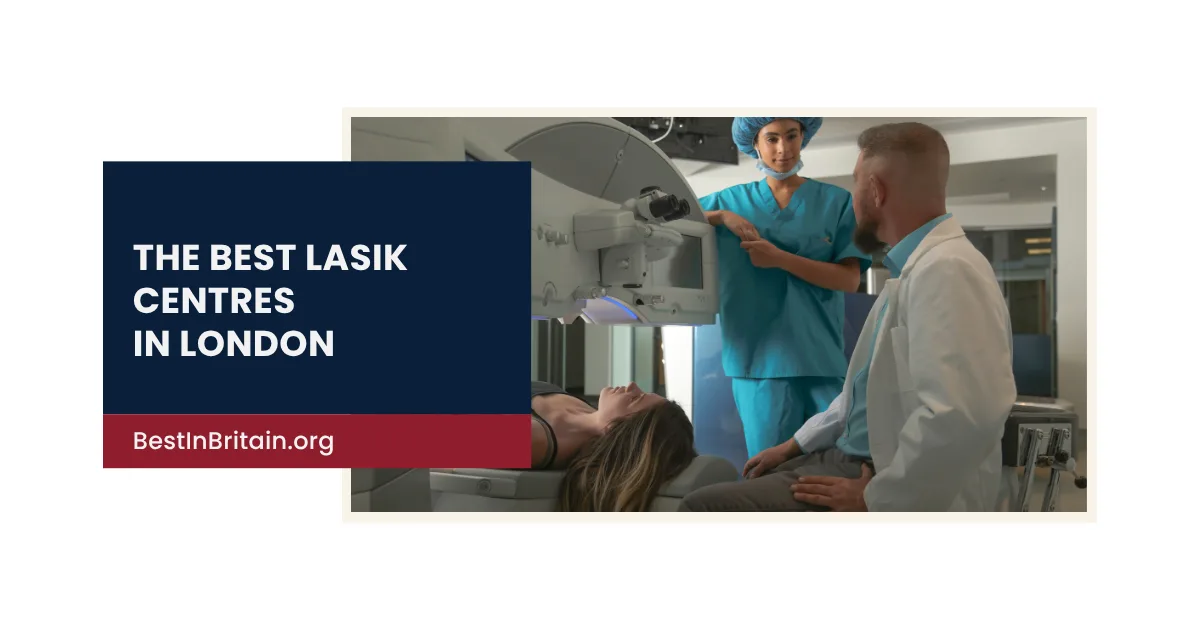
Laser eye surgery can reduce dependence on glasses and contact lenses, but it is permanent elective surgery rather than a guaranteed route to perfect vision.
The safest clinic is not necessarily the one advertising the newest laser, the highest procedure count or the most dramatic testimonial. Suitability depends on prescription stability, corneal shape and thickness, tear-film health, pupil size, age, occupation, lifestyle, existing eye disease and expectations.
Some patients are better suited to LASIK, surface laser treatment or small-incision lenticule surgery. Others may be advised to continue using glasses or contact lenses, consider an implantable contact lens, or delay treatment until their prescription is stable.
The six providers below represent several different approaches to laser vision correction in London. They include dedicated refractive clinics, consultant-led groups with multiple locations, a hospital-based service and providers using promotional or fixed-price models.
The most suitable clinic depends on the full eye examination, prescription stability, corneal measurements, tear-film health, lifestyle and the surgeon responsible for treatment. No provider can guarantee 20/20 vision, permanent freedom from glasses or future eligibility for enhancement surgery.
What distinguishes a responsible laser-eye clinic?
A responsible service should examine the entire eye before recommending a procedure. The assessment should consider corneal shape and thickness, dry eye, pupil size, retinal health, eye pressure, prescription stability and any occupational or night-driving requirements.
Patients should meet the operating surgeon before consent and understand why LASIK, surface laser, lenticule extraction, an implantable lens or no surgery is being recommended. Technology and branded procedure names do not replace clinical judgement.
The written quotation should identify the procedure, surgeon, treatment location, diagnostic tests, medication, reviews, emergency support, enhancement criteria, finance charges and cancellation terms.
This is general editorial information rather than medical advice.
How much does laser eye surgery cost in London?
Published London prices commonly range from around £1,250 to more than £3,750 per eye, depending on procedure, prescription and package.
Published examples include: - Optimal Vision: promotional LASIK or LASEK from £1,250 per eye - OCL Vision: approximately £1,995 to £2,650 per eye for LASIK, LASEK or SmartSight - EuroEyes London: LASIK and PRK/LASEK from £2,000 per eye, with current promotions affecting some treatments - London Vision Clinic: LASIK or PRK/LASEK from £2,950 to £3,750 per eye - London Vision Clinic PRESBYOND: approximately £3,450 to £3,900 per eye - Moorfields Private: £5,682 for both eyes - Focus Clinics: assessment-based quotation, with finance and aftercare terms published separately
Ask whether the price includes: - Initial consultation - Surgeon consultation - Corneal topography - Tomography - Wavefront or ray-tracing measurements - Dry-eye assessment - Dilated examination - Surgery - Medication - Protective shields - Emergency contact - Follow-up appointments - Enhancement or retreatment - Longer-term review - Transfer of records - Finance charges - Cancellation fees
Promotional prices may apply only to limited prescriptions, selected procedures or bookings made within a specified period.
LASIK, LASEK, PRK and SMILE
LASIK
LASIK creates a thin corneal flap before an excimer laser reshapes the tissue beneath it. Recovery is usually faster than after surface treatment, but the flap remains a permanent feature of the cornea.
LASEK and PRK
Surface laser procedures remove or move the surface cell layer before reshaping the cornea. They avoid a LASIK flap but usually involve more discomfort and slower visual recovery.
SMILE and SmartSight
These procedures create and remove a small lenticule through a limited corneal incision. They may suit some prescriptions and lifestyles, but are not automatically safer or better for every patient.
PRESBYOND and blended vision
Blended-vision treatment creates different focal ranges between the eyes to reduce dependence on reading glasses. It requires careful testing because not everyone adapts comfortably.
The choice should be based on examination and risk assessment rather than brand preference.
A clinic offering several procedures may provide a broader comparison, but the patient should still ask whether commercial pricing or equipment availability influences the recommendation.
London Vision Clinic
Editorially SelectedBusiness details
Address
138 Harley Street, London W1G 7LA
Phone: 020 7224 1005
Opening: Monday to Friday, 8am to 6pm
CQC rating: Good
Published prices: - SMILE, LASIK or PRK/LASEK: £2,950 to £3,750 per eye - PRESBYOND Laser Blended Vision: £3,450 to £3,900 per eye - More complex treatment may cost more
London Vision Clinic is particularly relevant for patients with complex prescriptions, presbyopia or a preference for an intensive Harley Street assessment and long-term follow-up model.
The clinic provides LASIK, surface laser treatment, PRESBYOND blended vision, implantable contact lenses and lens-based surgery. Professor Dan Reinstein is closely associated with the clinic's refractive-surgery programme, alongside other clinicians.
The current CQC profile rates the clinic Good and confirms that it provides refractive eye and cataract surgery.
The official fee page is unusually clear for a high-cost clinic. Ongoing aftercare is stated to be included in the surgical fee, excluding tests or services delivered by other providers.
Its place in this guide rests on its regulated service, published treatment range, pricing and established refractive focus rather than promotional descriptions.
The clinic states that customised diagnostic and treatment-planning systems are used. Patients should still ask which measurements directly change the proposed procedure and whether a simpler option would be equally appropriate.
Pros - Good CQC rating - Dedicated refractive-surgery clinic - LASIK, surface laser, blended vision and lens options - Clear published fee range - Ongoing aftercare included under current terms - Suitable for complex suitability discussions
Best for: Complex prescriptions, presbyopia and patients wanting a highly detailed independent refractive-surgery assessment.
What to confirm: Ask which surgeon will operate, what aftercare includes and whether any future enhancement would carry an additional charge.
Moorfields Private
Editorially SelectedBusiness details
Address
Moorfields Eye Hospital, 162 City Road, London EC1V 2PD
Phone: 0800 328 3421
Published package price: £5,682 for both eyes
Moorfields Private is the principal hospital-based option in this selection.
Its refractive service offers LASIK, SMILE and surface laser treatments including PRK, LASEK and TransPRK. Patients choose a consultant surgeon who oversees the treatment pathway from consultation through follow-up.
The current two-eye package includes postoperative eye drops, follow-up appointments for up to three months and a five-year commitment under the service's terms.
Moorfields Private operates within the wider Moorfields Eye Hospital organisation. The private service's income supports the hospital's NHS and research work, although this does not mean private surgery is clinically necessary or superior for every patient.
The hospital brand can be reassuring, but patients should compare the individual consultant, proposed procedure, package terms and access to urgent review rather than selecting solely because of the institution's reputation.
Pros - Hospital-based ophthalmic service - LASIK, SMILE and surface laser options - Named consultant continuity - Fixed two-eye package - Postoperative drops and early follow-up included - Access to broader ophthalmic expertise
Best for: Patients wanting laser eye surgery within a specialist eye-hospital environment.
What to confirm: Ask which consultant will provide every stage, what the five-year commitment covers and what happens if unrelated eye disease is found.
Focus Clinics
Editorially SelectedBusiness details
Address
22 Wimpole Street, London W1G 8GQ
Phone: 020 7307 8250
Opening: Monday to Friday, 9am to 6pm; Saturday, 9am to 3pm
CQC rating: Good
Focus Clinics provides refractive surgery from Wimpole Street and is led by ophthalmic surgeon David Allamby.
Its current services include LASIK and customised diagnostic or laser-planning approaches. The clinic promotes ray-tracing guided treatment and publishes a ten-year care or enhancement proposition under its own terms.
Procedure-count and success claims depend on definitions, prescription ranges and data periods and should not be treated as independent evidence of an individual outcome.
The clinic is currently rated Good by the CQC. That regulatory rating is more useful than review-based rankings because it concerns the inspected service rather than customer popularity.
A free initial assessment is advertised. Patients should clarify when they will meet the operating surgeon and whether the quotation includes every scan, medication, review and medically appropriate enhancement.
The ten-year commitment should be read carefully. Enhancement eligibility depends on prescription stability, corneal thickness, eye health and clinical judgement; it cannot mean that repeat surgery will always be possible.
Pros - Good CQC rating - Central Wimpole Street clinic - Surgeon-led refractive practice - Customised diagnostic and treatment-planning options - Free initial assessment advertised - Published long-term care proposition
Best for: Patients wanting a small central refractive clinic with long-term follow-up terms.
What to confirm: Request the complete cash price and written enhancement criteria before relying on the advertised guarantee.
OCL Vision
Editorially SelectedMarylebone clinic: 55 New Cavendish Street, London W1G 9TF
Kensington clinic: First Floor, Universal Building, 364 - 366 Kensington High Street, London W14 8NS
Phone: 0330 017 1112 for New Cavendish Street
CQC rating: Good at the New Cavendish Street service
Published laser prices: Approximately £1,995 to £2,650 per eye
OCL Vision is useful for patients who want consultant-led treatment across more than one London location and a clear price range covering several refractive procedures.
The group offers LASIK, LASEK, SmartSight lenticule extraction, implantable contact lenses and lens replacement. Its New Cavendish Street clinic is rated Good by the CQC.
OCL publishes LASIK and LASEK from £1,995 to £2,650 per eye and SmartSight from approximately £2,330 to £2,650 per eye. A refundable consultation deposit may apply, and minimum treatment deposits are published.
Follow-up appointments and a 15-year aftercare guarantee are advertised. As with every long-term guarantee, patients should read the eligibility, enhancement and exclusion terms. No clinic can promise that the cornea will remain suitable for retreatment for 15 years.
Visual-outcome claims should be interpreted with patient selection, prescription range and outcome definitions in mind.
Pros - Good CQC rating at New Cavendish Street - Two London locations - LASIK, LASEK and SmartSight - Clear published price ranges - Consultant-led service - Long-term aftercare terms advertised
Best for: Patients comparing LASIK with flapless lenticule treatment and wanting a published mid-range price.
What to confirm: Ask which clinic performs the surgery, who provides urgent cover and whether every follow-up is included at either location.
Optimal Vision
Editorially SelectedBusiness details
Address
7 Gower Street, London WC1E 6HA
Phone: 020 7183 3725
Opening: Monday to Friday, 9am to 6pm; Saturday, 9am to 4pm
CQC status: Registered but not yet inspected
Current published promotional price: LASIK or LASEK from £1,250 per eye for qualifying prescriptions
Optimal Vision offers one of the lowest current published promotional starting prices among the clinics in this guide.
The clinic provides LASIK, LASEK, blended-vision treatment, implantable lenses and lens-replacement surgery. Its current CQC profile confirms registration at 7 Gower Street but states that the service has not yet been inspected.
The current offer advertises LASIK or LASEK from £1,250 per eye for prescriptions up to minus 3.00 dioptres spherical equivalent. Stronger and long-sighted prescriptions attract additional charges, and wavefront-guided treatment currently costs an additional £150 per eye. A refundable booking fee also applies under the published terms.
“Lifetime aftercare” requires particular attention. Patients should request the exact current contract, including the free review period, enhancement criteria and any later charges, rather than relying on the headline.
Pros - Low current promotional LASIK and LASEK price - Central Gower Street location - LASIK, LASEK and lens-based options - Diagnostic scans and early aftercare advertised - Saturday appointments - Active CQC registration
Best for: Price-sensitive patients willing to examine the promotion, CQC status and aftercare terms carefully.
What to confirm: Request a signed quotation showing the standard price, promotional conditions, free follow-up period and future enhancement charge.
EuroEyes London
Editorially SelectedBusiness details
Address
Retail Unit 2, Collier House, 163 - 169 Brompton Road, London SW3 1PY
Phone: 020 3910 8970
CQC status: Registered but not yet inspected
Published prices: - LASIK: £2,000 per eye - PRK/LASEK: £2,000 per eye - SMILE Pro: currently advertised from £2,000 per eye under a promotion - PRESBYOND: £3,000 per eye
EuroEyes London provides laser and lens-based vision correction from Knightsbridge as part of an international clinic group.
Its London services include LASIK, PRK/LASEK, SMILE Pro, PRESBYOND, implantable contact lenses and lens replacement. The breadth is useful for patients who may not be suitable for LASIK.
The clinic is registered with the CQC under EuroEyes London Knightsbridge Ltd, trading through the Laser Eye Clinic London service. The current location has not yet been inspected.
Group history and individual surgeon experience are not the same, while location alone does not establish value. Patients should check the named surgeon's current UK registration and refractive experience.
EuroEyes publishes 0% finance information and a 10% typical deposit illustration. Promotional prices and monthly figures should be checked against the total cash price and lender terms.
Pros - LASIK, surface laser, SMILE Pro and blended vision - Clear current price menu - Knightsbridge location - Lens-based alternatives available - Finance options published - Active CQC registration
Best for: Patients in west or central London comparing LASIK, SMILE Pro and lens-based alternatives.
What to confirm: Ask for the named surgeon, their UK registration, the total cash price and the exact aftercare and enhancement terms.
Quick comparison
| Clinic | CQC signal | Published price signal | Main strength | Best fit |
|---|---|---|---|---|
| London Vision Clinic | Good | £2,950 - £3,750 per eye | Complex refractive assessment | High prescriptions and presbyopia |
| Moorfields Private | Hospital service | £5,682 for both eyes | Hospital-based consultant care | Wider ophthalmic needs |
| Focus Clinics | Good | Personal quotation | Small surgeon-led clinic | Central long-term follow-up |
| OCL Vision | Good at New Cavendish Street | £1,995 - £2,650 per eye | LASIK, LASEK and SmartSight | Mid-range consultant service |
| Optimal Vision | Registered, not yet inspected | From £1,250 per eye for qualifying prescriptions | Low advertised entry price | Price-conscious comparison |
| EuroEyes London | Registered, not yet inspected | LASIK £2,000 per eye | Broad laser and lens menu | Knightsbridge and SMILE comparison |
Comparing laser-eye quotations properly
Two quotations are comparable only when they cover the same procedure, diagnostic work and aftercare. A low starting price may apply only to a limited prescription range or exclude customised treatment.
Ask each clinic to show: - Initial assessment - Surgeon consultation - Corneal topography - Corneal tomography - Wavefront or ray-tracing tests - Dry-eye assessment - Dilated examination - Procedure - Medication - Protective shields - Follow-up appointments - Emergency review - Enhancement criteria - Enhancement fee - Record-transfer costs - Deposit - Cancellation charge - Finance cost - Total cash price
The quotation should state which conditions can increase the price after diagnostic testing.
Sales assessment versus surgeon consultation
Some clinics begin with an optometrist-led or non-surgical assessment before the patient meets the operating surgeon. This can be useful for screening, but the surgeon should still confirm suitability, explain alternatives and obtain valid consent.
Ask: - When the operating surgeon becomes involved - Whether the surgeon reviews every scan - Who recommends the procedure - Who explains material risks - Whether the surgeon may change - What happens if the surgeon disagrees with the initial recommendation - Whether the patient can take consent documents home
A promotional assessment should not create pressure to pay a deposit before the surgical recommendation is clear.
Which clinic suits which patient?
For complex prescriptions or presbyopia
London Vision Clinic provides the clearest specialist positioning for complex corneal-laser planning and blended vision.
For hospital-based care
Moorfields Private offers treatment within a specialist eye-hospital environment.
For LASIK versus SMILE-type treatment
OCL and EuroEyes provide the clearest current comparison between flap-based LASIK and small-incision lenticule procedures.
For lower headline pricing
Optimal Vision has the lowest current published promotional figure, but the patient should compare standard pricing, aftercare and inspection status.
For a small central clinic
Focus provides a Wimpole Street surgeon-led model with a current Good CQC rating.
Surgeon, optometrist and clinical-team roles
Refractive care commonly involves an ophthalmic surgeon, optometrist, nurses and technicians. Patients should know who is responsible at each stage.
Ask who will: - Perform the suitability examination - Interpret tomography - Diagnose dry eye - Recommend the procedure - Obtain consent - Operate - Review the first postoperative day - Manage complications - Decide whether enhancement is appropriate
Continuity can be valuable, but a team model can also be safe where responsibilities and escalation are clearly defined.
Checking the surgeon
Use the General Medical Council register to confirm: - Full name - GMC number - Licence to practise - Specialist registration in ophthalmology - Any conditions or warnings
Also ask: - How often does the surgeon perform the proposed procedure? - Will the surgeon personally examine me before consent? - Who chooses the treatment? - Who performs the operation? - Who handles emergencies? - Who provides follow-up? - Does the surgeon hold the Royal College of Ophthalmologists Certificate in Laser Refractive Surgery or an equivalent documented credential?
The Royal College states that its CertLRS practical examination is a prerequisite for independent laser-refractive practice within its framework.
Work, driving and professional standards
Some occupations have specific visual requirements. Pilots, armed-forces personnel, emergency-service workers, professional drivers and people working in visually demanding environments should check the applicable rules before surgery.
Ask: - Whether the procedure is accepted by the employer or regulator - Required recovery period - Night-vision standard - Depth-perception implications - Contact-sport restrictions - Whether documentation is provided - When driving can legally resume
The clinic cannot override an occupational regulator's standard.
Suitability assessment
A proper assessment may include: - Stable spectacle prescription - Corneal thickness - Corneal tomography - Topography - Tear-film and dry-eye assessment - Pupil size - Eye pressure - Retinal examination - General eye health - Previous surgery - Medication - Pregnancy or breastfeeding status - Occupation - Night-driving needs - Contact sports - Expectations
The surgeon should be willing to advise against surgery where the risk-benefit balance is poor.
Patients should have enough time to consider the recommendation, risks, alternatives and cost before surgery. Same-day pressure is inappropriate for elective permanent treatment.
Who may not be suitable?
Possible reasons include: - Unstable prescription - Keratoconus or suspicious corneal shape - Insufficient corneal thickness - Significant dry eye - Active eye disease - Pregnancy or breastfeeding - Certain autoimmune conditions - Unrealistic expectations - Prescription outside the safe treatment range - Untreated retinal or glaucoma concerns
Unsuitability for LASIK does not automatically mean that PRK, SMILE or lens surgery is appropriate.
Pregnancy, breastfeeding and recent prescription change can affect timing even where the eyes are otherwise healthy.
Risks and side effects
The NHS and Royal College of Ophthalmologists describe common side effects including: - Glare - Halos - Starbursts - Ghost images - Blurred or variable vision - Dry-eye symptoms - Sore eyes - Red marks on the white of the eye
Less common but important complications can include: - Infection - Inflammation - Corneal haze - Flap complications - Ectasia - Persistent pain - Loss of best-corrected vision - Under-correction - Over-correction - Need for enhancement - Difficulty with night driving
Most early side effects improve, but they do not always resolve completely.
Corneal ectasia and long-term corneal risk
Ectasia is a rare but serious weakening and distortion of the cornea that can occur after refractive surgery. Careful tomography, thickness measurement and risk assessment are central to reducing risk.
Ask how the clinic evaluates: - Suspicious corneal shape - Keratoconus risk - Residual stromal thickness - Family history - Eye rubbing - High prescription - Young age - Future enhancement
No screening process removes every risk.
Dry eye
Laser surgery can temporarily worsen dry-eye symptoms and may produce longer-lasting problems in some patients.
Tell the clinic about: - Contact-lens intolerance - Burning or grittiness - Screen-related discomfort - Previous dry-eye treatment - Autoimmune disease - Eyelid inflammation - Hormonal changes - Relevant medication
Dry eye should be assessed and treated before surgery where possible.
Ask whether treatment should be delayed and whether eyelid inflammation, meibomian-gland dysfunction or contact-lens wear is affecting the measurements.
Night vision
Halos, glare and starbursts are common early concerns, particularly with larger pupils or higher prescriptions.
People who drive professionally at night, fly aircraft or work in visually demanding roles should discuss this explicitly.
Ask whether treatment could affect occupational visual standards and when night driving can safely resume.
Presbyopia and ageing
Laser surgery does not stop the natural ageing of the eyes.
Someone treated for distance vision when young may still need reading glasses later. Blended vision can reduce this dependence but involves compromise between the eyes and may affect depth perception or visual preference.
Natural lens changes can eventually produce cataract regardless of previous laser treatment.
Where blended vision is proposed, ask whether a contact-lens simulation can be tried before permanent treatment.
Alternatives
Glasses
The lowest-risk option and easily updated when the prescription changes.
Contact lenses
Convenient for many people but carry infection and tolerance risks.
Implantable contact lens
May suit higher prescriptions or corneas unsuitable for laser treatment. It is intraocular surgery with its own long-term risks.
Refractive lens exchange
Replaces the natural lens and is generally more relevant as people age or develop presbyopia. It is more invasive than corneal laser surgery.
The consultation should explain why the proposed treatment is preferable to these alternatives.
Lens-based surgery is intraocular and carries a different risk profile from corneal laser treatment. It should not be presented simply as the next upgrade where laser is unsuitable.
Emergency care and complications
The clinic should provide a clear route for urgent advice outside normal opening hours.
Seek prompt clinical assessment for: - Severe or worsening pain - Sudden loss of vision - Increasing redness - Discharge - Light sensitivity - New flashes or floaters - A curtain-like shadow - Trauma to a LASIK flap - Rapidly worsening symptoms
Ask where emergency examination takes place and whether the operating surgeon or another ophthalmologist provides cover.
Aftercare and enhancement guarantees
A guarantee should state: - Duration - Included appointments - Medication - Emergency contact - Enhancement eligibility - Clinical exclusions - Age limits - Prescription stability - Corneal-thickness requirements - Charges after the initial period - What happens if the clinic closes or changes ownership
An enhancement guarantee does not mean repeat surgery is always safe or possible.
Ask whether the guarantee is provided by the legal clinic, an individual surgeon or a wider group and what happens if the provider closes, relocates or changes ownership.
Finance and deposits
Compare: - Cash price - Deposit - Interest rate - Term - Total repayable - Credit criteria - Early settlement - Refund if unsuitable - Cancellation after booking - Whether finance begins before surgery
Do not select surgery solely because the monthly payment appears low.
The contract should explain whether assessment and booking payments are refunded if the surgeon decides that treatment is unsuitable.
Records and future eye care
Keep copies of: - Prescription - Corneal maps - Treatment plan - Consent form - Laser settings where supplied - Operation record - Follow-up reports - Enhancement terms - Invoices
Tell future optometrists, ophthalmologists and cataract surgeons about previous refractive surgery. Historical measurements can help with later lens calculations and eye-care decisions.
Questions to ask before surgery - What is my diagnosis and prescription? - Why is this procedure recommended? - What alternatives are safer? - Who is the operating surgeon? - What is their GMC number? - What is the clinic's current CQC status? - What is the total cash price? - What is included in aftercare? - What are the main risks in my case? - What happens if I develop dry eye? - What is the night-vision risk? - Can I still meet my occupational standard? - What happens if I am under-corrected? - Is enhancement included? - Could I need reading glasses? - What emergency support is available? - Can I take the consent documents home before deciding?
A reputable clinic should allow time to consider the information without pressuring the patient to book immediately.
Recovery and returning to normal activity
Recovery differs by procedure. LASIK often provides faster functional vision than PRK or LASEK, while surface treatment can involve more discomfort and a longer period of visual fluctuation.
Ask when it is safe to resume: - Driving - Screen work - Exercise - Swimming - Eye make-up - Contact sports - Dusty work - Flying - Night driving
Follow the clinic's medication and eye-protection instructions rather than relying on a generic recovery timetable.
Common mistakes to avoid
Choosing by success percentage alone
Definitions and patient groups differ.
Assuming the newest laser is best
Suitability and surgeon judgement matter more than a brand name.
Comparing monthly payments
Compare the full cash and financed cost.
Believing “lifetime aftercare” means free lifelong surgery
Read the exclusions and enhancement terms.
Ignoring dry-eye symptoms
Pre-existing surface disease can affect comfort and visual quality.
Booking before meeting the surgeon
The operating clinician should be involved in consent and suitability.
Assuming surgery permanently prevents glasses
Vision can change with age.
Frequently asked questions
Is LASIK painless?
Anaesthetic drops are used, but pressure, discomfort or postoperative irritation can occur.
How quickly can I return to work?
Many LASIK patients return quickly, while surface-laser recovery is slower. Follow the surgeon's individual advice.
Does LASIK last forever?
The corneal reshaping is permanent, but the eyes can continue to change with age.
Can both eyes be treated together?
This is common, but the surgeon should discuss individual risks and alternatives.
Is SMILE better than LASIK?
Not universally. Each has advantages and limitations.
Can laser surgery cause blindness?
Severe sight-threatening complications are uncommon, but no eye surgery is risk-free.
Choosing with confidence
The most suitable London laser-eye clinic is the one that evaluates the whole eye, explains alternatives and provides realistic consent rather than promising permanent freedom from glasses.
London Vision Clinic offers a dedicated complex-case service, Moorfields Private provides hospital-based consultant care, Focus is a small CQC-rated Wimpole Street clinic, OCL publishes prices across several procedures, Optimal Vision offers a conditional promotional starting price, and EuroEyes provides a broad Knightsbridge laser and lens menu.
Check the surgeon, CQC profile, complete price and aftercare contract before deciding. Technology is only one part of safe refractive surgery.
London Home Health Care & Domiciliary Services Market Statistics
Registered Care Providers
11,275
CQC providers in London
CQC 'Good / Outstanding'
91.5%
Quality inspection rating
Registered Care Staff
~2,800
Active nurses & carers
Elderly vs Specialist Split
55% / 45%
Care service focus
Primary Domiciliary Care Hubs in London
- EC/WC/W/N/E/SE/SW1 (Central Domiciliary Hub)46% focus
- EC/WC/W/N/E/SE/SW2 (Suburban Care Corridor)28% focus
- EC/WC/W/N/E/SE/SW3 (Residential Care District)16% focus
- EC/WC/W/N/E/SE/SW4 (Outer Metro Nursing Zone)10% focus
Care Types & Specialism Breakdown
- Personal Domiciliary Care & Support52% of care hours
- Dementia & Memory Care26% of care hours
- Physical Disability Support14% of care hours
- Respite & Live-in Home Nursing8% of care hours
Related articles
Related guides

Private Clinics
Best Home Care Services in London
A researched guide to six London home-care providers, covering visiting care, live-in care, nursing, dementia support, current costs, CQC ratings, funding and choosing a safe service.
Updated 22 July 2026

Private Clinics
Best IVF Clinics in London
A researched guide to six London IVF clinics, covering HFEA licensing, current prices, success-rate interpretation, medication, add-ons, counselling, donor treatment and choosing safe fertility care.
Updated 14 July 2026

Private Clinics
Best Fertility Clinics in London
A researched guide to six London fertility clinics, covering IVF, IUI, egg freezing, donor treatment, current costs, HFEA data, treatment add-ons and choosing the right clinic.
Updated 6 July 2026
Private Clinics
Best Hair Transplant Clinics in London
A researched guide to six London hair transplant clinics, covering FUE and FUT, current prices, CQC checks, surgeon credentials, donor management, risks, medication and aftercare.
Updated 2 July 2026

Private Clinics
Top Sexual Health Clinics in London
A practical guide to NHS sexual health clinics in London, covering STI testing, contraception, PrEP, PEP, HIV care, urgent access, confidentiality and specialist support.
Updated 27 June 2026
Private Clinics
Best Botox and anti-wrinkle clinics in London
A researched guide to medically led London clinics providing Botox and anti-wrinkle injections, with transparent consultations, practitioner credentials and follow-up care.
Updated 21 May 2026
Know a business we should consider?
Send us the details and our editorial team will review whether it fits a future guide.
Submit businessWriter profile
Sophie Brown
Health and wellness desk researcher
Sophie compiles research for private clinics, dental practices, therapists, physiotherapy clinics, and wellness providers.
Editorial Trust Standard
Independent ReviewIndependent Research
Featured rankings are editorially determined. Commercial partner listings are strictly labeled as Sponsored or Featured.
Public Register Audit
Listings are cross-checked against public regulatory registries, Companies House filings, and published fee schedules.
Regional Directory
Explore Other Verified Services in London
accountants
Top Accountants in London
marketing agencies
Top digital marketing agencies in London
private clinics
Best Home Care Services in London
solicitors
Best Immigration Lawyers in London
things to do
Best Jazz Clubs in London for Live Music
commercial property agents