
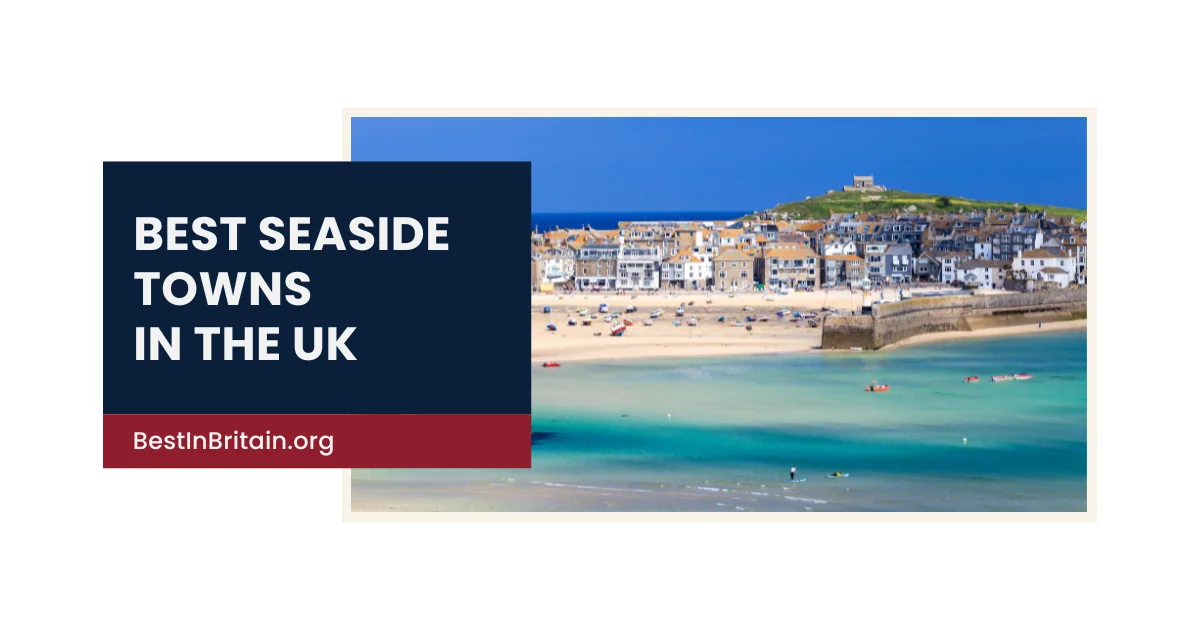
The best seaside towns in the UK are not all traditional beach resorts. Some are built around long promenades and family attractions, while others are working harbours, artistic communities, fishing towns or compact coastal escapes where food, walking and local character matter as much as the beach.
St Ives and Tenby are especially strong for visual appeal and walkable coastal breaks; Whitby combines harbour character, history and dramatic views; Brighton offers the liveliest mix of beach and city culture; North Berwick stands out for an easy Scottish coastal escape; and Portstewart and Portrush provide two very different bases on the Northern Irish coast.
A good seaside weekend depends on more than sand. Harbour areas, old streets, independent shops, seafood, local museums, coast paths and the surrounding landscape often determine whether a town feels worth an overnight stay rather than a few hours by the water.
This guide brings together 25 of the best seaside towns in the UK across England, Scotland, Wales and Northern Ireland. It is an editorial selection rather than a rigid ranking, with each place chosen for its combination of atmosphere, scenery, heritage, walkability and overall short-break appeal.
Best UK seaside towns at a glance
| Seaside town | Nation | Best for | Character |
|---|---|---|---|
| St Ives | England | Beaches, art and a beautiful harbour | Artistic Cornish resort |
| Whitby | England | History, harbour atmosphere and seafood | Historic fishing town |
| Brighton | England | Nightlife, culture and an urban beach break | Lively coastal city |
| Tenby | Wales | Colourful harbour, beaches and walkability | Historic Welsh resort |
| North Berwick | Scotland | Easy rail access, beaches and coastal scenery | Compact East Lothian town |
| Salcombe | England | Sailing, estuary views and a polished weekend | Upscale waterside town |
| Llandudno | Wales | Victorian resort character and Great Orme views | Traditional seaside resort |
| Falmouth | England | Maritime heritage and a year-round town feel | Working harbour town |
| Oban | Scotland | Seafood, ferries and island views | West-coast harbour gateway |
| Portstewart | Northern Ireland | Beach, promenade and Causeway Coast access | Relaxed coastal resort |
| Barmouth | Wales | Beach, estuary and mountain backdrop | Scenic Welsh seaside town |
| Anstruther | Scotland | Harbour atmosphere and seafood | Small East Neuk fishing town |
If you are choosing between them, start with the type of trip you want. Brighton, Whitby and Falmouth have the most urban and cultural depth; St Ives, Tenby and Barmouth stand out for scenery; Llandudno and Scarborough deliver a more traditional resort experience; while North Berwick, Anstruther and Deal suit visitors who prefer smaller, more walkable coastal towns.
How we selected the best seaside towns in the UK
This is an editorial selection rather than a ranking by beach length, visitor numbers or resort size.
We considered:
- Seaside character: Whether the town feels meaningfully shaped by the coast rather than simply having a beach nearby.
- Walkability: How easily visitors can move between the seafront, harbour, old town, shops and attractions.
- Beaches and waterfront: The quality and variety of the shoreline, promenade, harbour or estuary setting.
- Food and local identity: Seafood, markets, independent businesses and distinctive local culture.
- Things to do beyond the beach: Museums, galleries, historic sites, coastal walks, ferries and nearby excursions.
- Atmosphere: Whether the town remains appealing outside the busiest summer hours.
- Weekend depth: Whether there is enough to justify an overnight stay rather than a short stop.
- Transport: Rail, ferry or road access and how easily a visitor can avoid moving the car repeatedly.
A larger resort is not automatically a better seaside break. Brighton and Scarborough offer scale and variety, while Deal, Anstruther and Brixham are included because their smaller size gives them a stronger sense of place.
The best seaside towns to visit in the UK
1. Spend a weekend in St Ives

Business details
Address
St Ives, Cornwall, England
Best for: Art, sandy beaches, harbour atmosphere and a walkable Cornish weekend
Visit details:
- The town is accessible throughout the year
- Beaches, galleries and attractions use separate opening schedules
- Summer parking is limited and rail access is often easier
Typical cost level: £££
St Ives succeeds because the beach, harbour and cultural side of the town all sit within a compact area. It is possible to move from Porthmeor Beach to Tate St Ives, cross the old streets to the harbour and continue towards Porthminster without turning the day into a transport exercise.
The artistic reputation is not decorative branding. Tate St Ives and the Barbara Hepworth Museum give the town genuine cultural depth, while the changing light, harbour and Atlantic coast explain why artists were drawn here in the first place.
Its weakness is popularity. In high summer the centre can feel overwhelmed, so St Ives is at its best early in the day, in the evening or outside the main school-holiday peak.
Pro tip:
Use the branch line or a park-and-ride option where possible, and explore the harbour early or late in the day for a calmer atmosphere.
2. Explore Whitby

Business details
Address
Whitby, North Yorkshire, England
Best for: Harbour character, history, seafood and dramatic coastal views
Visit details:
- The town is accessible throughout the year
- Museums, abbey and harbour attractions use separate schedules
- Parking and accommodation fill quickly during holiday periods
Typical cost level: ££
Whitby feels unmistakably connected to both the sea and its history. Fishing boats still work from the harbour, the old town climbs sharply towards St Mary’s Church and Whitby Abbey, and the 199 Steps turn the change in elevation into part of the experience rather than an inconvenience.
There is enough here for a proper weekend without relying on the beach. The harbour, piers, independent shops, seafood, museums and coastal walking all add layers to the town, while the abbey gives Whitby one of the strongest silhouettes of any seaside destination in England.
The steep streets and narrow centre become congested quickly, especially during events and school holidays, so staying overnight is valuable. Early morning and evening reveal a much calmer side of the town.
Pro tip:
Walk across the swing bridge and up to the abbey early, then return to the harbour after the main day-trip crowds build.
3. Enjoy the seaside in Brighton

Business details
Address
Brighton and Hove, East Sussex, England
Best for: Nightlife, independent culture and an urban beach break
Visit details:
- The city is accessible throughout the year
- Pier, pavilion and cultural venues operate separate schedules
- Rail travel is often easier than city-centre parking
Typical cost level: £££
Brighton is closer to a coastal city break than a traditional seaside-town escape. The beach and Palace Pier matter, but the real attraction is the way the seafront connects with the Royal Pavilion, the Lanes, North Laine, music venues, independent restaurants and nightlife.
That gives Brighton unusual year-round depth. Bad weather does not ruin the weekend because the city has enough indoor culture, food and shopping to carry the trip, while clear days make the seafront and walks towards Hove or Kemptown much more rewarding.
Visitors looking for quiet beaches should choose elsewhere. Brighton works because it is busy, urban and culturally mixed rather than despite those qualities.
Pro tip:
Travel by train if practical and explore away from the pier towards Hove or Kemptown when the central seafront becomes crowded.
4. Discover Tenby

Business details
Address
Tenby, Pembrokeshire, Wales
Best for: Colourful harbour views, sandy beaches and an easy car-light weekend
Visit details:
- The town is accessible throughout the year
- Boat trips and visitor services operate seasonally
- Summer parking and accommodation should be booked early
Typical cost level: £££
Tenby is one of the rare seaside towns where the harbour, old town and beaches all reinforce one another. Colourful houses rise above the water, medieval walls still shape the street pattern and several good beaches are reachable on foot within minutes.
North Beach gives the classic view back towards the town, South Beach provides more space, and Castle Beach adds another compact stretch of sand close to the centre. Boat trips towards Caldey Island and the Pembrokeshire Coast Path extend the visit beyond the town itself.
The centre becomes crowded in school holidays, but Tenby remains unusually easy to enjoy without a car once you have arrived.
Pro tip:
Park once and explore Tenby entirely on foot, combining the harbour, town walls and at least one longer beach walk.
5. Walk along the coast in North Berwick

Business details
Address
North Berwick, East Lothian, Scotland
Best for: Beaches, coastal walks and an easy seaside trip from Edinburgh
Visit details:
- The town is accessible throughout the year
- Boat trips and attractions use separate schedules
- Rail access from Edinburgh makes it especially convenient
Typical cost level: £££
North Berwick is one of Scotland's easiest seaside escapes to recommend because it combines proper coastal scenery with a compact town and direct rail access from Edinburgh.
The Bass Rock dominates the horizon and gives the harbour a setting that feels far more dramatic than the town's modest size suggests. Beaches lie on both sides of the centre, while the Scottish Seabird Centre, boat trips and coastal paths add enough depth for more than a simple day on the sand.
The high street is another strength. Independent food and shops mean the town still feels lived in, which helps North Berwick work as a weekend destination outside summer.
Pro tip:
Take the train from Edinburgh where possible and walk out towards the harbour and Milsey Bay for the best coastal views.
6. Explore Salcombe

Business details
Address
Salcombe, Devon, England
Best for: Sailing, estuary scenery and a polished waterside break
Visit details:
- The town is accessible throughout the year
- Boat services and water activities operate seasonally
- Road access and parking are limited in peak season
Typical cost level: ££££
Salcombe is less about a traditional seafront and more about the relationship between town, estuary and water. Boats fill the harbour, ferries connect nearby beaches and the surrounding hills create constantly changing views across the Kingsbridge Estuary.
North Sands and South Sands provide easy beach access, but the strongest weekends mix the water with harbour walks, seafood and short ferry journeys. Once parked, the town is much more enjoyable on foot or by boat than by repeatedly trying to move a car through narrow streets.
The drawback is cost. Accommodation and summer demand can be intense, so Salcombe makes more sense for visitors who value the estuary atmosphere enough to pay for it.
Pro tip:
Stay centrally if possible and use local ferries or footpaths rather than relying on the car once you arrive.
7. Visit Llandudno

Business details
Address
Llandudno, Conwy, Wales
Best for: Victorian seaside character, promenade walks and Great Orme views
Visit details:
- The town is accessible throughout the year
- Tramway, cable car and attractions operate seasonally
- The promenade and pier are open year-round
Typical cost level: ££
Llandudno remains one of the clearest surviving examples of the grand Victorian seaside resort. The broad crescent of the bay, long promenade, pier and regular street plan give it a formality that feels very different from smaller harbour towns.
The Great Orme is what gives Llandudno extra depth. Walking, tramway and cable-car routes lift visitors above the resort and reveal the wider coastline, while nearby Conwy adds an easy historic extension.
This is not a wild coastal escape. Its appeal is the combination of organised resort architecture and immediate access to a much more open headland landscape.
Pro tip:
Walk the full promenade and head up the Great Orme for perspective before judging the town only from the pier area.
8. Discover Deal

Business details
Address
Deal, Kent, England
Best for: Independent food, historic streets and a quieter south-east coast break
Visit details:
- The town is accessible throughout the year
- Castle and cultural venues use separate opening schedules
- The seafront is easy to explore on foot
Typical cost level: ££
Deal works because it still feels like a real town beside the sea rather than a resort built around attractions. Georgian and Victorian streets sit close to the shingle waterfront, independent food and shops give the centre energy, and the long seafront encourages walking rather than queuing for things to do.
Deal Castle adds historical interest, but the town's strength is atmosphere. The old streets behind the front, the pier and the ability to continue north or south along the coast make it ideal for a slower weekend.
Visitors expecting a long sandy beach or major family attractions may prefer another destination. Deal is strongest for food, walking and character.
Pro tip:
Spend time in the old streets behind the seafront and walk north or south along the coast instead of staying only near the pier.
9. Spend time in Southwold

Business details
Address
Southwold, Suffolk, England
Best for: Classic seaside atmosphere, beach huts and a polished Suffolk weekend
Visit details:
- The town is accessible throughout the year
- Pier, brewery and attractions use separate schedules
- Road access can be slow in summer
Typical cost level: £££
Southwold looks polished, but it avoids feeling entirely staged. The beach huts, pier and lighthouse create the classic image, while the common, harbour and compact town centre give visitors enough variety to move beyond the seafront.
Local food and the town's long association with Adnams strengthen its identity, and the walk towards the harbour reveals a quieter, more working side of the coast.
Accommodation demand is high and prices reflect the town's reputation. The best reason to stay is to experience Southwold before day visitors arrive and after the busiest beach hours have passed.
Pro tip:
Walk towards the harbour and river mouth as well as the main beach, since this shows a broader and quieter side of Southwold.
10. Explore Portstewart

Business details
Address
Portstewart, County Londonderry, Northern Ireland
Best for: A broad beach, promenade and relaxed Causeway Coast base
Visit details:
- The town is accessible throughout the year
- Beach facilities and visitor services vary seasonally
- Nearby golf and coastal attractions operate separate schedules
Typical cost level: ££
Portstewart offers two different coastal experiences within one compact base. The promenade has cafés, restaurants and sea views, while Portstewart Strand opens into a much broader landscape of sand and dunes just outside the centre.
That contrast is the town's main strength. It has enough life to work as a weekend base, but feels calmer than nearby Portrush and slots naturally into a wider Causeway Coast itinerary.
Visitors should make time for the cliff path and promenade as well as the beach. The best sense of Portstewart comes from moving between the town and the open coast rather than choosing one or the other.
Pro tip:
Walk the cliff path and promenade as well as visiting the Strand, since the contrast between town and beach is part of the appeal.
11. Enjoy a weekend in Falmouth

Business details
Address
Falmouth, Cornwall, England
Best for: Maritime heritage, ferries, beaches and year-round town life
Visit details:
- The town is accessible throughout the year
- Museums, ferries and attractions operate separate schedules
- Seasonal events and university terms affect accommodation demand
Typical cost level: £££
Falmouth has more depth than many Cornish resort towns because it remains a working harbour, university town and maritime centre as well as a holiday destination.
Pendennis Castle and the National Maritime Museum Cornwall provide strong all-weather attractions, ferries connect the town with the wider estuary, and Gyllyngvase Beach supplies the straightforward seaside element. The centre also has enough food, shops and year-round activity to avoid feeling seasonal.
This makes Falmouth particularly good for visitors who want Cornwall without building the whole trip around one beach or picturesque harbour.
Pro tip:
Use ferries and harbour walks to experience the estuary rather than treating Falmouth only as a beach destination.
12. Explore Oban

Business details
Address
Oban, Argyll and Bute, Scotland
Best for: Seafood, ferries and a west-coast harbour atmosphere
Visit details:
- The town is accessible throughout the year
- Ferries and island services run to separate timetables
- Accommodation can fill quickly during touring season
Typical cost level: £££
Oban is a working harbour first and a seaside break second, which is exactly why it has character. Ferries come and go throughout the day, seafood is closely tied to the port and the view west towards the islands constantly reminds visitors that the town is part of a much larger coastal network.
McCaig's Tower provides the essential high-level view, while the waterfront, distillery and short ferry excursions add enough variety for a weekend.
Some areas around the transport hub feel functional rather than picturesque, but that activity is part of Oban's identity. It feels connected to the sea in a practical way rather than simply facing it.
Pro tip:
Take time to walk above the harbour to McCaig’s Tower and use one short ferry excursion if the weather allows.
13. Visit Tynemouth

Business details
Address
Tynemouth, Tyne and Wear, England
Best for: Beaches, surf culture, historic ruins and easy Metro access
Visit details:
- The town is accessible throughout the year
- Priory, market and local venues use separate schedules
- Metro access from Newcastle makes it easy to reach without a car
Typical cost level: ££
Tynemouth packs an unusual amount into a small area. The priory and castle dominate the headland, King Edward's Bay sits below the cliffs and Longsands provides the broader beach experience a short walk away.
The village centre adds independent food, surf culture and the weekend market, while the Metro connection makes the town exceptionally easy to combine with Newcastle.
Its biggest strength is convenience without loss of character. Visitors can have a proper coastal weekend without needing a car or travelling deep into the countryside.
Pro tip:
Walk between the priory, Longsands and the village centre instead of treating the town only as a quick beach stop.
14. Discover Porthmadog and nearby Portmeirion coast

Business details
Address
Porthmadog, Gwynedd, Wales
Best for: Harbour history, railways and a coast-and-mountains base
Visit details:
- The town is accessible throughout the year
- Railway and nearby attractions use separate seasonal schedules
- The harbour and town centre are open year-round
Typical cost level: ££
Porthmadog is not a conventional seaside resort and is stronger for that reason. The harbour and town sit between coast and mountains, creating a practical base for heritage railways, nearby beaches and short journeys around the Glaslyn estuary.
Borth-y-Gest, Black Rock Sands and Portmeirion all add very different coastal experiences within easy reach, while the mountain backdrop gives the area a scale that pure resort towns lack.
The town works best as the centre of a wider weekend rather than the only attraction. Visitors who enjoy railways, landscape and local exploration will get much more from it than anyone looking for a promenade-and-pier break.
Pro tip:
Use Porthmadog as a base for short local explorations rather than trying to cover all of north-west Wales in one weekend.
15. Spend a weekend in Scarborough

Business details
Address
Scarborough, North Yorkshire, England
Best for: A traditional family resort with two contrasting bays
Visit details:
- The town is accessible throughout the year
- Castle, spa and attractions operate separate schedules
- Summer weekends can be extremely busy
Typical cost level: ££
Scarborough remains one of Britain's definitive traditional resorts, and much of its appeal comes from the scale of the place. North Bay and South Bay feel distinct, with the castle headland separating them and giving the town a strong geographical identity.
The Spa, cliff lifts, promenades and resort architecture make the history of seaside tourism visible rather than abstract. At the same time, the castle and cliff-top walks give visitors easy opportunities to step away from the busiest amusement areas.
Scarborough will not suit anyone looking for understated coastal minimalism. It works because it still embraces the classic family-resort experience.
Pro tip:
Explore both bays and the castle headland rather than staying only in the busiest amusement-focused areas.
16. Discover Aberystwyth

Business details
Address
Aberystwyth, Ceredigion, Wales
Best for: Promenade atmosphere, culture and a dramatic west Wales setting
Visit details:
- The town is accessible throughout the year
- Cliff railway, museums and attractions use separate schedules
- University terms influence the atmosphere of the town
Typical cost level: ££
Aberystwyth feels like a university and cultural town that happens to sit directly on the sea. The long promenade, castle ruins and Constitution Hill create the obvious coastal route, but the National Library of Wales and local arts scene give the town a depth that many resorts of similar size do not have.
The beach is not the main reason to visit. What makes Aberystwyth memorable is the combination of sea, academic life, Welsh culture and the exposed west-coast setting.
It is particularly atmospheric in the evening, when the promenade becomes the town's social spine and the scale of Cardigan Bay is easier to appreciate.
Pro tip:
Walk the promenade at sunset and head up Constitution Hill for a clearer sense of the town’s setting.
17. Explore Brixham

Business details
Address
Brixham, Devon, England
Best for: Working-harbour character, seafood and coastal walking
Visit details:
- The town is accessible throughout the year
- Boat trips and harbour activities operate seasonally
- Road access can be slow during peak periods
Typical cost level: ££
Brixham's strongest asset is that the harbour still works. Fishing boats, seafood businesses and a busy waterfront give the town an authenticity that distinguishes it from more polished resort neighbours on the English Riviera.
Colourful houses climb the hills above the water, while Berry Head and nearby coves extend the visit naturally into coastal walking. The steep streets can be tiring, but they also create the elevated views that make the town so photogenic.
Visitors who want a working-harbour atmosphere will find more character here than in many larger seaside resorts.
Pro tip:
Climb above the harbour for the best views and allow time for a coastal walk towards Berry Head.
18. Visit Eastbourne

Business details
Address
Eastbourne, East Sussex, England
Best for: A traditional seafront combined with major cliff walking
Visit details:
- The town is accessible throughout the year
- Pier, theatres and attractions use separate schedules
- The surrounding cliffs and coast path are open subject to local safety conditions
Typical cost level: ££
Eastbourne is at its best when the town and the surrounding chalk coast are treated as one destination. The seafront, pier, theatres and parks provide the traditional resort side, while Beachy Head and the South Downs begin almost immediately beyond the western edge.
That proximity is unusual. Visitors can have the convenience of a larger town and still reach some of southern England's most dramatic cliff scenery without a long transfer.
The central seafront itself is more conventional than Brighton or Hastings, but as a base for walking and a comfortable coastal weekend, Eastbourne is exceptionally practical.
Pro tip:
Use the town as a base for at least one walk towards Beachy Head rather than staying only around the pier and promenade.
19. Enjoy Penzance

Business details
Address
Penzance, Cornwall, England
Best for: A practical Cornish base with harbour, lido and wider coastal access
Visit details:
- The town is accessible throughout the year
- Lidos, ferries and attractions operate separate schedules
- Connections to St Michael’s Mount and the Isles of Scilly vary seasonally
Typical cost level: ££
Penzance is often treated as somewhere to pass through on the way to the Isles of Scilly or west Cornwall, but that misses the town's own strengths. The promenade, Jubilee Pool, harbour, galleries and views across Mount's Bay create a more substantial coastal base than its transport-hub reputation suggests.
Its greatest advantage is location. St Michael's Mount, the Minack Theatre and much of far-west Cornwall can be reached without changing accommodation every night.
Penzance is less polished than St Ives, but that also makes it feel more practical and less dependent on tourism. For a longer Cornish trip, that can be a major advantage.
Pro tip:
Treat Penzance as a base as well as a destination, and make time for an early walk along the promenade.
20. Explore Portrush

Business details
Address
Portrush, County Antrim, Northern Ireland
Best for: Surfing, lively resort atmosphere and Causeway Coast exploring
Visit details:
- The town is accessible throughout the year
- Coastal attractions and visitor services operate seasonally
- Golf events can significantly increase demand
Typical cost level: ££
Portrush is the livelier of the two main resort towns on this stretch of the Northern Irish coast. Beaches and surfing give the town energy, while the nearby headlands and views towards Dunluce Castle create a much more dramatic natural setting than a typical resort.
Its location is also strategically strong. The Giant's Causeway, Dunluce Castle and other Causeway Coast stops are close enough to visit without turning every day into a long drive.
Visitors looking for quiet evenings may prefer Portstewart. Portrush is better for those who want beaches, activity and a busier resort atmosphere.
Pro tip:
Combine the town with a coastal walk and one nearby headland or castle rather than spending the whole stay only on the main beaches.
21. Discover Swanage

Business details
Address
Swanage, Dorset, England
Best for: Families, sandy beach, heritage railway and Jurassic Coast access
Visit details:
- The town is accessible throughout the year
- Railway and boat services use separate seasonal schedules
- Summer parking becomes very limited
Typical cost level: ££
Swanage combines the accessibility of a traditional family resort with unusually strong surroundings. The sandy beach, pier and compact centre cover the classic seaside essentials, while Durlston Country Park, cliff walks and the Swanage Railway create several completely different ways to spend a day.
Its manageable scale is important. Visitors can move between beach, town and walking routes without constantly returning to the car.
That makes Swanage particularly effective for mixed groups, where some people want the beach and others want heritage, walking or wider Jurassic Coast scenery.
Pro tip:
Walk out to Durlston or ride the heritage railway to turn the weekend into more than a beach stay.
22. Spend time in Barmouth

Business details
Address
Barmouth, Gwynedd, Wales
Best for: Beach, estuary views and a mountain-backed Welsh coast break
Visit details:
- The town is accessible throughout the year
- Beach, harbour and bridge are open year-round
- Seasonal attractions and rail services use separate timetables
Typical cost level: ££
Barmouth has one of the strongest natural settings of any Welsh seaside town. The broad beach faces Cardigan Bay, the Mawddach estuary opens immediately to the south and mountains rise behind the town, giving the landscape far more depth than a conventional resort.
The old town climbs above the harbour, while Barmouth Bridge creates one of the defining views and a natural walking route across the estuary.
It is less polished than Tenby or Llandudno, but that is part of its appeal. Barmouth is strongest for visitors who value scenery, walking and a relaxed atmosphere over refined resort presentation.
Pro tip:
Walk the estuary bridge or at least its approach paths to appreciate how the town sits between sea and mountains.
23. Explore Cromer

Business details
Address
Cromer, Norfolk, England
Best for: Pier, local seafood and a traditional north Norfolk seaside weekend
Visit details:
- The town is accessible throughout the year
- Pier, theatre and local attractions use separate schedules
- Road access can be slow in holiday periods
Typical cost level: ££
Cromer combines the ingredients of a traditional seaside town with a local identity that feels unusually specific. The pier, beach and cliff-top streets provide the classic resort structure, while the continuing association with Cromer crab gives food a real connection to place.
The centre is compact enough for a short weekend, and nearby stretches of the Norfolk coast make it easy to add walking and quieter scenery.
The town's elevated position means some routes between the centre and beach are steeper than they first appear, but those same cliffs provide the broader coastal views that distinguish Cromer from flatter resorts.
Pro tip:
Try local crab and walk along the clifftop as well as the seafront to experience the town more fully.
24. Visit Anstruther

Business details
Address
Anstruther, Fife, Scotland
Best for: Harbour atmosphere, seafood and East Neuk coastal walking
Visit details:
- The town is accessible throughout the year
- Boat trips and coastal attractions vary seasonally
- The harbour and town remain walkable year-round
Typical cost level: ££
Anstruther is small enough that the harbour dominates the experience, which gives the town a strong and immediate sense of place. Fishing history, seafood and traditional streets all sit close together, while the Fife Coastal Path connects the town naturally with neighbouring East Neuk villages.
There is not a long list of attractions, and that is not really the point. Anstruther is better suited to walking, eating, watching harbour activity and using the town as part of a slower coastal itinerary.
Visitors wanting a busy resort should look elsewhere. Those who value atmosphere and compactness are likely to appreciate it more.
Pro tip:
Walk a section of the Fife Coastal Path and explore at least one neighbouring village rather than staying only around the harbour.
25. Discover Hastings Old Town

Business details
Address
Hastings, East Sussex, England
Best for: Old-town character, fishing heritage and layered south-coast history
Visit details:
- The town is accessible throughout the year
- Castle, museums and funiculars use separate schedules
- Summer weekends and events can increase visitor numbers
Typical cost level: ££
Hastings is far more interesting than its long seafront alone suggests. The old town, Stade fishing beach, net shops, funicular railways and castle ruins create several layers of local history within a compact area.
The fishing quarter is particularly important because it keeps the town visibly connected to the sea as a working environment, not just a leisure backdrop. Climbing above the old town also changes the perspective completely, with broad views across the coast.
Hastings feels less polished and more irregular than Brighton or Eastbourne. For many visitors, that texture is exactly what gives it character.
Pro tip:
Focus on the old town, fishing quarter and hill views rather than treating Hastings only as a beach destination.
Best UK seaside towns by type
Best for beautiful coastal settings
St Ives, Tenby, Barmouth, North Berwick and Salcombe stand out for the relationship between town and surrounding landscape.
Best for traditional seaside atmosphere
Llandudno, Scarborough, Swanage and Cromer provide the clearest classic resort experiences in this guide.
Best for food and harbour character
Whitby, Brixham, Anstruther, Oban and Falmouth are particularly strong when the working harbour and local food scene matter as much as the beach.
Best for culture and nightlife
Brighton is the strongest choice for nightlife and a city-style coastal break, while St Ives, Falmouth and Aberystwyth provide more cultural depth than their size might suggest.
Best without a car
Brighton, North Berwick, Tynemouth, Llandudno, Scarborough and several other towns in this guide can work well by rail or local public transport.
Best for coastal walking
North Berwick, Eastbourne, Brixham, Tynemouth, Barmouth and Anstruther all connect naturally with worthwhile coastal or cliff walks.
Best for a quieter weekend
Deal, Anstruther, North Berwick and Portstewart are strong choices for visitors who prefer a smaller town and less resort intensity.
Frequently asked questions
What are the best seaside towns in the UK?
St Ives, Whitby, Brighton, Tenby, North Berwick, Salcombe, Llandudno, Falmouth, Oban and Portstewart are among the strongest all-round choices in this guide. The best destination depends on whether you want beaches, culture, food, walking, nightlife or a traditional resort atmosphere.
What is the prettiest seaside town in the UK?
St Ives and Tenby are among the strongest choices for immediately attractive harbour and beach settings, while Barmouth stands out for the combination of sea, estuary and mountain backdrop. Beauty is subjective, so the most appealing town depends on whether you prefer colourful harbours, grand promenades or wilder scenery.
What are the best seaside towns for a weekend break?
St Ives, Whitby, Tenby, Brighton, North Berwick, Falmouth and Llandudno all offer enough food, walking, culture or attractions to justify more than a day trip.
Which UK seaside towns are best without a car?
Brighton, North Berwick, Tynemouth, Llandudno, Scarborough and Whitby can all work well without relying entirely on a car. Once in town, places such as St Ives and Tenby are also particularly walkable.
Which seaside towns are best for families?
Llandudno, Scarborough, Swanage, Tenby and the Isle-style resort experience around Southwold all offer straightforward beach access alongside attractions or easy town-centre facilities.
Which seaside towns are best for food?
Whitby and Brixham are especially strong for seafood and fishing identity. Falmouth, North Berwick, Anstruther and Deal also have food scenes that add significantly to the overall trip.
Which seaside towns are best for coastal walking?
Eastbourne provides immediate access to Beachy Head and the South Downs, while North Berwick, Tynemouth, Brixham, Barmouth and Anstruther all connect well with worthwhile coast paths or headland walks.
When is the best time to visit a UK seaside town?
Late spring and early autumn often provide the best balance of daylight, space and accommodation prices. July and August offer the warmest conditions but also the highest demand, while winter can suit towns with strong food, cultural or walking appeal.
How to plan a seaside town break in the UK
The best UK seaside breaks are shaped by the character of the town as much as by the beach. Some destinations in this guide, such as St Ives, Tenby, Southwold and North Berwick, are compact enough to explore almost entirely on foot. Others, including Falmouth, Penzance, Oban and Portstewart, work best when combined with ferries, coastal routes or nearby excursions.
Summer weekends bring the highest prices and the heaviest traffic, especially in Cornwall, Devon, Dorset and popular Welsh coastal towns. In many places, the shoulder seasons of late spring and early autumn provide a better balance of weather, space and accommodation value.
Rail can be a major advantage. Brighton, North Berwick, Whitby, Scarborough, Anstruther’s wider region, Tynemouth, Llandudno and several larger coastal destinations can be visited without relying entirely on a car. Where driving is necessary, arrive early and avoid repeatedly moving the car once parked.
Weather matters more than temperature alone. Wind can make a seafront unpleasant even on a dry day, while tides can transform beaches and harbour areas within hours. Pack waterproof clothing and walking shoes, particularly if the trip includes cliff paths or harbour-side exploration.
The strongest seaside weekends mix beach time with one or two additional experiences: a harbour walk, boat trip, seafood meal, old town, local market, gallery or coast-path section. This is especially important in smaller towns, where atmosphere and setting matter more than a long list of attractions.
Final thoughts
No single seaside town is right for every visitor. Brighton and Whitby are stronger for urban atmosphere and culture, Tenby and St Ives for visual appeal, Llandudno and Scarborough for traditional resort character, and Oban, Portstewart and North Berwick for visitors who want the sea as part of a broader landscape experience.
The most rewarding coastal breaks usually combine the obvious seafront with the part of town that gives it identity. That might be Whitby's old streets, Brixham's working harbour, Aberystwyth's cultural institutions, Hastings' fishing quarter or Anstruther's connection with the wider East Neuk.
The best choice therefore depends less on which town has the longest beach and more on what you want to do once you arrive: walk, eat, swim, browse, explore local history or simply spend a couple of days somewhere where the sea shapes daily life.
Related guides

Destinations and Escapes
20 best cities in the UK for a memorable weekend break
Discover the best UK cities for a weekend break, from historic capitals and compact cathedral cities to creative cultural centres, waterfront destinations and lively food and music scenes.
Updated 10 July 2026

Destinations and Escapes
30 best villages in the UK for a picture-perfect escape
Discover the best villages across the United Kingdom, from honey-stone Cotswold communities and historic fishing villages to Highland settlements, Welsh mountain villages and characterful coastal places in Northern Ireland.
Updated 9 July 2026

Things to Do
25 best Christmas markets in the UK
Discover 25 of the best Christmas markets in the UK, from Bath's Georgian streets and Birmingham's Frankfurt market to cathedral fairs, city festivals and historic estate markets.
Updated 26 September 2026

Things to Do
20 best places for a romantic weekend in the UK
Discover 20 of the best places for a romantic weekend in the UK, from historic cities and coastal towns to countryside escapes, islands and mountain retreats across all four nations.
Updated 26 September 2026

Food and Drink
25 best romantic hotels in the UK
Discover 25 of the best romantic hotels in the UK, from intimate country houses and adults-only coastal retreats to castle stays, private-island hotels and elegant city hideaways.
Updated 30 June 2026

Things to Do
15 best wildlife parks in the UK
Discover 15 of the best wildlife parks in the UK, from drive-through safari reserves and open-range animal parks to native-species centres and wetland conservation attractions.
Updated 30 June 2026
Know a business we should consider?
Send us the details and our editorial team will review whether it fits a future guide.
Submit businessWriter profile
George Davies
Regional and city guide desk researcher
George researches location-led guides, city roundups, regional comparisons, attractions, and practical local recommendations.
Editorial Trust Standard
Independent ReviewIndependent Research
Featured rankings are editorially determined. Commercial partner listings are strictly labeled as Sponsored or Featured.
Public Register Audit
Listings are cross-checked against public regulatory registries, Companies House filings, and published fee schedules.