
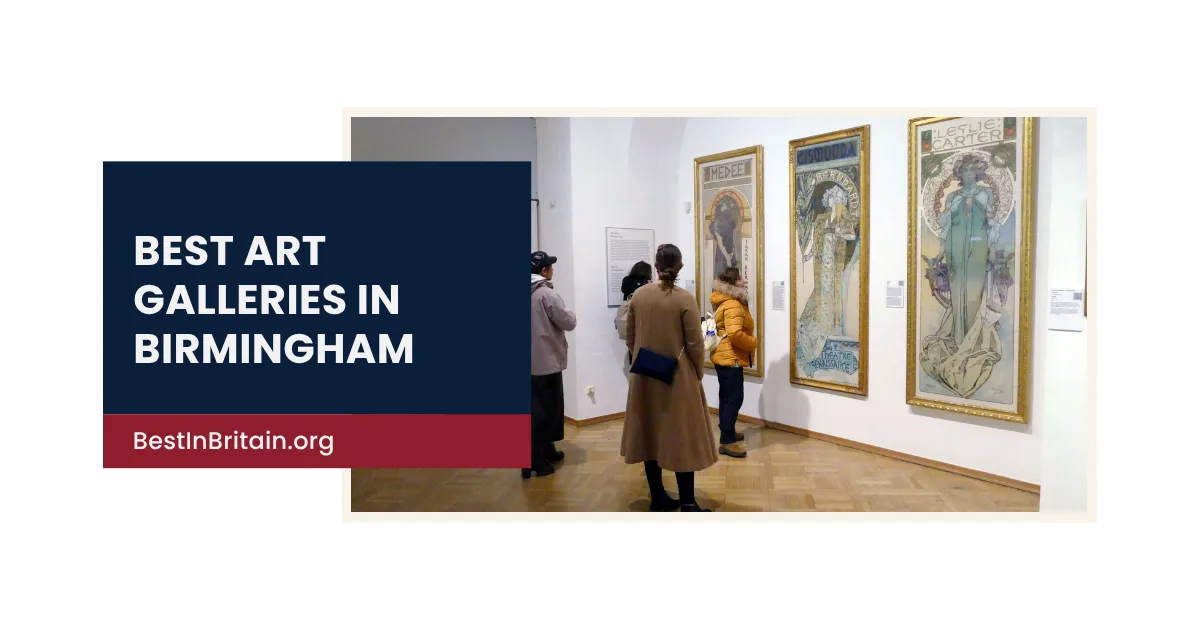
Birmingham's art scene extends well beyond one museum or commercial district. The city combines major civic collections, internationally programmed contemporary galleries, artist-led spaces, commercial dealers and multidisciplinary arts centres.
Visitors can move from Victorian paintings and Pre-Raphaelite works in Chamberlain Square to experimental installations in Digbeth, artist-led exhibitions in the Jewellery Quarter and contemporary shows in a converted nineteenth-century school.
The eight galleries in this guide represent those different parts of Birmingham's visual-arts landscape. Birmingham Museum & Art Gallery provides the broadest historic and civic collection, while Ikon is the city's principal internationally focused contemporary-art institution.
The Royal Birmingham Society of Artists combines changing exhibitions with a permanent collection linked to more than two centuries of local artistic activity. Midlands Arts Centre presents free gallery exhibitions alongside theatre, cinema, workshops and community programmes.
Eastside Projects, Centrala and Grand Union provide artist-led and socially engaged programmes in Digbeth. St Paul's Gallery offers a contrasting commercial experience centred on music-related art, signed editions and collectible prints.
The Barber Institute of Fine Arts would ordinarily be central to any Birmingham gallery guide, but its building and galleries are currently closed for a major improvement programme. It has therefore not been included as an active visitor venue until a confirmed reopening date is published.
How we selected the galleries
The venues were considered according to their current public access, exhibition programme, distinctiveness, relationship with Birmingham's artistic history and contribution to the city's contemporary culture.
The selection includes:
- Historic paintings and sculpture
- Pre-Raphaelite art
- Contemporary installation
- Photography
- Ceramics and craft
- Artist-led practice
- Community exhibitions
- Central and Eastern European art
- Commercial prints and editions
- Music-related artwork
- Talks and workshops
- Free public exhibitions
- Work available to purchase
Customer reviews and commercial awards were not used to rank the galleries. Exhibition quality is better assessed through the programme, artists, curatorial approach, collection and suitability for the visitor's interests.
Admission and planning a visit
Most public galleries in this guide offer free general admission, although donations are encouraged and some events, workshops or temporary exhibitions may be ticketed.
Commercial galleries are free to enter but are primarily designed for viewing and purchasing work. Visitors are not required to buy, although staff may naturally offer information about prices, editions and availability.
Before travelling, check:
- Current exhibition dates
- Installation closures
- Bank-holiday hours
- Ticket requirements
- Photography rules
- Accessibility
- Group-booking requirements
- Event-specific opening times
Contemporary galleries frequently close between exhibitions while installations are changed. An organisation being generally open Tuesday to Saturday does not guarantee that every gallery is accessible throughout the year.
Ikon Gallery
Editorially SelectedView this post on Instagram
Media credits: ikongallery
Business details
Address
1 Oozells Square, Brindleyplace, Birmingham, B1 2HS
Phone: 0121 248 0708
Opening hours:
- Tuesday to Sunday: 11 am to 5 pm
- Bank-holiday Mondays: 11 am to 5 pm
- Monday: Normally closed
Admission: Free; donations welcome
Ikon is Birmingham's principal internationally focused contemporary-art gallery.
Established in 1964 as an artist-led alternative space, it now operates from a Grade II-listed former school in Brindleyplace. Its exhibition programme brings together established and emerging artists working across painting, sculpture, film, sound, photography, ceramics and installation.
There is no permanent display arranged as a chronological history of modern art. Instead, the building presents a changing programme across two principal floors. A visit can therefore feel very different from one season to the next.
The gallery's educational work is central to its identity. Talks, short tours, family activity, creative-health projects and community partnerships accompany the exhibitions, while off-site work takes art beyond the building itself.
Ikon also runs a specialist shop selling art books, catalogues, cards and artists' editions. Purchases support the organisation's charitable exhibition and education work.
The building is fully accessible and provides visitor information for different access needs. Individual exhibitions may include low lighting, sound, moving images or installations that affect how the rooms are experienced, so it is worth reviewing the relevant exhibition guide in advance.
Photography is generally possible where the artist and lender permit it, but rules may vary between exhibitions. Visitors should check signage or ask a member of staff before photographing individual works.
Pros
- International contemporary-art programme
- Free admission
- Distinctive converted Victorian building
- Painting, film, sculpture, sound and installation
- Regular talks, tours and family activity
- Specialist art bookshop
- Central Brindleyplace location
- Strong accessibility information
Best for: Contemporary art, experimental installations, artist talks and visitors who prefer changing exhibitions to a permanent collection.
Good to know: The gallery is approximately a 20-minute walk from Birmingham New Street station. Allow time to visit both floors rather than judging the exhibition from the entrance level alone.
Birmingham Museum & Art Gallery
Editorially SelectedBusiness details
Address
Chamberlain Square, Birmingham, B3 3DH
Email: hello@birminghammuseums.org.uk
Opening hours:
- Tuesday to Sunday: 10 am to 5 pm
- Open daily during specified Birmingham school holidays
- Monday: Normally closed outside holiday periods
Admission: General admission is free; some special exhibitions or events may be ticketed
Birmingham Museum & Art Gallery is the city's principal civic museum and historic art collection.
The institution occupies part of Birmingham's Council House complex in Chamberlain Square. Its collections include fine art, decorative art, archaeology, local history and material connected with the development of the city.
The museum is especially associated with its Pre-Raphaelite collection, which includes paintings and works on paper by artists connected with one of the most influential British art movements of the nineteenth century.
Visitors should be aware that the museum has reopened in stages following extensive closure and building work. Several important public spaces are accessible, including the Round Room, Industrial Gallery, Bridge Gallery, Birmingham history displays, Staffordshire Hoard material and selected fine-art galleries.
The whole historic building and complete collection are not necessarily available at the same time. Displays can change as restoration, interpretation and fundraising work continue.
This phased reopening should not deter visitors, but expectations should be realistic. Birmingham Museum & Art Gallery currently works best as a combination of fine art, city history and changing exhibitions rather than as an uninterrupted encyclopaedic art museum.
The exhibition programme also connects visual culture with Birmingham's popular history, communities and contemporary artists. Recent and current displays have included work addressing disability, local identity, music and the changing city.
The museum is suitable for families and visitors who want more context than a commercial or artist-led gallery normally provides. The tearoom and shop make it possible to spend several hours in the building.
Pros
- Birmingham's principal civic art and museum collection
- Important Pre-Raphaelite holdings
- Historic paintings, sculpture and decorative art
- Free general admission
- Changing exhibitions
- Central Chamberlain Square location
- Family and local-history displays
- Tearoom and shop
Best for: Pre-Raphaelite art, Birmingham history, historic collections and visitors wanting a broad museum experience.
Good to know: Check the current exhibition and gallery list rather than relying on memories of the museum before its long closure. Some familiar works may be in storage, conservation or a different display.
Royal Birmingham Society of Artists Gallery
Editorially SelectedView this post on Instagram
Media credits: rbsagallery
Business details
Address
4 Brook Street, Birmingham, B3 1SA
Phone: 0121 236 4353
Email: rbsagallery@rbsa.org.uk
Opening hours:
- Tuesday to Saturday: 10:30 am to 5 pm
- Sunday and Monday: Closed
Admission: Free
The Royal Birmingham Society of Artists is an artist-led charity and gallery in the Jewellery Quarter.
Its origins can be traced to the Birmingham Academy of Arts, established in 1814. The society has played a continuing role in the city's artistic life through exhibitions, membership, prizes, education and the preservation of its own collection and archive.
The gallery operates across several floors and hosts more than 20 exhibitions each year. Its programme includes open exhibitions, member shows, solo presentations, drawing and portrait prizes, craft exhibitions and displays drawn from the permanent collection.
The collection contains almost 1,000 works, including painting, prints, drawing, sculpture, ceramics and jewellery. It reflects both the history of the society and Birmingham's wider artistic development.
Not all of the permanent collection is displayed continuously. Heritage exhibitions provide periodic access to selected works, while much of the annual programme is devoted to contemporary artists.
The ground-floor craft gallery and shop sell jewellery, ceramics, prints, textiles, glass and other work by artists and makers. This makes the RBSA a useful place for visitors interested in acquiring original work at a range of prices.
The gallery also runs workshops, talks and demonstrations. Some are led by RBSA members and associates, providing a direct connection between exhibiting artists and the public.
The historic society is not limited to traditional art. Its exhibitions cover contemporary painting, photography, drawing, printmaking, sculpture and craft, although the character remains more artist-society-led than that of an international curatorial institution such as Ikon.
Pros
- Artist-led society with roots dating to 1814
- Free changing exhibitions
- Permanent collection and archive
- Open exhibitions and artist prizes
- Strong regional and local-artist representation
- Craft gallery selling work by makers
- Workshops, talks and demonstrations
- Jewellery Quarter location
Best for: Regional art, open exhibitions, contemporary craft, original work for sale and visitors interested in Birmingham's artist-led history.
Good to know: The exhibition spaces are separate from the ground-floor craft shop. Explore the upper floors rather than assuming the retail area represents the complete gallery.
St Paul's Gallery
Editorially SelectedView this post on Instagram
Media credits: stpaulsgallery
Business details
Address
108 Northwood Street, Birmingham, B3 1TH
Phone: 07711 141415
Opening arrangements: Contact the gallery before travelling to confirm current public viewing or appointment arrangements
St Paul's Gallery is a commercial gallery in Birmingham's Jewellery Quarter specialising in music-related art, signed prints and limited editions.
Established in 2003, the gallery has developed a substantial catalogue of album-cover artwork, signed soundwave pieces, photography, pop-cultural images and editions connected with musicians and visual artists.
Its stock has included work associated with Pink Floyd, The Beatles, David Bowie, Queen, Peter Blake, Storm Thorgerson, Andy Warhol and Salvador Dalí.
The experience differs considerably from a public museum. Works are presented as objects available to purchase, with prices influenced by the artist, edition size, signature, condition, provenance, rarity and demand.
The gallery's website now functions as a significant online sales catalogue. Visitors wanting to see a particular work should contact the business before travelling because online availability does not guarantee that the item is physically displayed in Birmingham.
Collectors should request written information about:
- Artist or signatory
- Edition number
- Publisher
- Certificate of authenticity
- Provenance
- Condition
- Framing
- Returns
- Delivery
- Resale restrictions
Terms such as rare, collectible and investment should be treated cautiously. Art prices can fall as well as rise, and a gallery is not providing regulated investment advice merely by describing a work's scarcity or potential appeal to collectors.
The strongest reason to visit is an interest in music, graphic design and the visual culture of albums rather than an expectation of a conventional contemporary-art exhibition.
Pros
- Specialist music and album-cover art
- Signed and limited-edition prints
- Large online catalogue
- Works connected with major musicians and visual artists
- Birmingham Jewellery Quarter location
- Suitable for collectors and music enthusiasts
- Staff can provide edition and provenance information
Best for: Music-related artwork, signed editions, album-cover design and collectors seeking a commercial gallery rather than a museum visit.
Good to know: Ask to see documentation for any significant purchase. A certificate should be assessed alongside provenance, publisher information and the terms of sale.
Midlands Arts Centre
Editorially SelectedBusiness details
Address
Cannon Hill Park, Birmingham, B12 9QH
Phone: 0121 446 3232
Email: info@macbirmingham.co.uk
Gallery opening hours:
- Tuesday to Sunday: Usually 11 am to 5 pm
- Monday: Normally closed
- Exhibition-specific hours may vary
Admission: Most gallery exhibitions are free; donations welcome
Midlands Arts Centre, commonly known as MAC, is a multidisciplinary arts venue in Cannon Hill Park.
Its programme includes visual art, theatre, cinema, dance, music, comedy, workshops and family activity. The building contains several exhibition spaces rather than one conventional gallery.
The First Floor Gallery hosts the largest exhibitions, while the Arena, Terrace, Community and Made at MAC galleries support touring shows, regional work, community projects and art created through MAC's learning programme.
The visual-arts programme can include painting, photography, design, craft, installation, archives and socially engaged work. Exhibitions are frequently accompanied by talks, workshops or events that connect with the wider creative programme.
MAC is particularly suitable for visitors who want to combine an exhibition with a film, performance, café visit or walk through Cannon Hill Park. Families may also find the broader building more approachable than a gallery devoted solely to formal exhibition spaces.
Most exhibitions are free, although occasional major shows may be ticketed. Individual pages identify the venue, dates and admission arrangements.
The building is designed for broad public use and provides accessible booking and visitor information. Some exhibitions may include content warnings, audio, moving image or low-light sections, which should be checked in advance where relevant.
Because several galleries operate simultaneously, a visitor can often see work by established artists alongside community groups, students or participants in MAC courses.
Pros
- Several gallery spaces within one arts centre
- Most exhibitions are free
- Contemporary art, photography, design and craft
- Strong community and learning programme
- Cinema, theatre and live events onsite
- Café and park setting
- Family-friendly environment
- Accessible visitor facilities
Best for: Visitors combining visual art with cinema, performance, workshops or a day in Cannon Hill Park.
Good to know: Look beyond the First Floor Gallery. Smaller exhibitions may also be displayed in the Arena, Terrace, Community and Made at MAC spaces.
Eastside Projects
Editorially SelectedBusiness details
Address
86 Heath Mill Lane, Birmingham, B9 4AR
Email: info@eastsideprojects.org
Opening arrangements: Opening hours vary according to the current exhibition and programme
Admission: Free unless an event states otherwise
Eastside Projects is an artist-run public gallery in Digbeth.
Founded in 2008, it describes itself as an artist-run space for testing how art can be made public. Its programme includes exhibitions, commissions, performances, publishing, artist development and longer-term projects across Birmingham.
The gallery often works with experimental, research-led and socially engaged practices. Exhibitions may involve installation, moving image, sound, sculpture, performance or material developed through workshops and collaboration.
Eastside Projects is also an Arts Council England National Portfolio Organisation and works in partnership with Birmingham City University.
Its role extends beyond presenting finished work. The organisation supports artists through programmes, opportunities, mentoring and events, making it an important part of Birmingham's professional visual-arts infrastructure.
The visitor experience can be less conventional than at a museum. Works may occupy a large industrial-style space, develop over time or form part of a wider process rather than a display of individually framed objects.
Opening times vary with the current programme. Visitors should always check the exhibition page or social channels rather than relying on a standard weekly schedule.
Eastside Projects regularly participates in Digbeth First Friday, when galleries, studios and creative organisations open for evening exhibitions, performances and events.
Detailed access guides are produced for individual exhibitions. The organisation can also discuss alternative visiting arrangements for people with particular access or health requirements.
Pros
- Artist-run contemporary gallery
- Experimental and research-led programme
- Free public exhibitions
- Installations, performance and moving-image work
- Significant artist-development activity
- Digbeth First Friday participation
- Partnership with Birmingham City University
- Exhibition-specific access information
Best for: Experimental contemporary art, artist-led practice, installations and visitors interested in how new work is developed.
Good to know: Read the exhibition description before attending. The programme may be process-led or conceptual and is not designed around a permanent collection.
Centrala
Editorially SelectedBusiness details
Address
Unit 4, Minerva Works, 158 Fazeley Street, Birmingham, B5 5RT
Phone: 0121 513 0240
Email: centrala@centrala-space.org.uk
Opening hours:
- Tuesday to Saturday: 12 pm to 6 pm
- Open later for selected events
- Sunday and Monday: Normally closed
Admission: Usually free; check individual events
Centrala is an art gallery and multidisciplinary creative space at Minerva Works in Digbeth.
Its programme has a particular connection with contemporary Central and Eastern European art, migration, identity and cross-cultural exchange. It also works more broadly with artists, photographers, filmmakers, musicians and socially engaged organisations.
The ground-floor gallery hosts exhibitions, screenings, talks and performance. An upstairs space is used for further events, workshops and creative activity.
Centrala's programme often creates a platform for perspectives underrepresented within larger British institutions. Exhibitions may address gender, displacement, memory, political change, labour, borders and belonging.
Photography forms an important part of the programme, alongside painting, installation, video and interdisciplinary work. Grassroots groups and independent curators also collaborate with the gallery.
The venue is more informal than a civic museum and functions partly as a meeting place for Birmingham's creative communities. Openings and evening events can offer a more social introduction to the work than an ordinary daytime visit.
The ground floor includes a café area and is accessible at street level. The first-floor event space is not fully accessible, so visitors attending a specific programme should check which level is being used.
Centrala accepts exhibition proposals, although submission does not guarantee a response or inclusion. Its curatorial focus remains central to how collaborations are assessed.
Pros
- Distinct focus on Central and Eastern European art
- Contemporary photography, installation and performance
- Free daytime gallery access
- Socially engaged and cross-cultural programme
- Regular evening events
- Grassroots and independent collaborations
- Digbeth location
- Café and gathering space
Best for: Contemporary European art, photography, migration and identity themes, and visitors seeking a socially engaged independent space.
Good to know: Check whether a listed event takes place in the ground-floor gallery or upstairs space when step-free access is required.
Grand Union
Editorially SelectedBusiness details
Address
Unit 19, Minerva Works, 158 Fazeley Street, Birmingham, B5 5RT
Email: info@grand-union.org.uk
Opening arrangements: Check the current exhibition page; hours vary with the programme
Admission: Free unless stated otherwise
Grand Union is a contemporary-art organisation and public gallery based at Minerva Works in Digbeth.
Its programme combines exhibitions, artist commissions, residencies, learning, public events and long-term work developed with communities across Birmingham.
The organisation works both inside its gallery and beyond it. Projects may take place in gardens, neighbourhood spaces, schools or other parts of the city, reflecting an interest in how artistic practice can connect with housing, ecology, care, migration and public life.
Inside the gallery, visitors may encounter moving image, installation, photography, sound, performance and research-led work. Exhibitions are generally free.
Grand Union regularly collaborates with artists at different career stages, university curating programmes and other cultural organisations. Its programme can therefore include a solo commission, a group exhibition or work emerging from a longer residency.
The organisation participates in Digbeth First Friday and sometimes offers quieter opening periods before busier evening events. These sessions may be useful for visitors who prefer fewer people or a reduced social atmosphere.
Opening hours are tied to the current exhibition rather than one permanent public timetable. The website should be checked immediately before visiting.
Grand Union shares Minerva Works with other creative organisations, including Centrala. The two galleries can be combined in one visit, although they maintain separate programmes and access arrangements.
Pros
- Free contemporary-art exhibitions
- Artist commissions and residencies
- Strong community and socially engaged practice
- Work inside and outside the gallery
- Moving image, installation and performance
- Digbeth First Friday participation
- Collaboration with curators and universities
- Close to Centrala and other Digbeth venues
Best for: Socially engaged contemporary art, moving image, artist research and visitors exploring Digbeth's independent cultural scene.
Good to know: Check the event listing for relaxed openings, screenings or discussions that provide additional context for the exhibition.
Quick comparison
| Gallery | Area | Principal focus | Admission | Work for sale | Fixed weekly opening |
|---|---|---|---|---|---|
| Ikon | Brindleyplace | International contemporary art | Free | Editions and books in shop | Yes |
| Birmingham Museum & Art Gallery | Chamberlain Square | Historic art, civic collections and temporary exhibitions | Mostly free | Shop only | Yes |
| RBSA Gallery | Jewellery Quarter | Artist-led exhibitions, regional art and craft | Free | Yes | Yes |
| St Paul's Gallery | Jewellery Quarter | Music art, signed prints and limited editions | Free to view | Core purpose | Confirm before visiting |
| Midlands Arts Centre | Cannon Hill Park | Contemporary exhibitions within a multidisciplinary arts centre | Mostly free | Occasionally | Usually |
| Eastside Projects | Digbeth | Experimental artist-led contemporary art | Free | Not the principal purpose | Programme dependent |
| Centrala | Digbeth | Central and Eastern European and socially engaged art | Usually free | Exhibition dependent | Yes |
| Grand Union | Digbeth | Contemporary commissions and community practice | Free | Not the principal purpose | Programme dependent |
Which gallery suits which visitor?
Historic paintings and civic collections
Birmingham Museum & Art Gallery is the clearest choice.
Its displays combine fine art with archaeology, industrial history and the wider story of Birmingham. Visitors should remember that access remains more limited than before the building's closure.
Contemporary international art
Ikon offers the strongest consistently international contemporary programme.
Its exhibitions are curated around individual artists and themes rather than a permanent survey collection.
Local and regional artists
The RBSA provides the clearest route into Birmingham's artist-led history and current regional practice.
Its open exhibitions and prizes also allow work by artists outside the formal membership to enter the programme.
Experimental art
Eastside Projects and Grand Union are the strongest choices for experimental, research-led and socially engaged work.
Their programmes reward visitors willing to read the contextual material and engage with installations, moving image or process-based practice.
Central and Eastern European art
Centrala has the most distinctive focus in this area.
Its programme is also relevant to visitors interested in migration, identity, photography and cross-cultural exchange.
Art and other activities
Midlands Arts Centre works particularly well for a mixed day involving an exhibition, cinema, performance, workshop, food or time in Cannon Hill Park.
Buying original art or craft
The RBSA sells original work and craft by contemporary artists and makers.
St Paul's Gallery is more specialised, concentrating on signed editions, music-related work and collectible prints.
Music and album-cover artwork
St Paul's Gallery is the clear specialist.
Contact the gallery before visiting when a particular artist or edition is the reason for the trip.
Public and commercial galleries
A public or charitable gallery usually selects work through curatorial programmes, collections, open calls or public objectives. Admission is commonly free or subsidised.
A commercial gallery represents or sells work and earns income when pieces are purchased.
This distinction affects the visitor experience:
Public or charitable gallery
- Exhibitions may be research-led
- Work is not necessarily for sale
- Interpretation and learning may be extensive
- Donations may be encouraged
- Programming may include challenging or experimental work
Commercial gallery
- Works are normally priced
- Staff may discuss purchasing
- Artists or editions may be represented continuously
- Stock can be available online and by appointment
- Provenance and sale terms are important
Neither model is inherently superior. They serve different purposes.
Buying art
Before buying original art or a limited edition, ask for:
- Artist's full name
- Title
- Date
- Medium
- Dimensions
- Edition size
- Edition number
- Signature details
- Publisher
- Provenance
- Condition report
- Framing information
- Certificate
- VAT position
- Delivery cost
- Returns policy
An edition marked 10/100 is one impression within an edition of 100. Artist's proofs and printer's proofs may exist in addition to the numbered edition.
A certificate of authenticity is useful only when issued by a credible source and supported by the work's provenance.
Do not assume that a signed print is a secure financial investment. Buy because the work is meaningful and the price is affordable, not because future resale growth has been implied.
Photography in galleries
Photography policies depend on the artist, lender, copyright position and installation.
A venue may allow:
- Personal photography
- Non-flash photography
- Photography in selected rooms
- Photography of the building but not the works
- No photography
Flash, tripods and commercial filming often require separate permission.
Avoid obstructing other visitors or photographing people closely without consent.
Accessibility
Gallery accessibility can involve more than step-free entry.
Consider:
- Level entrance
- Lift
- Accessible toilet
- Seating
- Gallery lighting
- Sound
- Captioning
- Audio description
- Large-print material
- Quiet opening
- Assistance dogs
- Wheelchair turning space
- Emergency evacuation
Ikon, MAC and Birmingham Museum & Art Gallery publish substantial access information.
Eastside Projects produces exhibition-specific access guides. Centrala's main ground floor is accessible, but its upstairs space is not fully step-free.
Historic buildings can present practical constraints even where adaptations have been made.
Visiting Digbeth galleries
Eastside Projects, Centrala and Grand Union can be combined within one Digbeth visit.
Opening hours do not always align, so build the day around current exhibitions rather than assuming all three will be open simultaneously.
Digbeth First Friday takes place through participating galleries and creative venues, with evening openings, performances and launches.
These nights provide an energetic introduction to the district but are busier than ordinary daytime visits. Some organisations offer earlier relaxed access before the main event.
Visiting with children
Birmingham Museum & Art Gallery, Ikon and MAC provide the clearest established family programmes.
A family-friendly gallery is not necessarily one where every exhibition is designed for children. Contemporary work can contain adult themes, loud sound, darkness or fragile installations.
Check:
- Content guidance
- Pushchair access
- Toilets and changing facilities
- Family activity sheets
- Workshop booking
- Food
- Quiet spaces
- Whether touching is permitted
Children should remain supervised around artworks and display barriers.
Gallery etiquette
Visitors should:
- Avoid touching works unless invited
- Follow photography signs
- Keep food and drink outside exhibition spaces
- Use headphones for personal audio
- Supervise children
- Keep a safe distance from installations
- Avoid blocking doorways
- Respect quiet areas
- Follow staff instructions
- Ask before sketching with wet materials
In an artist-led space, an installation may extend onto the floor or resemble an ordinary object. Do not assume that something can be moved or sat upon.
Frequently asked questions
What is the best art gallery in Birmingham?
There is no single answer.
Ikon is strongest for international contemporary art, while Birmingham Museum & Art Gallery provides the broadest historic and civic collection. The RBSA is particularly useful for regional artists and work available to buy.
Are Birmingham's galleries free?
Most of the galleries in this guide offer free general admission.
Some special exhibitions, performances, talks and workshops may be ticketed.
Is Birmingham Museum & Art Gallery fully open?
No.
It is open to visitors, but the building and collections have reopened in stages. Check the current gallery and exhibition list before travelling.
Is the Barber Institute open?
Its gallery building is currently closed for a major transformation project.
The collection remains active through online resources, loans and off-site exhibitions.
Where can I see contemporary art?
Ikon, MAC, Eastside Projects, Centrala and Grand Union all present contemporary work.
Their programmes differ substantially, from internationally established artists to experimental and community-led projects.
Where can I buy art in Birmingham?
The RBSA sells original art, prints, jewellery and craft. St Paul's Gallery sells signed prints, music-related art and collectible editions.
Commercial work may also be available through temporary exhibitions elsewhere.
Where can I see Pre-Raphaelite art?
Birmingham Museum & Art Gallery holds an important Pre-Raphaelite collection.
The exact works on display can vary during the phased reopening.
Are the Digbeth galleries open every day?
No.
Centrala maintains regular Tuesday-to-Saturday hours, while Eastside Projects and Grand Union operate according to their current programmes.
Can I submit artwork to these galleries?
Policies vary.
The RBSA runs open exhibitions and prizes. Centrala accepts proposals. Major curated institutions such as Ikon generally develop their programmes well in advance and rarely accommodate unsolicited exhibition proposals.
Can I take photographs?
Often, but not always.
Check the signs and ask staff because restrictions may apply to particular artworks or exhibitions.
Choosing the right Birmingham gallery
Ikon offers the strongest route into international contemporary art, while Birmingham Museum & Art Gallery connects fine art with the history and identity of the city.
The RBSA provides artist-led exhibitions, regional heritage and an accessible route to buying original art and craft. St Paul's Gallery is a distinctive commercial destination for music-related artwork and signed editions.
MAC combines free visual-art exhibitions with cinema, theatre, workshops and Cannon Hill Park. Eastside Projects offers the most explicitly experimental artist-run programme.
Centrala provides a rare focus on Central and Eastern European perspectives, migration and socially engaged practice. Grand Union connects exhibitions with artist residencies, neighbourhood projects and public life.
Birmingham's strongest gallery day will often combine two different models: a major public institution followed by a smaller artist-led or commercial space. Check the current exhibitions first, allow time to read the accompanying material and avoid judging the city's art scene by one venue alone.
Birmingham Visual Arts & Exhibition Gallery Market Statistics
Registered Art Galleries
38
Gallery spaces in Birmingham
Contemporary Focus
64%
Modern & visual art focus
Public Access Days
100%
Free admission entry
Independent vs Civic Split
58% / 42%
Gallery model ratio
Top Art & Creative Quarters in Birmingham
- B5 (Digbeth Arts & Media Quarter)48% focus
- B18 (Jewellery Quarter Studios)26% focus
- B1 (Centenary Sq & Civic Centre)16% focus
- B15 (Edgbaston & Barber Institute)10% focus
Gallery Specialisms & Exhibition Focus
- Contemporary Visual Art & Installations46% of venues
- Fine Art & Printmaking Galleries28% of venues
- Photography & Digital Media Spaces16% of venues
- Sculpture & Craft Design Studios10% of venues
Related articles
Related guides
Museums and Galleries
Best Museums in Birmingham
An independent guide to Birmingham museums, covering fine art, science, industry, working-class life, policing history, Tudor buildings and Jacobean architecture.
Updated 25 June 2026
Museums and Galleries
The best art galleries in Edinburgh to discover and acquire exceptional works
A researched guide to Edinburgh art galleries offering contemporary prints, Scottish painting, sculpture, tapestry, ceramics and collectable works by established and emerging artists.
Updated 1 August 2026
Museums and Galleries
Best art galleries in London
Explore London’s finest art galleries, from world-renowned national collections to historic houses, modern landmarks and leading contemporary spaces.
Updated 19 July 2026
Museums and Galleries
4 exceptional museums to visit in Glasgow
An editorial guide to the leading museums in Glasgow, highlighting Victorian civic art galleries, modern transport exhibits, and historic tenement apartments.
Updated 17 July 2026
Museums and Galleries
The Best Museums in London for an Inspiring Visit
A comprehensive guide to London’s most rewarding museums, from major national collections to intimate historic houses and family-friendly science attractions.
Updated 8 July 2026
Museums and Galleries
The 4 best museums in Liverpool for a cultural day out
An editorial selection of the premier museums in Liverpool, covering waterfront social history collections, world heritage sites, and wartime bunkers.
Updated 2 July 2026
Know a business we should consider?
Send us the details and our editorial team will review whether it fits a future guide.
Submit businessWriter profile
Gabriela Krumova
Arts, Culture & Performance Contributor
Actor, theatre director and Queen Margaret University Drama graduate with international performance experience across Edinburgh, London, New York, Paris and Venice. Gabriela has performed in and directed Edinburgh Festival Fringe productions and covers theatre, performing arts, cultural venues, live entertainment, festivals and the creative industries for Best in Britain.
Editorial Trust Standard
Independent ReviewIndependent Research
Featured rankings are editorially determined. Commercial partner listings are strictly labeled as Sponsored or Featured.
Public Register Audit
Listings are cross-checked against public regulatory registries, Companies House filings, and published fee schedules.
Regional Directory
Explore Other Verified Services in Birmingham
solicitors
Top criminal defence firms in Birmingham
business services
Top party planners in Birmingham
therapists
Top counselling services in Birmingham
business services
Top immigration agencies in Birmingham for reliable visa and settlement support
business services
Top Domestic Cleaning Companies in Birmingham
private clinics