
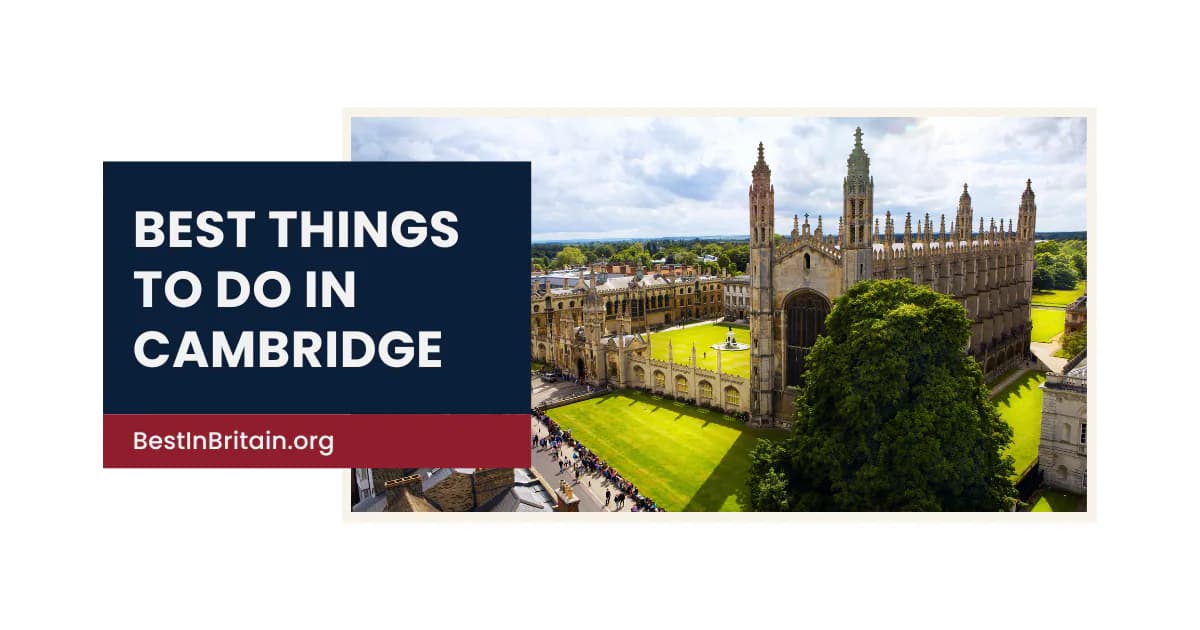
Cambridge is one of Britain’s most beautiful and intellectually significant cities. Medieval college courts, riverside gardens and Gothic chapels sit alongside busy markets, independent shops, contemporary galleries and green spaces that extend almost into the historic centre.
The city is compact enough to explore on foot, but its appeal goes far beyond a quick walk past the university buildings. Visitors can punt beneath famous bridges, enter some of the world’s most celebrated academic spaces, see major art and scientific collections, cycle beside the River Cam or follow the meadows towards Grantchester.
This guide brings together the very best things to do in Cambridge, combining its essential landmarks with museums, neighbourhoods, outdoor spaces and local experiences that reveal more of the city.
Historic and university things to do in Cambridge
1. Visit King’s College Chapel
Business details
Address
King’s Parade, Cambridge CB2 1ST
Contact details: +44 1223 331100
Operating hours:
- Visitor opening days and times vary throughout the year
- Access may be restricted during services, university events and examination periods
Price: £££
King’s College Chapel is Cambridge’s defining landmark and one of the finest examples of late Gothic architecture in Britain. Its extraordinary fan-vaulted ceiling, towering stained-glass windows and carved stonework create a space of remarkable scale and detail.
Construction began under Henry VI in the 15th century and continued under later monarchs. The chapel remains an active place of worship and is internationally known for the Choir of King’s College and its Christmas Eve Festival of Nine Lessons and Carols.
Admission generally includes access to part of the college grounds, where visitors can see the chapel from the River Cam and the Backs.
Pro tip:
Check the official visitor calendar before travelling. Opening times can change at short notice around services, term dates and special events.
2. Go punting on the River Cam
Business details
Address
Departures from Quayside, Jesus Green and the Mill Pond
Operating hours:
- Tours operate throughout the year
- Frequency and final departures vary by season, daylight and weather
Price: ££ to £££
Punting is Cambridge’s signature experience and one of the best ways to see the historic colleges. Chauffeured tours travel along the Backs, passing landmarks such as King’s College Chapel, the Bridge of Sighs, the Wren Library and the Mathematical Bridge.
Visitors can also hire a punt and propel it themselves. This is more affordable for groups and can be enjoyable, but controlling a punt is harder than it appears, particularly when the river is busy.
Licensed operators depart from established riverside stations rather than approaching visitors far from the water.
Pro tip:
Choose a chauffeured tour for your first visit. The guide’s commentary and uninterrupted view are usually worth the extra cost.
3. Walk along the Backs
Business details
Address
Queen’s Road and riverside paths west of central Cambridge
Operating hours:
- Public roads and paths are generally accessible at all times
- College grounds have separate visitor restrictions
Price: Free
The Backs are the landscaped riverside grounds behind several of Cambridge’s oldest colleges. From this side of the River Cam, visitors can see lawns, bridges, chapels and college façades that are partly hidden from the city streets.
The best public views include King’s College from Queen’s Road, the river near Garret Hostel Bridge and the approaches to Silver Street.
Not every section of the riverbank is publicly accessible because much of the land belongs to individual colleges.
Pro tip:
Walk north from Silver Street towards Garret Hostel Bridge, then continue to Queen’s Road for several of the classic college views.
4. Explore Trinity College
Business details
Address
Trinity Street, Cambridge CB2 1TQ
Contact details: +44 1223 338400
Operating hours:
- Visitor access varies by season and university commitments
- Some areas may close during examinations and college events
Price: £ to ££
Trinity College is the largest college in the University of Cambridge and has associations with figures including Isaac Newton, Francis Bacon and Lord Byron.
The Great Court is one of the most impressive college spaces in the city. Visitors may also see the chapel and, when public access is available, the Wren Library, designed by Sir Christopher Wren.
The library contains historic manuscripts and books, including material connected with Newton and other major writers and scientists.
Pro tip:
Do not assume the Wren Library will be open on the day of your visit. Check its separate public access arrangements in advance.
5. Visit St John’s College and the Bridge of Sighs
Business details
Address
St John’s Street, Cambridge CB2 1TP
Contact details: +44 1223 338600
Operating hours:
- Visitor access varies throughout the year
- Closures may apply during examinations, ceremonies and private events
Price: ££
St John’s College contains a sequence of historic courts extending from the city centre across the River Cam. Its architecture ranges from Tudor brickwork to the dramatic 19th-century New Court.
The Bridge of Sighs is the college’s best-known feature. Built in the 1830s, the covered bridge links Third Court with New Court and is most often seen from a punt on the river.
A college visit gives a closer look at the courts, chapel and riverside spaces that cannot be appreciated fully from public streets.
Pro tip:
See the bridge from both perspectives if possible: from the river during a punt tour and from within the college grounds.
6. See the Mathematical Bridge at Queens’ College
Business details
Address
Silver Street, Cambridge CB3 9ET
Contact details: +44 1223 335511
Operating hours:
- Visitor access varies by date and university commitments
- The bridge can also be viewed from Silver Street and the River Cam
Price: £
The Mathematical Bridge connects two parts of Queens’ College across the River Cam. Its carefully arranged timber structure creates the appearance of a curved bridge using straight wooden members.
The current bridge is a later reconstruction of the original 18th-century design. Despite a popular story, it was not built by Isaac Newton and was never assembled without bolts or fastenings.
Queens’ College itself contains historic courts and buildings on both sides of the river.
Pro tip:
The easiest free view is from Silver Street Bridge. A punt provides a lower and more complete perspective of the structure.
7. Climb the tower of Great St Mary’s Church
Business details
Address
Senate House Hill, Cambridge CB2 3PQ
Contact details: +44 1223 747273
Operating hours:
- Church and tower hours vary
- Tower access can be affected by services, events and weather
Price: Free church entry, with a charge for the tower
Great St Mary’s is the University Church and occupies a central position beside King’s Parade and the market square. Its history is closely connected with the development of the University of Cambridge.
The church interior contains university memorials and historic features, but the main visitor attraction is the tower. After climbing a narrow staircase, visitors reach an outdoor viewing platform overlooking King’s College, the market and the rooftops of central Cambridge.
Pro tip:
Climb on a clear morning before the centre becomes busy. The tower offers one of the best elevated views of King’s College Chapel.
8. Find the Corpus Clock
Business details
Address
Taylor Library, Corpus Christi College, Trumpington Street, Cambridge CB2 1RH
Operating hours:
- Visible from the street at all times
Price: Free
The Corpus Clock is a striking modern timepiece set into the exterior of Corpus Christi College. Its rippling gold face has no traditional hands or numbers and is topped by a mechanical creature known as the Chronophage, or time eater.
Unveiled in 2008, the clock was designed to make the passage of time feel unsettling rather than reassuring. Its movement appears irregular, although it remains accurate over time.
Pro tip:
Visit after dark as well as during the day. The illuminated mechanism is easier to appreciate once reflections on the glass are reduced.
Museums and cultural things to do in Cambridge
9. Explore the Fitzwilliam Museum
Business details
Address
Trumpington Street, Cambridge CB2 1RB
Contact details: +44 1223 332900
Operating hours:
- Monday: Closed
- Tuesday to Saturday: 10 am to 5 pm
- Sunday and bank holidays: 12 pm to 5 pm
Price: Free
The Fitzwilliam Museum is one of Britain’s finest regional museums. Its collections span ancient Egypt, Greece and Rome, European paintings, manuscripts, ceramics, armour, coins and decorative art.
Artists represented include Titian, Rubens, Rembrandt, Monet, Renoir and Picasso. The grand entrance hall and neoclassical galleries make the building itself an important part of the experience.
The museum is large enough to reward several hours, but free admission also makes a shorter focused visit practical.
Pro tip:
Choose two or three collections in advance rather than trying to cover every gallery in one visit.
10. Visit the University Museum of Zoology
Business details
Address
Downing Place, Cambridge CB2 3EJ
Contact details: +44 1223 336650
Operating hours:
- Tuesday to Saturday: 10 am to 4:30 pm
- Sunday: 12 pm to 4:30 pm
- Monday: Closed
- Hours may vary on bank holidays
Price: Free
The University Museum of Zoology explores the diversity and evolution of animal life through skeletons, preserved specimens and scientific collections.
Its most dramatic exhibits include large whale skeletons suspended above the galleries. The collections also contain specimens connected with Charles Darwin and the history of zoological research in Cambridge.
The museum works particularly well for families, but its scientific importance makes it equally rewarding for adult visitors.
Pro tip:
Look beyond the largest skeletons. Some of the smaller historic specimens have the strongest connections to Cambridge’s scientific past.
11. Discover polar exploration at the Polar Museum
Business details
Address
Scott Polar Research Institute, Lensfield Road, Cambridge CB2 1ER
Contact details: +44 1223 336540
Operating hours:
- Tuesday to Saturday: 10 am to 4 pm
- Closed on Sundays, Mondays and bank holidays
Price: Free
The Polar Museum tells the story of Arctic and Antarctic exploration, science and indigenous cultures. Its collections include equipment, clothing, maps, photographs, artworks and personal objects carried on historic expeditions.
The museum is part of the Scott Polar Research Institute and has particularly strong material connected with Robert Falcon Scott, Ernest Shackleton and the heroic age of Antarctic exploration.
It also addresses modern polar science and environmental change, giving the displays relevance beyond historic expedition stories.
Pro tip:
Allow at least an hour. The museum is small, but its personal letters and expedition objects deserve careful attention.
12. Visit the Museum of Archaeology and Anthropology
Business details
Address
Downing Street, Cambridge CB2 3DZ
Contact details: +44 1223 333516
Operating hours:
- Tuesday to Saturday: 10 am to 5 pm
- Sunday: 12 pm to 5 pm
- Monday: Closed
Price: Free
The Museum of Archaeology and Anthropology holds collections relating to human history and cultures from around the world. Its archaeological displays range from early human tools to Roman and medieval objects, while its anthropological collections include textiles, carvings, ceremonial objects and photographs.
The museum also examines how collections were formed and how museums should interpret objects acquired during periods of empire and colonial expansion.
Pro tip:
Combine this museum with the Museum of Zoology. They are close together and offer two very different views of life and human history.
13. See modern art at Kettle’s Yard
Business details
Address
Castle Street, Cambridge CB3 0AQ
Contact details: +44 1223 748100
Operating hours:
- Tuesday to Sunday: 11 am to 5 pm
- Monday: Closed
- House entry may require a timed ticket
Price: Free
Kettle’s Yard combines a modern art gallery with the carefully arranged former home of collector Jim Ede. Paintings, sculpture, furniture, ceramics and natural objects are displayed in domestic rooms filled with changing daylight.
Artists represented include Barbara Hepworth, Joan Miró, Ben Nicholson and Alfred Wallis. The house does not feel like a conventional museum, and the relationship between art, objects and architecture is central to the experience.
Separate gallery spaces host temporary exhibitions and events.
Pro tip:
Reserve a house entry time before visiting. The gallery may be freely accessible while access to the historic house is capacity controlled.
14. Learn about the city at the Museum of Cambridge
Business details
Address
2/3 Castle Street, Cambridge CB3 0AQ
Contact details: +44 1223 355159
Operating hours:
- Opening days and hours vary seasonally
- Check the official website before visiting
Price: £
The Museum of Cambridge occupies a 17th-century building and focuses on the everyday history of the city and surrounding area.
Its rooms contain domestic objects, shop signs, toys, clothing, tools and local stories that reveal a Cambridge beyond the university. The old building’s low ceilings, narrow stairs and historic rooms contribute strongly to the atmosphere.
Pro tip:
Visit alongside Kettle’s Yard and Castle Hill. All three are close together and form a useful route beyond the busiest central streets.
Outdoor and local things to do in Cambridge
15. Explore Cambridge University Botanic Garden
Business details
Address
1 Brookside, Cambridge CB2 1JE
Contact details: +44 1223 336265
Operating hours:
- Open daily from 10 am
- Closing times vary seasonally
- Closed during the Christmas period
Price: ££
Cambridge University Botanic Garden contains thousands of plant species across 40 acres. Landscaped collections include woodland, rock gardens, lakes, systematic beds, seasonal displays and glasshouses representing different climates.
The garden supports university teaching and scientific research while remaining one of the city’s most relaxing visitor attractions.
Its location near the railway station makes it a convenient first or final stop for visitors arriving by train.
Pro tip:
Allow at least two hours and check the seasonal highlights before visiting. Different parts of the garden reach their peak at different times of year.
16. Walk beside the River Cam across Jesus Green and Midsummer Common
Business details
Address
Jesus Green and Midsummer Common, Cambridge CB4 and CB5
Operating hours:
- Open 24 hours
Price: Free
Jesus Green and Midsummer Common create a broad band of open space beside the River Cam immediately north-east of the city centre.
The area is popular with walkers, cyclists, rowers and picnickers. Riverside paths provide views of college boathouses, narrowboats and rowing crews, while mature avenues make Jesus Green particularly attractive.
The commons also host fairs and community events at different times of year.
Pro tip:
Begin at Quayside, follow the river through Jesus Green and continue across Midsummer Common before returning through the city.
17. Relax on Parker’s Piece
Business details
Address
Parker’s Piece, Cambridge CB1 1NA
Operating hours:
- Open 24 hours
Price: Free
Parker’s Piece is one of Cambridge’s most important open spaces. Its broad grass field sits between the historic centre, railway station and Mill Road.
The common is associated with the development of the modern rules of football and remains a popular place for sport, picnics and informal gatherings.
Its diagonal paths provide a practical and attractive route across the city, while the surrounding buildings include the grand University Arms hotel.
Pro tip:
Cross Parker’s Piece on the way between the station and the centre rather than following the busiest main roads.
18. Explore Mill Road
Business details
Address
Mill Road, Cambridge CB1
Operating hours:
- Street accessible at all times
- Individual businesses keep their own hours
Price: Free to explore
Mill Road offers a more local and multicultural side of Cambridge. Independent cafés, restaurants, food shops, pubs, bakeries and small retailers line the street east of the city centre.
The area has a noticeably different atmosphere from the college quarter and is one of the best places to eat beyond the most tourist-focused streets.
Side roads contain Victorian terraces, community spaces and access towards Romsey and the railway.
Pro tip:
Visit around lunchtime or early evening and choose an independent venue rather than treating the street only as a shopping route.
19. Cycle through the city
Business details
Address
Cycle routes throughout Cambridge and surrounding villages
Operating hours:
- Routes accessible at all times
- Hire businesses keep separate hours
Price: £ to ££
Cambridge is one of Britain’s most cycle-oriented cities. Its flat terrain and extensive network of cycle routes make a bicycle an efficient way to explore beyond the compact historic centre.
Possible routes include the River Cam, Grantchester, the Botanic Garden, West Cambridge and nearby villages. Cycling also makes it easier to connect attractions that would require longer walks.
Visitors should remain alert around busy junctions and avoid cycling in pedestrian-only college streets where restrictions apply.
Pro tip:
Practise away from the busiest centre before joining commuter routes. Cambridge cyclists move quickly and expect predictable road positioning.
20. Walk through Grantchester Meadows
Business details
Address
Grantchester Meadows, Cambridge CB3 and Grantchester CB3
Operating hours:
- Public paths are generally accessible throughout the year
Price: Free
Grantchester Meadows offer one of the best walks from Cambridge into the surrounding countryside. The route follows the River Cam through open meadows towards the village of Grantchester.
The village has long associations with writers, academics and artists, including Rupert Brooke, Virginia Woolf and E M Forster. Tea gardens and pubs provide natural stopping points before the return journey.
The walk feels rural surprisingly quickly, despite beginning close to the city centre.
Pro tip:
Walk from Cambridge to Grantchester, stop for tea or lunch and return by a different riverside path where conditions allow. Expect muddy ground after rain.
How to make the most of a visit to Cambridge
Cambridge is highly walkable, and most central attractions sit within a compact area between King’s Parade, the market and the River Cam. A strong first-day route begins at the Fitzwilliam Museum, continues past the Corpus Clock and King’s College, then reaches Trinity Street, St John’s College and Quayside.
Punting is best booked with a licensed operator, particularly on warm weekends and during summer. College access is less predictable than access to conventional attractions because opening arrangements change around terms, examinations, services and private events. Always check individual college websites on the day of your visit.
A second day allows time for Kettle’s Yard, the specialist university museums, the Botanic Garden or a walk to Grantchester. Visitors who enjoy cycling can cover significantly more of the city and surrounding countryside.
Driving into central Cambridge is rarely the easiest option. The railway station is within walking distance of the centre, and park-and-ride services help visitors avoid limited and expensive central parking.
Cambridge Visitor, Culture & Leisure Market Statistics
Annual Visitor Footfall
2.4M
Annual visitors in Cambridge
Tourist & Visitor Spend
£450M
Annual visitor expenditure
Cultural & Leisure Venues
120
Attractions & landmarks
Visitor Stay Profile
70% Day
30% Overnight stays
Primary Attraction & Cultural Hubs in Cambridge
- UK1 (Historic Centre & Landmarks)48% focus
- UK2 (Cultural Quarter & Museums)28% focus
- UK3 (Parks & Waterfront Promenade)14% focus
- UK4 (Outer Trails & Heritage Sites)10% focus
Attraction Types & Category Breakdown
- Museums & Cultural Heritage38% of venues
- Parks, Nature & Scenic Walks26% of venues
- Historic Architecture & Landmarks20% of venues
- Guided Tours & Family Attractions16% of venues
Related guides

Things to Do
25 best Christmas markets in the UK
Discover 25 of the best Christmas markets in the UK, from Bath's Georgian streets and Birmingham's Frankfurt market to cathedral fairs, city festivals and historic estate markets.
Updated 26 September 2026

Things to Do
20 best places for a romantic weekend in the UK
Discover 20 of the best places for a romantic weekend in the UK, from historic cities and coastal towns to countryside escapes, islands and mountain retreats across all four nations.
Updated 26 September 2026

Things to Do
Top Escape Rooms in Edinburgh for a Thrilling Challenge
A researched guide to Edinburgh escape rooms offering historical mysteries, cinematic adventures, magical puzzles, detective stories and team-building games.
Updated 1 August 2026

Things to Do
Best Jazz Clubs in London for Live Music
A current guide to six London jazz clubs and live-music venues, covering ticket prices, seating, food, age rules, accessibility, jam sessions and the different styles each venue presents.
Updated 22 July 2026
Things to Do
16 best things to do in Norwich for an unforgettable visit
Explore 16 of the best things to do in Norwich, including the restored castle, cathedral quarter, historic lanes, independent market, riverside walks and Norfolk day trips.
Updated 22 July 2026
Things to Do
20 best things to do in Bath for an unforgettable visit
Discover the best things to do in Bath, from the Roman Baths and Thermae Bath Spa to Georgian landmarks, museums, gardens, riverside walks and memorable local experiences.
Updated 21 July 2026
Know a business we should consider?
Send us the details and our editorial team will review whether it fits a future guide.
Submit businessWriter profile
Gabriela Krumova
Arts, Culture & Performance Contributor
Actor, theatre director and Queen Margaret University Drama graduate with international performance experience across Edinburgh, London, New York, Paris and Venice. Gabriela has performed in and directed Edinburgh Festival Fringe productions and covers theatre, performing arts, cultural venues, live entertainment, festivals and the creative industries for Best in Britain.
Editorial Trust Standard
Independent ReviewIndependent Research
Featured rankings are editorially determined. Commercial partner listings are strictly labeled as Sponsored or Featured.
Public Register Audit
Listings are cross-checked against public regulatory registries, Companies House filings, and published fee schedules.
Regional Directory