
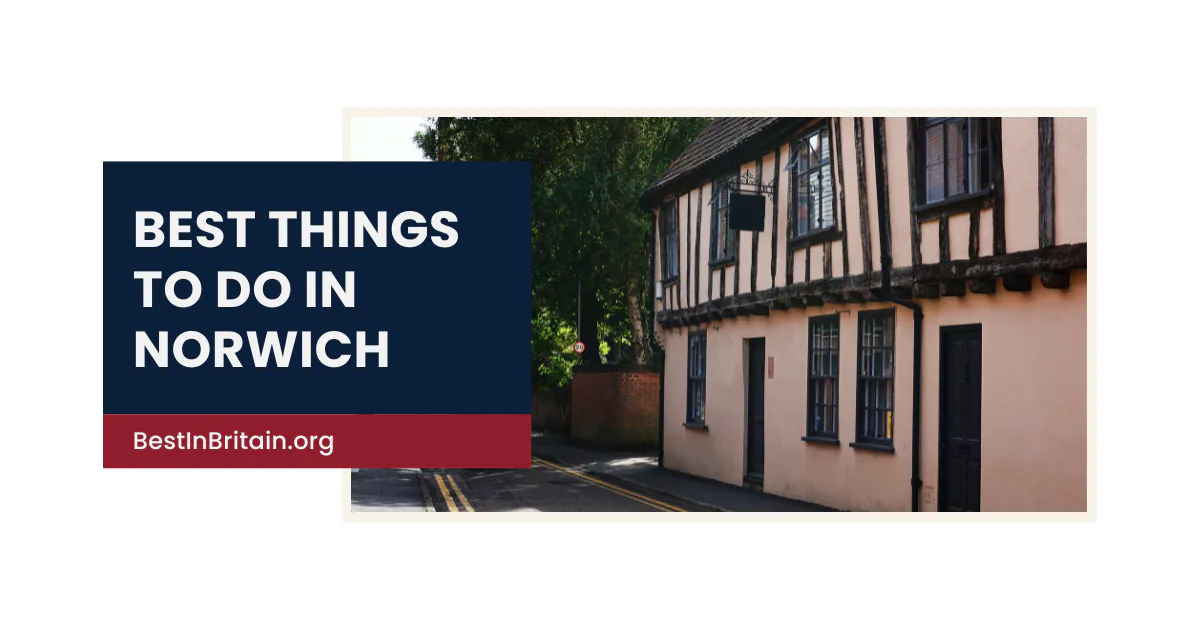
16 best things to do in Norwich for an unforgettable visit
Norwich is a city that rewards curiosity. A few steps away from its busy market, a narrow lane can suddenly reveal a flint-built church, a timber-framed merchant's house or a courtyard that looks much as it might have centuries ago. The effect is not of a city preserved behind glass. People still shop, eat, study, work and live among these historic buildings, and that is a large part of Norwich's appeal.
Once one of England's wealthiest and most important towns, Norwich made much of its fortune from trade and textiles. Its prosperity left behind a Norman castle, two cathedrals, a remarkable concentration of medieval churches and streets that have resisted becoming an interchangeable high street. The city has also embraced a distinctive cultural identity, from independent shops and a lively food market to contemporary art and literature.
What should you see first? For a first visit, we would build a walk around Norwich Castle, the market, Elm Hill and the Cathedral Close. Those places explain the city's shape far better than a hurried circuit of disconnected landmarks. With another day, add a museum that interests you, the River Wensum and one of the green spaces beyond the busiest streets.
This guide keeps the best-known sights alongside places that deserve more attention. It also makes the practical distinctions clear: some historic buildings are open every day, others only on selected dates; some outdoor attractions need a few minutes, while others justify a half-day. The aim is not to tick off all 16 in one visit, but to help you make good choices and leave room to discover Norwich for yourself.
Where to begin: a quick guide to Norwich
| If you want to... | Start with... | Why it stands out |
|---|---|---|
| Understand Norwich's history | Norwich Castle | Norman architecture and wide-ranging museum collections |
| Experience the city's medieval character | Elm Hill and Cathedral Close | Historic streets best explored slowly |
| Find an affordable local lunch | Norwich Market | Independent traders in the heart of the centre |
| See how Norwich people lived | Strangers' Hall or the Museum of Norwich | Domestic life, trades and everyday history |
| Enjoy a quieter afternoon | Plantation Garden or the River Wensum | Greenery and water within reach of the centre |
| Spend longer outdoors | Whitlingham Country Park | Lakeside paths and space to walk or cycle |
| Take a countryside day trip | Blickling Estate | Jacobean architecture, gardens and parkland |
These are starting points, not a ranking. The city's greatest advantage is that its central history is easy to explore on foot, leaving you free to mix major sights with smaller discoveries.
Historic and cultural things to do in Norwich
1. Explore Norwich Castle Museum and Art Gallery

Business details
Address
Castle Hill, Norwich NR1 3JU
Operating hours:
- Monday to Sunday: 10 am to 5 pm
- Last entry: 4:30 pm
- Seasonal and festive variations may apply
Price: £££
Norwich Castle is the city’s defining landmark. Built as a Norman royal palace, its great stone keep has recently undergone a major redevelopment that restores the scale and atmosphere of the medieval interior.
Visitors can explore reconstructed royal spaces, new galleries on medieval life, archaeological collections, fine art and natural history. Roof-level access also provides elevated views across Norwich.
The castle’s long history as a palace, prison and museum makes it far more than a single-period attraction.
The most important improvement to the visitor experience is the ability to understand the keep as a building rather than merely admire it as a monumental shell. Its reinstated floors help make sense of a royal residence whose scale is difficult to grasp from the outside. That matters in a city where medieval history is so visible on the streets but not always explained.
There is a choice to make once inside. Visitors interested primarily in the castle's Norman story should give proper time to the keep; those who enjoy art or local history should avoid using all their time before reaching the collections. Families can approach the castle as a journey through different periods of Norwich's past, rather than expecting a single themed experience.
Worth knowing: Norwich Castle is a strong first stop because it puts later walks through the old city into context. Do not confuse the hours of the castle with those of the city's smaller museums, which may have more restricted schedules.
Pro tip:
Allow at least two to three hours. The restored keep and wider museum collections are substantial enough to fill most of a morning or afternoon.
2. Visit Norwich Cathedral

Business details
Address
65 The Close, Norwich NR1 4DH
Contact details: +44 1603 218300
Operating hours:
- Open daily from 7:30 am
- Generally closes at 6 pm, with later summer closing on selected dates
- Visitor access can change for services and events
Price: Free, with donations welcomed
Norwich Cathedral is one of the finest Romanesque buildings in England. Its tall spire, Norman nave, medieval cloisters and extensive Cathedral Close create one of the city’s most impressive historic settings.
Inside, visitors can see carved roof bosses, stained glass, medieval monuments and a large cloister that remains unusually complete.
The cathedral is still a working place of worship and often hosts concerts, exhibitions and seasonal events.
The cathedral's architecture invites two different kinds of visit. You can absorb the sheer proportions of the nave and spire in a few moments, or spend much longer studying the carved roof bosses, chapels and cloister. The second approach is the more rewarding one. Small medieval details have a way of disappearing when visitors focus only on the grandest views.
The surrounding grounds are not incidental scenery. They form part of a living religious precinct, making the cathedral feel rooted in the city rather than isolated as a tourist attraction. Services and community events continue, so a little sensitivity around worship and photography is appropriate.
A useful distinction: This is Norwich Cathedral, the Anglican cathedral. The city also has the Roman Catholic Cathedral of St John the Baptist, which is near the Plantation Garden and deserves consideration if ecclesiastical architecture is a particular interest.
Pro tip:
Do not miss the cloisters. The carved bosses and changing views of the cathedral tower are among the strongest parts of the visit.
3. Walk around Cathedral Close

Business details
Address
The Close, Norwich NR1
Operating hours:
- Public outdoor areas are generally accessible throughout the day
Price: Free
Cathedral Close is one of the largest and best-preserved cathedral precincts in Britain.
Historic houses, flint walls, gateways, gardens and old institutional buildings surround Norwich Cathedral. The area feels remarkably peaceful despite being only minutes from the commercial centre.
Pulls Ferry and the riverside sit at the eastern edge, while Elm Hill and Tombland are close by.
The pleasure of Cathedral Close lies in what you notice between the obvious landmarks: old doorways, fragments of flint wall, small gardens and the contrast between formal cathedral architecture and domestic buildings. It is worth resisting the urge to walk straight through to the next attraction.
The Close can be particularly appealing after time spent in Norwich Market or the busier shopping streets. Although the city centre is compact, the atmosphere changes dramatically within a short distance. Approaching the river past Pulls Ferry also illustrates how closely the cathedral precinct relates to Norwich's waterways.
How to experience it: Give yourself time to wander within publicly accessible routes, while respecting private homes, institutional buildings and areas reserved for cathedral activities.
Pro tip:
Enter through Ethelbert Gate, explore the quieter lanes behind the cathedral and continue towards Pulls Ferry for the most complete route.
4. Wander along Elm Hill

Business details
Address
Elm Hill, Norwich NR3
Operating hours:
- Street accessible at all times
- Individual businesses keep separate hours
Price: Free
Elm Hill is Norwich’s most famous medieval street. Timber-framed buildings, cobbles, small courtyards and old merchant houses create one of the most atmospheric streets in East Anglia.
Much of the area was rebuilt after a major fire in the early 16th century, although its layout and surviving buildings still reveal the scale of Norwich’s medieval prosperity.
Today, the street contains independent shops, galleries and cafés.
Elm Hill is frequently described as a medieval street, but its fascination is also in the layers of rebuilding, repair and continued use. The timber-framed façades are not identical, and looking at their different proportions offers a better experience than taking one photograph and leaving.
This is a place to explore rather than a major attraction with a ticketed entrance. You may find an independent shop worth entering or a quiet corner that offers a different view of the buildings. Those small encounters are part of its character.
Editorial choice: If you only have time for one atmospheric street in Norwich, Elm Hill is a compelling contender. But it is best understood as part of a walk linking Tombland, Cathedral Close and the river, not as a destination requiring a long visit on its own.
Pro tip:
Visit before 10 am or late in the afternoon. The street is at its most atmospheric when it is quieter.
5. Explore Tombland and the historic lanes

Business details
Address
Tombland, Wensum Street and surrounding streets, Norwich NR3
Operating hours:
- Public streets are accessible at all times
Price: Free
Tombland was Norwich’s main marketplace before the Norman cathedral was built. Despite the name, it is not connected with tombs; the word refers to an open space.
The area contains historic buildings, old inns and routes leading towards the cathedral, Elm Hill and the River Wensum.
Nearby lanes preserve flint walls, medieval street patterns and architecture from several periods.
Tombland gives a useful clue to the city's evolution. Streets and spaces that now feel like picturesque connections were once central to civic and commercial life. Exploring them reveals how the arrival of the Norman cathedral reshaped the surrounding neighbourhood.
Look for the variety of materials and building periods rather than expecting one continuous medieval streetscape. Norwich's older quarters developed over many centuries, and that mixture is more revealing than a perfectly preserved reconstruction would be.
Why include it: Tombland is easy to overlook on a list of attractions because it is a district rather than a museum. In practice it is one of the best places to connect Norwich's history into a coherent walking route.
Pro tip:
Use Tombland as the link between the cathedral and Elm Hill rather than treating the two attractions as separate stops.
6. Visit Strangers’ Hall

Business details
Address
Charing Cross, Norwich NR2 4AL
Operating hours:
- Opening days are limited and vary seasonally
- Check the official museum calendar before travelling
Price: ££
Strangers’ Hall is a historic merchant’s house with rooms spanning several centuries.
Furnished interiors reveal how wealthy Norwich residents lived from the medieval period through to the Victorian era. The maze-like building includes a great hall, bedrooms, domestic rooms and hidden staircases.
Its name recalls the skilled textile workers, many from the Low Countries, who settled in Norwich and contributed significantly to the city’s prosperity.
Where Norwich Castle tells a monumental story of royal and civic power, Strangers' Hall brings history down to the scale of rooms, furnishings and family life. Its unusual plan reflects a building altered and extended across generations. That complexity is part of the interest rather than a drawback.
The house also opens up questions about wealth, trade and migration. The word “Strangers” is associated with overseas textile workers who contributed to Norwich's commercial development. Their story is a reminder that the city's celebrated heritage was shaped by people arriving from elsewhere as well as those born locally.
Who will enjoy it: Readers interested in historic interiors, textiles and social history may find Strangers' Hall more memorable than another broad collection museum. Its restricted opening pattern is the main practical limitation.
Pro tip:
Check opening carefully. Strangers’ Hall does not operate on the same daily schedule as Norwich Castle.
7. See the medieval Dragon Hall

Business details
Address
115 to 123 King Street, Norwich NR1 1QE
Operating hours:
- Selected visitor drop-in sessions and guided tours are advertised
- Check the current National Centre for Writing programme before visiting
Price: Selected drop-in visits are free; guided tour donations or event charges may apply
Dragon Hall is a remarkable medieval trading hall built for merchant Robert Toppes during the 15th century.
Its great timber roof and carved dragon reveal the wealth generated by Norwich’s textile and trading industries. The building now forms part of the National Centre for Writing and is not open continuously as a standard museum.
Guided tours and special events provide the best opportunity to enter.
Dragon Hall deserves attention because Norwich's wealth was not created only in castles and churches. Merchant buildings were equally important to the city, and this trading hall offers rare physical evidence of the prosperity generated by commerce. Its roof structure is an architectural highlight, but the history of how the building was later divided and rediscovered is just as interesting.
Today its connection to the National Centre for Writing gives it a contemporary purpose. That combination suits Norwich, a city that draws strength from historic spaces still being used creatively.
Access matters: The National Centre for Writing has advertised selected free visitor drop-in sessions as well as bookable heritage tours. These are not the same as unrestricted daily museum access. Check the current programme for the precise format and dates before planning your visit.
Pro tip:
Book a tour or attend an event rather than relying on spontaneous access.
Markets, museums and city experiences
8. Browse Norwich Market

Business details
Address
Gentleman's Walk, Norwich NR2 1NA
Operating hours:
- Monday to Saturday: daytime trading
- Individual stall hours vary
Price: Free to explore
Norwich Market is one of the largest and oldest open-air markets in England. Its colourful striped roofs cover stalls selling food, produce, flowers, clothing, books, household goods and specialist products.
The market is particularly strong for affordable independent food, with cuisines from around the world represented across its compact rows.
From the upper level around City Hall, visitors can look across the market towards Norwich Castle.
The market is not a decorative backdrop to the city; it is a working part of Norwich's identity. Rows of small stalls reward comparison, especially when choosing lunch. The busiest frontage is not necessarily where you will find the meal that best suits you, so a short circuit before ordering is time well spent.
There is also a useful relationship between the market and the civic architecture around it. Viewed from the steps above, the coloured roofs form a memorable scene framed by City Hall and the castle's commanding position. At ground level, the emphasis shifts to conversations, food and everyday trade.
Our recommendation: Make this your lunch stop rather than treating it as something to squeeze in after eating elsewhere. Check individual opening days, as traders do not all keep exactly the same hours.
Pro tip:
Visit around lunchtime and walk through every row before choosing where to eat. Some of the best traders are hidden away from the main entrances.
9. Visit the Museum of Norwich at the Bridewell

Business details
Address
Bridewell Alley, Norwich NR2 1AQ
Operating hours:
- Opening days and hours vary
- Check the current Norfolk Museums listing before visiting
Price: ££
The Museum of Norwich tells the story of the city’s people, trades and industries.
Its displays cover textiles, shoemaking, chocolate, mustard, printing and other businesses that shaped Norwich. Personal stories and everyday objects show how work and domestic life changed over time.
The museum occupies a historic building that has served several purposes, including as a prison and house of correction.
The Bridewell adds an important everyday perspective to Norwich's story. Textiles may explain its early wealth, but later trades such as shoes, mustard, chocolate and printing tell us how the city adapted economically over time. The exhibits are most effective when you connect them to the streets and commercial buildings outside.
This is a museum for readers who appreciate social history: how people worked, what industries employed local families and how livelihoods changed across generations. It complements the castle instead of simply competing with it.
Planning note: Because opening arrangements can be limited or change, this is a museum to check first when building a history-heavy day. It is not safe to assume every Norwich museum follows the castle's seven-day schedule.
Pro tip:
Visit after Norwich Market. The museum explains the commercial and industrial history behind many of the surrounding streets.
10. See contemporary art at Norwich Arts Centre and East Gallery

Operating hours:
- Varies by exhibition, event and performance
Price: Free to ££
Norwich has a strong contemporary arts scene supported by galleries, performance venues and the city’s university.
Norwich Arts Centre occupies a converted church and hosts live music, comedy and performance. East Gallery presents exhibitions connected with contemporary art, design and creative practice.
The changing programmes mean these venues are most rewarding when visitors check what is on in advance.
Historic Norwich can dominate the conversation, but the city's cultural identity is not confined to its past. Norwich Arts Centre and East Gallery serve different purposes, which is why the programme matters more than the building alone when choosing a visit.
An evening gig in a converted church can provide an entirely different memory of the city from a daytime museum. A contemporary exhibition, meanwhile, offers a chance to engage with present-day artistic practice and the work of students, graduates or established artists, depending on the programme.
How to decide: Look at specific exhibitions and events before travel. Neither venue should be treated as a guaranteed walk-in experience at any arbitrary time.
Pro tip:
Build an evening around a confirmed performance or exhibition rather than treating either venue as a fixed daytime attraction.
11. Walk through The Norwich Lanes

Business details
Address
St Benedicts Street, Pottergate, Bedford Street and surrounding lanes, Norwich NR2
Operating hours:
- Streets are accessible at all times
- Individual businesses keep separate hours
Price: Free to explore
The Norwich Lanes form the independent heart of the city centre. Narrow streets and historic buildings contain cafés, restaurants, record shops, bookshops, boutiques and creative businesses.
The district sits between the market, cathedral quarter and St Benedicts Street, making it easy to include in a central walking route.
Its strongest appeal is the mix of architecture and genuinely independent businesses rather than any single landmark.
Norwich Lanes is where the city's independent identity becomes especially tangible. Its interest is not merely that the streets are old, but that so many of their units continue to be occupied by distinctive businesses. That makes browsing worthwhile even when shopping is not the main purpose of your trip.
There is no prescribed way to explore the district. A record shop, bookseller, coffee stop or small gallery may be more memorable than any single architectural feature. This is one place where deliberately leaving a gap in the itinerary improves the visit.
Our advice: Allow enough time to turn off the most obvious routes. Smaller passages and side streets often reveal the Lanes at their best, while individual shops may have shorter Sunday hours.
Pro tip:
Allow time to explore side streets rather than following only the best-known shopping route.
Outdoor things to do in Norwich
12. Relax in The Plantation Garden

Business details
Address
4 Earlham Road, Norwich NR2 3DB
Operating hours:
- April to September: 9 am to 6 pm
- October to March: 9 am to 4 pm
Price: £2 entry
The Plantation Garden is a restored Victorian garden created inside a former chalk quarry.
Its Gothic fountain, terraces, flower beds, woodland paths and rustic structures create a surprisingly secluded space close to the city centre.
The garden is compact but highly detailed, making it one of Norwich’s best quieter attractions.
The Plantation Garden has a slightly theatrical quality. Once a quarry, it was transformed into a landscaped Victorian retreat filled with features designed to surprise visitors as they move through the space. It is not a vast botanical destination, and judging it by its size misses the point.
The garden's appeal lies in its changes of level, built details and sheltered planting. It is a particularly appealing contrast to the hard surfaces and busy shopping streets of central Norwich.
Current practical detail: The garden's official website lists opening from 9 am to 6 pm from April to September and 9 am to 4 pm from October to March, with £2 admission. Check for special events and changes before travelling.
Pro tip:
Visit in late spring or summer when the planting is at its strongest, and carry coins or use the available donation method for entry.
13. Walk beside the River Wensum

Business details
Address
Riverside paths through central Norwich
Operating hours:
- Public paths are generally accessible throughout the day
Price: Free
The River Wensum winds through Norwich past historic bridges, former industrial sites and quiet green spaces.
Useful sections include the route around Pulls Ferry, Cow Tower, Riverside Walk and paths north-east of the cathedral. The river provides a calmer perspective on the city and connects several important landmarks.
The Wensum is one of the best ways to see how Norwich's natural setting and historic buildings fit together. The riverside is not uniformly picturesque, and that is part of what makes it interesting: former industrial areas, quieter stretches and distinctive structures reflect different phases of the city's development.
The route around Pulls Ferry and Cow Tower is a particularly accessible introduction. From the water you gain different perspectives on the cathedral quarter, while the pace is slower than on the city's principal shopping streets.
Keep it flexible: Rather than committing to an unnecessarily long circuit, choose a short stretch and continue if the weather and your energy allow. Some riverside sections can be wet or uneven after rain.
Pro tip:
Start at Pulls Ferry and follow the river towards Cow Tower for one of the most attractive short walks.
14. Visit Whitlingham Country Park

Business details
Address
Whitlingham Lane, Trowse, Norwich NR14 8TR
Operating hours:
- Country park open daily
- Car park, café and activity hours vary seasonally
Price: Free entry, with charges for parking and activities
Whitlingham Country Park lies just south-east of Norwich and contains lakes, woodland, riverside paths and open grassland.
Visitors can walk or cycle around the Great Broad, watch wildlife or book water-based activities through local operators.
The park feels rural despite being close to the city and is one of the best options for a longer outdoor break.
Whitlingham offers an appealing change of scale after a day among Norwich's narrow streets. The broad water, wildlife habitats and more open paths make it suitable for people who want to spend time outdoors without undertaking a long countryside excursion.
A walk around the Great Broad gives a satisfying sense of distance from the centre, while bookable activities can make it a more active visit. Families may appreciate the space for children to move around, although supervision near open water is essential.
Best use of your time: Treat Whitlingham as a half-day outing rather than a ten-minute stop. Check activity availability and transport before leaving the centre, especially if you are relying on public transport.
Pro tip:
Walk or cycle from Norwich via Trowse if weather allows, avoiding the need to park during busy weekends.
15. Explore Mousehold Heath

Business details
Address
Gurney Road and surrounding access points, Norwich NR1
Operating hours:
- Open at all times
Price: Free
Mousehold Heath is an extensive area of woodland and heathland overlooking Norwich.
Paths cross wooded slopes, open clearings and historic viewpoints. The heath is associated with Kett’s Rebellion of 1549 and has long provided a recreational landscape for the city.
Selected viewpoints offer broad views towards Norwich Cathedral and the centre.
Mousehold Heath shows a very different face of Norwich. Unlike the ordered spaces around the cathedral and civic buildings, its woodland and open heath feel less formal. It is a place to walk with a route in mind, particularly if you are hoping to reach one of the viewpoints.
Its association with Kett's Rebellion adds historical significance to the landscape. The uprising in 1549 was connected with profound tensions around land, enclosure and social inequality, giving the heath a place in the city's political history as well as its recreational life.
Who should go: Visitors seeking a woodland walk or an elevated view will appreciate Mousehold. Those short of time should prioritise central Norwich rather than making the journey solely for a quick photograph.
Pro tip:
Use a map or marked route. The network of paths is larger and less straightforward than it first appears.
Strong day trip near Norwich
16. Visit Blickling Estate

Business details
Address
Blickling, Norwich NR11 6NF
Operating hours:
- Estate, house and garden hours vary by date and season
- The house commonly opens from 11 am to 4 pm during the main season
- Check the National Trust calendar before travelling
Price: £££, free for National Trust members
Blickling Estate is one of Norfolk’s finest country-house experiences and a strong day trip from Norwich.
The Jacobean mansion contains historic interiors, paintings, books and collections connected with generations of owners. Formal gardens, a lake and extensive parkland surround the house.
The estate is often associated with Anne Boleyn’s family, although the present house was built after her lifetime.
Blickling is a reminder that Norwich is also a gateway to the wider Norfolk countryside. Its Jacobean house, gardens and parkland reward a different pace from city sightseeing, and it is easily substantial enough to justify the greater part of a day.
Inside, the collections and historic rooms tell the story of successive owners and their tastes. Outside, the scale of the grounds creates opportunities for longer walks, seasonal colour and time away from Norwich's urban centre.
The Anne Boleyn association is worth understanding accurately: the estate is linked with her family, but the present house was built after her death. Presenting this distinction matters more than repeating a romantic legend.
Our judgement: Blickling is a strong choice when you have already given Norwich itself a proper day. Before setting off, check the National Trust calendar because the house, gardens and parkland do not necessarily share identical opening arrangements.
Pro tip:
Check which parts of the estate are open on your chosen date. The house, gardens and wider parkland can operate on different schedules.
How to make the most of a visit to Norwich
Norwich is highly walkable. A strong first-day route begins at Norwich Castle, continues through the market and Norwich Lanes, then reaches Elm Hill, Tombland and Norwich Cathedral.
The Museum of Norwich and Strangers’ Hall have more limited opening patterns than the castle, so check their schedules before building a museum-heavy itinerary.
The River Wensum, Plantation Garden and Mousehold Heath provide contrasting outdoor experiences. Whitlingham Country Park requires more time and is best treated as a separate half-day.
Norwich railway station is close to the riverside and cathedral quarter. Most central attractions can be reached on foot, while buses or a car are more practical for Blickling Estate and wider Norfolk day trips.
An easy walking route through medieval Norwich
Norwich works best when you follow its streets rather than repeatedly returning to the same starting point. On a first visit, the following route links several of its defining sights without trying to fit a full museum tour into every stop.
Begin at Norwich Castle if you have booked admission. The keep provides a useful sense of the city's Norman history and the importance of its historic centre. Continue towards Norwich Market, where the stalls make a good place for an early lunch or something to eat later.
From the market, move through the Norwich Lanes. This is the point to slow down, browse independent shops and explore whichever side streets catch your attention. Work your way towards Tombland and Elm Hill, where the architectural character changes noticeably.
Enter the Cathedral Close and visit Norwich Cathedral, leaving time for the cloisters and the surrounding precinct. Finish by heading towards Pulls Ferry and the River Wensum. If the weather is pleasant, extend the walk towards Cow Tower.
This is a walking framework, not a promise of fixed journey times. Norwich's cobbles, occasional slopes, museum visits and café stops will all affect how long you spend exploring. You can also reverse the order to suit opening hours.
How to spend two days in Norwich
Day one: The city that trade built
Make your first day an introduction to Norwich's long commercial and architectural history. Norwich Castle is a natural anchor, especially for a first visit. Follow it with Norwich Market, then spend unhurried time around the Lanes, Elm Hill and Tombland.
Leave the afternoon for Norwich Cathedral and its Close. The contrast between the imposing Norman building and the small lanes and houses around it is one of the city's most satisfying experiences.
If you have an evening free, look at the Norwich Arts Centre programme or choose a restaurant in the central neighbourhoods. A city with this much independent character is worth experiencing after museum opening hours.
Day two: A different perspective
Use your second day to explore whichever part of Norwich interests you most. History enthusiasts could choose Strangers' Hall and the Museum of Norwich, provided both are open. Readers and architecture enthusiasts may prefer a scheduled Dragon Hall tour.
For a more relaxed day, visit the Plantation Garden before exploring the River Wensum. Those wanting a larger outdoor experience could spend the afternoon at Whitlingham Country Park or Mousehold Heath.
If you have an extra day and transport arranged, Blickling Estate is the more substantial countryside excursion. It should not displace your first day in Norwich simply because it appears on the same list.
The best free things to do in Norwich
Norwich is particularly generous to visitors who prefer to spend their money on food, shopping or a few carefully chosen admissions. Norwich Cathedral welcomes visitors without a standard entry charge, although donations support its upkeep. The surrounding Cathedral Close, Elm Hill and Tombland can all be explored independently.
Norwich Market is free to browse, as are the public streets of the Norwich Lanes. Around the city, a walk beside the River Wensum provides a different perspective without needing a ticket. Mousehold Heath offers woodland and viewpoints, while Whitlingham Country Park has free general entry, although parking and organised activities may cost extra.
The Plantation Garden is an inexpensive rather than free attraction. Its modest admission charge is worth distinguishing from the open-access parks and streets.
A rewarding low-cost day could include the cathedral, market, Elm Hill and a riverside walk, leaving plenty of room for coffee or lunch from independent traders.
Norwich with children: what works best?
The answer depends on whether your children enjoy interactive history, open spaces or simply having room to explore. Norwich Castle is the most obvious starting point for a family interested in its Norman past and museum collections. The market makes an easy food stop where different tastes can be accommodated.
Whitlingham Country Park is better for families seeking a longer outdoor activity, while Mousehold Heath suits children happy with a woodland walk. The River Wensum route can also work as a shorter outing, with the usual need for care beside the water.
Historic houses such as Strangers' Hall are more likely to appeal to children interested in rooms, objects and stories than those expecting hands-on play throughout. Look for school-holiday activities or special events when planning around younger visitors.
Rather than attempting several museums in succession, combine one substantial cultural attraction with a walk, food stop or outdoor activity.
Where to go in Norwich when it rains
Rain is not a reason to abandon Norwich's historic centre, but it can change the order in which you explore it. Norwich Castle Museum and Art Gallery is a strong choice for an extended indoor visit. The Museum of Norwich and Strangers' Hall can be alternatives if their limited opening days align with your plans.
Norwich Arts Centre and East Gallery may have relevant exhibitions or performances, but check schedules rather than assuming either will be open for casual entry. Norwich Market is an open-air market with stall roofs, not a fully enclosed indoor shopping centre, so it is best approached with suitable clothing when the weather is poor.
The city's medieval streets can still be atmospheric in rain, though cobbles may become slippery. Save longer walks at Whitlingham or Mousehold for better conditions if flexibility allows.
When is the best time to visit Norwich?
Late spring and summer are attractive for outdoor walking, gardens and longer days, particularly if you hope to include the Plantation Garden, riverside or Blickling Estate. Popular weekends and school holidays can be busier in central areas.
Autumn suits a city break focused on architecture, museums and independent shopping. Garden and country-house schedules may become more restricted later in the season.
Winter is still worthwhile for Norwich's indoor culture and historic streets, but shorter daylight hours make a tightly planned itinerary less useful. Always confirm festive opening and museum schedules in advance.
The day of the week can be as important as the season. Norwich Market normally trades Monday to Saturday, while some smaller museums open on selected days. If those attractions matter to you, build your dates around their confirmed schedules rather than fitting them in afterwards.
Getting to Norwich and travelling around
Norwich railway station provides a straightforward arrival point for visitors using rail. From there, you can walk towards the riverside and cathedral quarter before moving deeper into the centre. It is possible to enjoy much of historic Norwich without a car.
For the main city attractions, walking is often more pleasant than repeatedly driving between car parks. However, be prepared for cobbled streets and uneven surfaces in older quarters, and check accessibility details for historic properties with stairs.
Buses and taxis are useful for longer cross-city journeys. Whitlingham Country Park is a more involved excursion than a central sightseeing stop, while Blickling Estate requires separate transport planning, especially for visitors without a car.
Frequently asked questions about things to do in Norwich
Is Norwich worth visiting for a weekend?
Yes. Norwich offers enough museums, historic streets, churches, shops, cultural venues and riverside routes to fill two days without relying on a long excursion. Its compact centre is especially helpful for visitors who enjoy exploring on foot.
What is Norwich best known for?
Norwich is known for its Norman castle, cathedral, medieval heritage, historic market and independent cultural life. The city's former wealth from textiles and trade helps explain the number and quality of its surviving historic buildings.
What are the must-see attractions in Norwich?
For a first visit, Norwich Castle, Norwich Cathedral, Elm Hill, Cathedral Close and Norwich Market provide a strong introduction. Their appeal is enhanced by exploring the streets between them rather than visiting each in isolation.
Can you see Norwich in one day?
You can see several major sights in one day, particularly the castle area, market, Cathedral Close and Elm Hill. However, a full tour of the castle plus additional museums leaves less time for leisurely walking. Two days make the experience more relaxed.
What is there to do in Norwich for free?
Walk around Cathedral Close, Elm Hill and Tombland, browse Norwich Market and the Lanes, visit Norwich Cathedral and follow suitable public stretches of the River Wensum. Mousehold Heath and general access to Whitlingham Country Park are further free options.
Is Norwich good for shopping and independent businesses?
Yes. Norwich Market and the Norwich Lanes are particularly good starting points for independent food traders, cafés, bookshops, galleries and smaller retailers. The appeal comes from the variety of businesses rather than one single shopping destination.
Is Norwich Castle suitable for children?
It can be, especially for families interested in castles, history and museum collections. Allow time for the restored keep and look for current family activities. Children's interests and attention spans will determine how long the wider collection remains engaging.
Can you go inside Dragon Hall?
Yes, on specified visitor sessions, tours and events. The building is used by the National Centre for Writing and is not a conventional attraction with unrestricted daily museum access. Check the current programme before travelling.
How far is Blickling Estate from Norwich?
Blickling Estate is outside the city near Aylsham in Norfolk, so it is best treated as a dedicated excursion rather than part of the central walking route. Allow time for the house, gardens and parkland, and check transport and opening details.
Is Norwich walkable?
The historic centre is very walkable, with the castle, market, Lanes, cathedral and Elm Hill connected by relatively short urban routes. However, historic surfaces, stairs and uneven pavements may require additional planning for some visitors.
Norwich rewards a slower kind of sightseeing
What makes Norwich special is not merely the number of medieval buildings it has retained. It is how naturally those buildings sit alongside present-day shops, cultural spaces, homes and everyday city life. The past is visible without turning the centre into a museum of itself.
Give the castle and cathedral the attention they deserve, but also make room for the market, a less familiar lane, a riverside walk and the smaller places you discover by chance. The best visit to Norwich is one that leaves space to wander.
Norwich Visitor, Culture & Leisure Market Statistics
Annual Visitor Footfall
2.4M
Annual visitors in Norwich
Tourist & Visitor Spend
£450M
Annual visitor expenditure
Cultural & Leisure Venues
120
Attractions & landmarks
Visitor Stay Profile
70% Day
30% Overnight stays
Primary Attraction & Cultural Hubs in Norwich
- UK1 (Historic Centre & Landmarks)48% focus
- UK2 (Cultural Quarter & Museums)28% focus
- UK3 (Parks & Waterfront Promenade)14% focus
- UK4 (Outer Trails & Heritage Sites)10% focus
Attraction Types & Category Breakdown
- Museums & Cultural Heritage38% of venues
- Parks, Nature & Scenic Walks26% of venues
- Historic Architecture & Landmarks20% of venues
- Guided Tours & Family Attractions16% of venues
Related guides

Things to Do
25 best Christmas markets in the UK
Discover 25 of the best Christmas markets in the UK, from Bath's Georgian streets and Birmingham's Frankfurt market to cathedral fairs, city festivals and historic estate markets.
Updated 26 September 2026

Things to Do
20 best places for a romantic weekend in the UK
Discover 20 of the best places for a romantic weekend in the UK, from historic cities and coastal towns to countryside escapes, islands and mountain retreats across all four nations.
Updated 26 September 2026

Things to Do
Top Escape Rooms in Edinburgh for a Thrilling Challenge
A researched guide to Edinburgh escape rooms offering historical mysteries, cinematic adventures, magical puzzles, detective stories and team-building games.
Updated 1 August 2026

Things to Do
Best Jazz Clubs in London for Live Music
A current guide to six London jazz clubs and live-music venues, covering ticket prices, seating, food, age rules, accessibility, jam sessions and the different styles each venue presents.
Updated 22 July 2026
Things to Do
20 best things to do in Bath for an unforgettable visit
Discover the best things to do in Bath, from the Roman Baths and Thermae Bath Spa to Georgian landmarks, museums, gardens, riverside walks and memorable local experiences.
Updated 21 July 2026

Things to Do
17 best things to do in Inverness for an unforgettable Highland visit
Discover the best things to do in Inverness, from the new castle experience and River Ness walks to Culloden, Clava Cairns, Loch Ness and memorable Highland day trips.
Updated 21 July 2026
Know a business we should consider?
Send us the details and our editorial team will review whether it fits a future guide.
Submit businessWriter profile
Gabriela Krumova
Arts, Culture & Performance Contributor
Actor, theatre director and Queen Margaret University Drama graduate with international performance experience across Edinburgh, London, New York, Paris and Venice. Gabriela has performed in and directed Edinburgh Festival Fringe productions and covers theatre, performing arts, cultural venues, live entertainment, festivals and the creative industries for Best in Britain.
Editorial Trust Standard
Independent ReviewIndependent Research
Featured rankings are editorially determined. Commercial partner listings are strictly labeled as Sponsored or Featured.
Public Register Audit
Listings are cross-checked against public regulatory registries, Companies House filings, and published fee schedules.
Regional Directory