
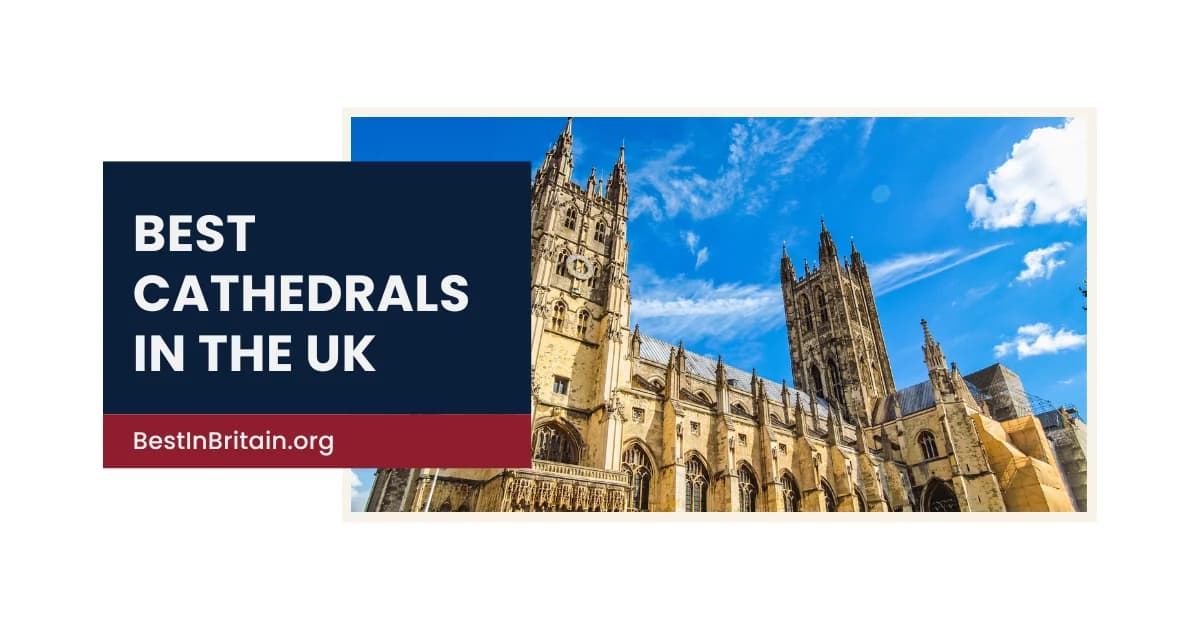
The finest cathedrals in the UK are more than large churches. They are places where architecture, music, pilgrimage, politics, craftsmanship and local identity have accumulated across centuries. Some still preserve the scale and ambition of medieval building campaigns, while others were created after war, industrial expansion or major shifts in modern worship.
A rewarding cathedral visit is rarely limited to the nave. Cloisters, crypts, chapter houses, libraries, towers, memorials and fragments of earlier buildings often tell the fuller story. Even the most famous sites remain active places of prayer, so visitors may encounter rehearsals, services, school groups, conservation work or temporary closures.
This guide brings together 20 of the best cathedrals in the UK. The selection includes major landmarks in England alongside significant cathedrals in Wales, Scotland and Northern Ireland, with a mixture of medieval, Victorian and modern architecture.
Visiting arrangements, admission charges and opening hours can change around worship and special events. Always check the official website before travelling.
How we selected the best cathedrals in the UK
Our editorial selection considered:
- Architectural importance: Buildings that represent an important style, period or moment in British architectural history.
- Historic significance: Cathedrals connected with pilgrimage, monarchy, conflict, reform or major national events.
- Interior quality: Stained glass, sculpture, woodwork, monuments, vaulting and other features that reward close attention.
- Visitor experience: Enough depth to justify a dedicated visit, with useful interpretation and access where possible.
- Living tradition: Music, worship and community life remain central to what makes a cathedral distinctive.
- Geographical range: A selection extending beyond the most famous English sites.
Cathedrals in England
1. Canterbury Cathedral, Kent
Location: Canterbury, Kent
Best for: Pilgrimage history, medieval architecture and stained glass
Allow: Half a day
Canterbury Cathedral stands at the centre of English Christian history. Founded in the late sixth century and later rebuilt on a far grander scale, it became one of medieval Europe's most important pilgrimage destinations following the murder of Archbishop Thomas Becket in 1170.
The building contains several distinct architectural periods. Norman work survives around the crypt, while the choir and Trinity Chapel show the development of early Gothic design. Medieval stained glass, royal tombs and memorials connected with Becket give the cathedral an exceptional concentration of historical material.
The wider precincts also matter. Cloisters, gardens and associated buildings help visitors understand that this was once a complete religious community rather than an isolated monument.
Why it stands out:
Canterbury combines national importance with extraordinary architectural depth. Few places in Britain connect pilgrimage, monarchy, literature and church history so directly.
Good to know:
Admission normally covers the precinct as well as the main cathedral. Services and major events can affect access to particular areas.
2. York Minster, North Yorkshire
Location: York, North Yorkshire
Best for: Medieval stained glass and monumental Gothic architecture
Allow: Half a day
York Minster dominates the historic centre of York and contains one of the finest collections of medieval stained glass in Europe. The Great East Window is the most famous example, but the Five Sisters Window, rose window and numerous smaller panels reward a much slower visit.
The nave has a remarkable sense of scale, while the chapter house introduces a more intimate circular space filled with carved details. Below ground, the undercroft presents evidence of the Roman and Norman structures beneath the present building.
For visitors comfortable with heights and steps, the central tower provides broad views across York and the surrounding landscape.
Why it stands out:
York Minster is one of Britain's most complete Gothic experiences. Architecture, glass, archaeology and the surrounding medieval city reinforce one another.
Good to know:
Tower access is ticketed separately and involves a demanding spiral climb. Check weather and access restrictions before booking.
3. Durham Cathedral, County Durham
Location: Durham
Best for: Norman architecture, pilgrimage and dramatic setting
Allow: Half a day
Durham Cathedral occupies a commanding position above the River Wear beside Durham Castle. Built largely during the late 11th and early 12th centuries, it is one of the most powerful surviving expressions of Norman architecture.
Its massive piers, carved geometric patterns and early ribbed vaulting give the nave a visual force unlike the lighter Gothic cathedrals that followed. The cathedral was built to house the shrine of St Cuthbert and also contains the tomb of the Venerable Bede.
The peninsula setting completes the experience. Approaching through the old city or viewing the cathedral from the river paths makes its historic authority immediately clear.
Why it stands out:
Durham feels architecturally unified and emotionally direct. Its scale, stonework and setting create one of the strongest cathedral experiences in Britain.
Good to know:
General cathedral entry is normally free, with donations encouraged. Museum, tower and specialist experiences may have separate charges.
4. Salisbury Cathedral, Wiltshire
Location: Salisbury, Wiltshire
Best for: Early English Gothic architecture, Magna Carta and elegant proportions
Allow: Half a day
Salisbury Cathedral is unusually coherent because most of the main building was completed within a relatively concentrated period. Its pale stone, pointed arches and long lines make it one of the clearest examples of Early English Gothic architecture.
The spire, added after the main body, is the tallest in Britain and can be explored through selected tower tours. Inside, visitors can see the medieval clock and one of the best-preserved surviving originals of Magna Carta.
The cathedral close is among the most attractive in England, with lawns, historic houses and views that allow the building to be appreciated from several angles.
Why it stands out:
Salisbury combines architectural consistency with nationally important objects. It feels refined rather than overwhelming.
Good to know:
Tower tours involve narrow stairs and height exposure. Magna Carta access may be affected by conservation or special arrangements.
5. St Paul's Cathedral, London
Location: City of London
Best for: Baroque architecture, national memorials and skyline views
Allow: Two to four hours
St Paul's Cathedral is Christopher Wren's defining architectural achievement and one of London's most recognisable landmarks. Rebuilt after the Great Fire of 1666, it replaced the medieval cathedral with a monumental English Baroque design centred on its great dome.
The interior contains grand ceremonial spaces, mosaics, sculpture and memorials to figures from military, political and cultural history. The crypt includes the tombs of Wren, Nelson and Wellington.
Visitors able to manage the climb can continue into the dome galleries, eventually reaching outdoor viewpoints across central London.
Why it stands out:
St Paul's combines architecture with national ceremony. Its history encompasses royal occasions, wartime symbolism, state funerals and major public services.
Good to know:
Sightseeing admission is charged, while worship remains free. Dome access can close because of weather, services or maintenance.
6. Lincoln Cathedral, Lincolnshire
Location: Lincoln
Best for: Gothic architecture, carved detail and hilltop views
Allow: Half a day
Lincoln Cathedral rises above the city from the steep historic quarter and can be seen from miles across the surrounding countryside. The building developed across several medieval campaigns, creating a rich mixture of Romanesque remnants and Gothic work.
The nave, choir and chapter house contain remarkable vaulting and sculpture. The Lincoln Imp, a small carved figure surrounded by local legend, is only one detail among hundreds worth noticing.
For part of the Middle Ages, the cathedral's central spire may have made it the tallest building in the world before its collapse in the 16th century.
Why it stands out:
Lincoln has the scale of a major national monument but often feels less crowded than Canterbury or York. Its exterior silhouette and interior craftsmanship are equally impressive.
Good to know:
The cathedral sits at the top of a steep hill. Allow time to explore the surrounding castle and historic streets as well.
7. Ely Cathedral, Cambridgeshire
Location: Ely, Cambridgeshire
Best for: The Octagon, painted ceilings and Fenland setting
Allow: Half a day
Ely Cathedral rises dramatically above the flat Fenland landscape, earning its long-standing description as the Ship of the Fens. Its most distinctive feature is the Octagon, created after the collapse of the original central tower in the 14th century.
The vast timber lantern appears almost weightless from below and creates a crossing unlike any other in Britain. The cathedral also contains a richly painted nave ceiling, medieval monastic spaces and the Stained Glass Museum.
Because Ely is compact, the cathedral remains closely connected to the surrounding streets and green spaces.
Why it stands out:
The Octagon alone would justify the journey. It is an ingenious architectural response to disaster and one of medieval Britain's great engineering achievements.
Good to know:
Specialist tours may provide closer views of the Octagon and roof spaces. These usually require advance booking and involve stairs.
8. Wells Cathedral, Somerset
Location: Wells, Somerset
Best for: Sculpted west front, medieval engineering and intimate cathedral-city atmosphere
Allow: Half a day
Wells Cathedral has one of the most celebrated west fronts in England, covered with medieval sculpture arranged across a vast architectural screen. Inside, the scissor arches beneath the central tower provide an equally distinctive sight.
These great curved supports were introduced to stabilise the structure, but their bold form gives the crossing an unexpectedly modern appearance. The chapter house, reached by a worn medieval staircase, is another highlight.
The cathedral sits beside Vicars' Close and the Bishop's Palace, making Wells one of the most complete cathedral-city visits in the country.
Why it stands out:
Wells combines monumental artistry with a compact and atmospheric setting. Its engineering solutions are as memorable as its decorative work.
Good to know:
The cathedral is an active place of worship and may close sections around services. Check whether the chapter house is accessible.
9. Winchester Cathedral, Hampshire
Location: Winchester, Hampshire
Best for: Royal and literary history, long nave and medieval burials
Allow: Half a day
Winchester Cathedral has one of the longest medieval naves in Europe and a history tied closely to the development of the English kingdom. Earlier churches on the site were associated with Anglo-Saxon rulers before the present cathedral expanded through Norman and Gothic phases.
The building contains mortuary chests associated with early kings, the grave of Jane Austen and the Winchester Bible, one of the great surviving illuminated manuscripts of the 12th century.
Flooded foundations created serious structural problems in the early 20th century, and the story of diver William Walker's work beneath the building adds an unexpected chapter to the visit.
Why it stands out:
Winchester's history moves from Anglo-Saxon monarchy to modern literary pilgrimage. The cathedral rewards visitors interested in both national history and individual lives.
Good to know:
Some treasures are displayed only under controlled conditions. Guided tours provide useful context for the complex building history.
10. Gloucester Cathedral, Gloucestershire
Location: Gloucester
Best for: Perpendicular Gothic architecture, cloisters and royal history
Allow: Two to three hours
Gloucester Cathedral developed from a Benedictine abbey and contains architecture from Norman to late Gothic periods. Its choir is one of the great achievements of Perpendicular design, with vertical lines and large windows transforming the earlier structure.
The fan-vaulted cloisters are the most immediately recognisable part of the cathedral and have appeared in film and television productions. They remain significant regardless of screen associations because of their architectural originality.
The tomb of Edward II helped secure the medieval abbey's wealth and influence, leaving the cathedral with an important connection to royal history.
Why it stands out:
Gloucester offers striking contrasts between heavy Norman masonry and later Gothic lightness. The cloisters are among the finest surviving monastic spaces in Britain.
Good to know:
Entry is generally donation-supported, although tours and special areas may cost extra. Check filming or event closures.
11. Liverpool Cathedral, Merseyside
Location: Liverpool
Best for: Monumental modern Gothic architecture and city views
Allow: Two to three hours
Liverpool Cathedral demonstrates that the great age of cathedral building did not end in the Middle Ages. Designed by Giles Gilbert Scott and constructed across much of the 20th century, it is the largest cathedral in Britain.
The vast interior uses Gothic principles on an industrial-city scale. Towering arches, dark red stone and carefully controlled light create a sense of grandeur quite different from a medieval church.
The tower offers expansive views over Liverpool, the Mersey and beyond when open. Exhibitions, music and large-scale installations also make the cathedral an active cultural venue.
Why it stands out:
Liverpool Cathedral is both traditional and modern. It adapts Gothic architecture to the ambitions and materials of the 20th century without becoming a historical copy.
Good to know:
General entry is usually free. Tower access, tours and some events are separately ticketed.
12. Coventry Cathedral, West Midlands
Location: Coventry
Best for: Modern sacred architecture, wartime history and reconciliation
Allow: Two to three hours
Coventry Cathedral is best understood as a pair of buildings. The ruins of the medieval cathedral remain beside the modern cathedral created after the destruction of the city centre during the Second World War.
Basil Spence's new building uses modern art and architecture to address loss, renewal and reconciliation. Graham Sutherland's tapestry, John Piper's stained glass and Jacob Epstein's sculpture are integral to the building rather than secondary decoration.
The open ruins preserve the scale of the destroyed church and create a direct emotional transition into the new cathedral.
Why it stands out:
No other British cathedral presents destruction and rebuilding so clearly. Coventry is one of the country's most important works of post-war architecture.
Good to know:
Visit the ruins before entering the modern cathedral. Access may change around services, events and conservation work.
13. Norwich Cathedral, Norfolk
Location: Norwich
Best for: Norman architecture, cloisters and medieval roof bosses
Allow: Two to three hours
Norwich Cathedral is one of England's great Norman buildings. Its long nave, pale stone and soaring tower retain much of the confidence of the original monastic church.
The cloisters are unusually large and contain hundreds of carved roof bosses illustrating biblical scenes, saints, everyday life and imaginative creatures. The close remains an attractive historic district within the city.
The cathedral is also known for its peregrine falcons, which have nested on the spire and can sometimes be observed through seasonal viewing arrangements.
Why it stands out:
Norwich offers a coherent medieval environment inside and outside the building. Its cloisters deserve far more attention than a quick walk through.
Good to know:
General entry is normally free, with donations encouraged. Check access to upper-level or specialist tours.
14. Westminster Cathedral, London
Location: Victoria, London
Best for: Byzantine Revival architecture, mosaics and Catholic heritage
Allow: One to two hours
Westminster Cathedral is the mother church of the Roman Catholic Church in England and Wales. Built around the turn of the 20th century, it offers a striking contrast to the Gothic architecture often associated with British cathedrals.
Its striped brick exterior and tall campanile lead into a vast Byzantine-inspired interior. Some surfaces remain intentionally unfinished, while chapels and mosaics reveal successive phases of decoration.
The result is a building that feels both complete in scale and visibly ongoing in artistic development.
Why it stands out:
Westminster Cathedral broadens the architectural story of British sacred buildings. Its dark interior, marble work and mosaics create an atmosphere entirely different from nearby Westminster Abbey.
Good to know:
This is an active place of worship with frequent services. Sightseeing should remain quiet and respectful, particularly around the sanctuary.
Cathedrals in Wales
15. St Davids Cathedral, Pembrokeshire
Location: St Davids, Pembrokeshire
Best for: Pilgrimage, Welsh Christian history and dramatic coastal setting
Allow: Half a day
St Davids Cathedral sits in a sheltered hollow below Britain's smallest city, hidden from view until visitors approach the cathedral close. Its location reflects centuries of pilgrimage to the shrine of St David, Wales's patron saint.
The building contains a richly carved timber ceiling, medieval tombs, chapels and the restored shrine of St David. The adjacent ruins of the Bishop's Palace show the former wealth and status of the medieval diocese.
The wider Pembrokeshire landscape makes this more than an architectural visit. Coastal walks and ancient religious sites reinforce the sense of pilgrimage.
Why it stands out:
St Davids combines national spiritual importance with an unusually remote and beautiful setting. It feels connected to the landscape as much as to the city.
Good to know:
The cathedral is reached by a sloping approach and steps from parts of the city. Check accessible routes in advance.
16. Llandaff Cathedral, Cardiff
Location: Llandaff, Cardiff
Best for: Medieval fabric, modern restoration and sacred art
Allow: One to two hours
Llandaff Cathedral stands in a quiet historic district that feels separate from central Cardiff despite being within the city. The building reflects repeated damage and restoration, including major work after the Second World War.
Its interior combines medieval architecture with modern interventions. Jacob Epstein's sculpture of Christ in Majesty, suspended beneath a concrete arch, is the defining feature and gives the restored nave a powerful focus.
The cathedral close and nearby village streets create a calm setting for a shorter visit.
Why it stands out:
Llandaff shows how modern work can be introduced into a medieval cathedral without disguising the effects of destruction and repair.
Good to know:
General visiting is shaped around worship. Check service times before making a special journey.
Cathedrals in Scotland
17. St Mary's Episcopal Cathedral, Edinburgh
Location: West End, Edinburgh
Best for: Victorian Gothic architecture and choral music
Allow: One to two hours
St Mary's Episcopal Cathedral is one of Edinburgh's major skyline landmarks. Designed by Sir George Gilbert Scott, it was built in the late 19th century and is distinguished by its central spire and two western spires.
The interior is more restrained than the exterior but gains atmosphere from its proportions, stonework and music. The cathedral maintains a strong choral tradition and remains an active centre of Scottish Episcopal worship.
Its West End location makes it easy to combine with Dean Village, the Water of Leith or the city's galleries.
Why it stands out:
St Mary's is one of Scotland's strongest examples of Victorian Gothic Revival architecture and an important reminder that cathedral building continued long after the Reformation.
Good to know:
Visitor access may be limited during rehearsals and services. Music is a central part of the cathedral's identity, so check the programme.
18. Glasgow Cathedral, Glasgow
Location: Cathedral Precinct, Glasgow
Best for: Medieval Scottish architecture and Reformation history
Allow: One to two hours
Glasgow Cathedral is one of the most complete medieval church buildings to survive in mainland Scotland. Although it is now a Church of Scotland place of worship rather than the seat of a bishop, the historic cathedral name remains firmly established.
The building is associated with St Kentigern, also known as St Mungo, whose tomb lies in the lower church. The crypt-like space beneath the choir is one of the cathedral's most atmospheric areas.
Its survival through the Reformation makes Glasgow particularly significant for understanding medieval Scottish religious architecture.
Why it stands out:
Glasgow Cathedral preserves a scale and complexity rarely encountered in surviving Scottish medieval churches.
Good to know:
The nearby Necropolis and Provand's Lordship can be combined with the cathedral for a fuller historic visit.
Cathedrals in Northern Ireland
19. St Anne's Cathedral, Belfast
Location: Cathedral Quarter, Belfast
Best for: Modern history, mosaics and Belfast's Cathedral Quarter
Allow: One to two hours
St Anne's Cathedral stands at the heart of Belfast's Cathedral Quarter and developed alongside the modern city during the 20th century. Its Romanesque-inspired architecture feels solid and restrained, while the interior contains mosaics, sculpture, textiles and memorials connected with Belfast and Northern Ireland.
The cathedral is unusual in serving two Church of Ireland dioceses and contains two bishop's seats. The Spire of Hope rises through the roof and has become one of the building's most recognisable modern features.
Its location makes it easy to include within a broader exploration of central Belfast.
Why it stands out:
St Anne's reflects the civic and religious history of modern Belfast rather than medieval monastic power. Its story is closely tied to the city around it.
Good to know:
Visitor admission arrangements can vary, and guided tours may be available. Check around services and events.
20. St Patrick's Cathedral, Armagh
Location: Armagh
Best for: Irish Christian history and commanding city views
Allow: One to two hours
Armagh has been associated with St Patrick and the ecclesiastical history of Ireland for more than a millennium. The Church of Ireland Cathedral of St Patrick occupies a hilltop site traditionally connected with Patrick's church.
The present building contains medieval and later work, reflecting repeated destruction, rebuilding and restoration. Memorials and church furnishings connect it with the history of the city and the wider Anglican tradition in Ireland.
Armagh is unusual in having two cathedrals dedicated to St Patrick on opposing hills, the other belonging to the Roman Catholic Church.
Why it stands out:
The importance of the site extends beyond the present architecture. Armagh remains one of the central places for understanding Christianity in Ireland.
Good to know:
Make time to view both St Patrick's cathedrals and the city between them. Confirm visitor hours separately for each building.
Other UK cathedrals worth visiting
A list of 20 necessarily leaves out many important buildings. Further strong choices include:
- Exeter Cathedral in Devon
- Peterborough Cathedral in Cambridgeshire
- Worcester Cathedral in Worcestershire
- Hereford Cathedral in Herefordshire
- Chester Cathedral in Cheshire
- Ripon Cathedral in North Yorkshire
- Southwark Cathedral in London
- Liverpool Metropolitan Cathedral
- Arundel Cathedral in West Sussex
- St Magnus Cathedral in Orkney
- Dunblane Cathedral in Stirling
- St Andrew's Cathedral in Glasgow
- Bangor Cathedral in Gwynedd
- Brecon Cathedral in Powys
- St Asaph Cathedral in Denbighshire
- Newport Cathedral in South Wales
- Derry's St Columb's Cathedral
- St Patrick's Roman Catholic Cathedral in Armagh
Best cathedrals for different interests
Best for medieval architecture
Durham, Lincoln, York, Ely, Wells and Norwich provide some of the strongest surviving medieval interiors.
Best stained glass
York Minster is the outstanding choice for medieval glass, while Coventry offers a powerful modern interpretation of stained glass within post-war architecture.
Best for royal and national history
Canterbury, Winchester, St Paul's and Salisbury connect directly with major moments in English political and constitutional history.
Best modern cathedrals
Coventry and Liverpool Cathedral demonstrate two very different approaches to 20th-century cathedral architecture. Westminster Cathedral provides an earlier Byzantine Revival alternative.
Best cathedral settings
Durham's river peninsula, St Davids in coastal Pembrokeshire and Salisbury's cathedral close are among the most memorable settings.
Best for tower views
St Paul's, York Minster, Liverpool Cathedral and Salisbury offer tower or dome experiences when access is available.
How to plan a cathedral visit
Cathedrals are working churches first. A normal sightseeing day can be affected by funerals, ordinations, concerts, rehearsals and seasonal worship without much warning.
Before travelling:
- Check general visiting and service times.
- Book tower tours in advance.
- Confirm photography rules.
- Look for luggage restrictions.
- Check step-free access and accessible entrances.
- Allow time for security checks at major sites.
- Avoid speaking loudly during prayer or worship.
- Consider attending Evensong or another service where appropriate.
- Donate when entry is free if you are able to support maintenance.
Some cathedrals charge admission for sightseeing, while others rely mainly on donations. Specialist tours, towers, museums and exhibitions often cost extra.
Frequently asked questions
What is the largest cathedral in the UK?
Liverpool Cathedral is the largest cathedral in Britain by overall scale. Its vast 20th-century Gothic Revival design makes it one of the country's most imposing religious buildings.
What is the oldest cathedral in the UK?
The answer depends on whether the question refers to the foundation, surviving fabric or continuous cathedral status. Canterbury traces its foundation to 597, while several other sites preserve very early Christian associations and later medieval buildings.
Are UK cathedrals free to enter?
Some are free with donations encouraged, while major visitor destinations such as Canterbury and St Paul's usually charge for sightseeing. Worship remains free.
Can non-religious visitors enter cathedrals?
Yes. Cathedrals welcome visitors interested in architecture, history, music and culture, provided they respect worship and the sacred character of the building.
What should visitors wear?
There is usually no strict dress code for ordinary sightseeing, but clothing should be respectful. Comfortable shoes are useful for stone floors, tower climbs and large precincts.
Can you attend services as a visitor?
Yes. Visitors are generally welcome at public services. Evensong can be a particularly memorable way to experience cathedral music without buying a concert ticket.
Which UK city has two major cathedrals?
Liverpool is known for its Anglican cathedral and Metropolitan Catholic cathedral, linked by Hope Street. Armagh also has two cathedrals dedicated to St Patrick.
Final thoughts
The UK's best cathedrals are not simply ranked by height, age or size. Their value comes from the relationship between architecture and the communities that have used, altered and protected them.
Canterbury and Durham carry the weight of pilgrimage and medieval power. York and Salisbury display the technical confidence of Gothic builders. St Paul's represents the rebuilding of London, while Coventry turns wartime destruction into a continuing message of reconciliation.
In Wales, Scotland and Northern Ireland, cathedrals reveal different religious histories and architectural traditions. St Davids belongs as much to pilgrimage and landscape as to masonry, Glasgow preserves a rare medieval Scottish interior, and Belfast's St Anne's reflects the growth and identity of a modern city.
Visit slowly. Look beyond the main nave, listen when the building is quiet and remember that these are living places rather than museums with altars.
Related articles
Related guides

Religious Heritage
Best Catholic Churches in the UK to Visit
A guide to notable Catholic churches across the UK, covering architecture, history, sacred art, pilgrimage, active worship and practical visitor information.
Updated 2 October 2026
Religious Heritage
Best Orthodox Churches in the UK to Visit
A guide to notable Orthodox churches across the UK, covering their history, traditions, architecture, icons, visitor information and active worship.
Updated 2 October 2026
Religious Heritage
20 best abbeys and monastery ruins in the UK
Explore 20 of the best abbeys and monastery ruins in the UK, from vast Cistercian landscapes and dramatic coastal remains to secluded Border abbeys and ancient island monasteries.
Updated 9 June 2026

Historic Sites
20 best historic houses in the UK to visit
Explore 20 of the best historic houses in the UK, from grand Baroque palaces and Elizabethan halls to royal retreats and richly furnished country estates.
Updated 22 June 2026
Historic Sites
20 best Roman sites in the UK to visit
Explore 20 of the best Roman sites in the UK, from Hadrian's Wall and the baths of Aquae Sulis to villas, legionary fortresses, frontier forts and buried cities.
Updated 17 June 2026

Historic Sites
25 best UNESCO World Heritage Sites in the UK
Explore 25 of the best UNESCO World Heritage Sites in the UK, from Stonehenge and Edinburgh to the Giant's Causeway, Hadrian's Wall and the Flow Country.
Updated 14 June 2026
Know a business we should consider?
Send us the details and our editorial team will review whether it fits a future guide.
Submit businessWriter profile
Gabriela Krumova
Arts, Culture & Performance Contributor
Actor, theatre director and Queen Margaret University Drama graduate with international performance experience across Edinburgh, London, New York, Paris and Venice. Gabriela has performed in and directed Edinburgh Festival Fringe productions and covers theatre, performing arts, cultural venues, live entertainment, festivals and the creative industries for Best in Britain.
Editorial Trust Standard
Independent ReviewIndependent Research
Featured rankings are editorially determined. Commercial partner listings are strictly labeled as Sponsored or Featured.
Public Register Audit
Listings are cross-checked against public regulatory registries, Companies House filings, and published fee schedules.