
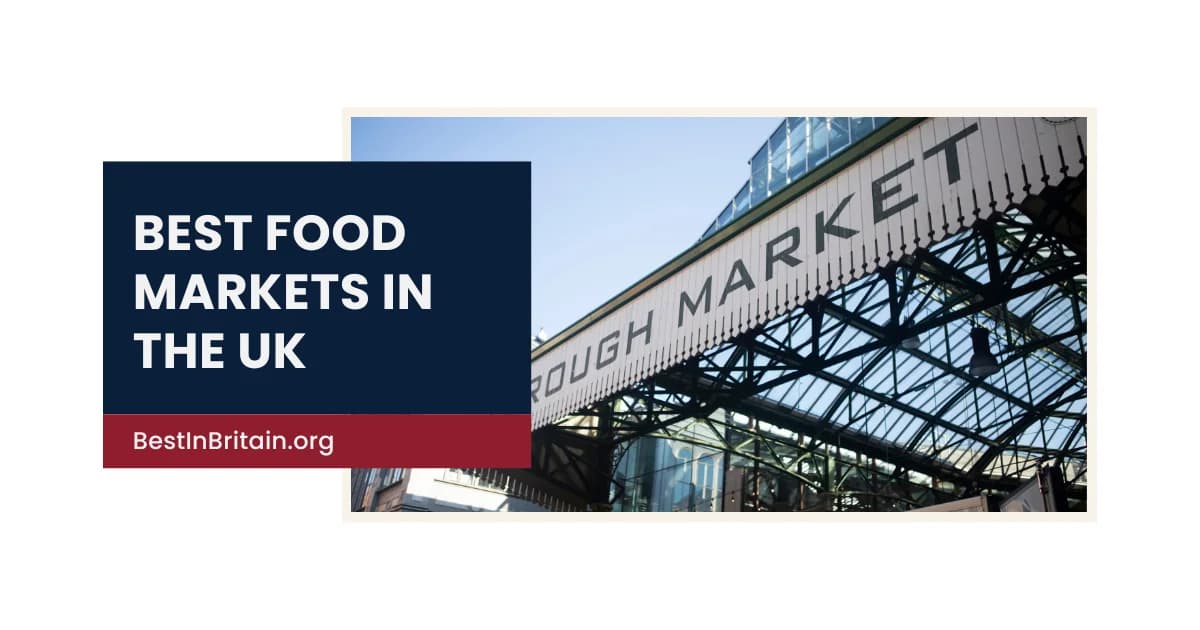
The UK's best food markets are not all built around the same formula. Some are traditional municipal halls where residents still shop for fish, meat, vegetables and household staples. Others are farmers' markets bringing producers into city centres for a few hours each week, while a newer generation of food halls has turned former warehouses, railway arches and market buildings into lively places for street food and independent dining.
A strong food market should offer more than a large number of counters. The most memorable ones have a clear connection with their city or region, whether through local produce, long-established traders, specialist ingredients or a building that remains part of everyday community life.
This guide brings together 25 of the best food markets in the UK. It includes historic institutions such as Borough Market, Norwich Market and St George's Market alongside modern destinations including Baltic Market, Trinity Kitchen and Mackie Mayor.
Trader line-ups, market days and opening times change regularly. Check the official website or social channels before travelling, particularly for weekly and seasonal markets.
How we selected the best UK food markets
Our editorial assessment considered:
- Quality and range: Strong produce, prepared food or specialist ingredients rather than quantity alone.
- Independent character: Markets that provide space for local traders, small producers and regional food businesses.
- Sense of place: A clear relationship with the surrounding city, neighbourhood or farming region.
- Visitor experience: Enough variety and atmosphere to reward a dedicated visit.
- Everyday usefulness: Markets that still serve local shoppers as well as visitors.
- Regional balance: A spread across England, Scotland, Wales and Northern Ireland.
- Format variety: Covered markets, farmers' markets, street-food halls and specialist food destinations.
Food markets in London
1. Borough Market, London
Location: Southwark, London
Market type: Historic produce and street-food market
Best for: Specialist ingredients, serious food shopping and a first London market visit
Borough Market is the most internationally recognised food market in the UK, but its appeal goes beyond reputation. The market combines specialist produce traders, bakers, cheesemakers, butchers, fishmongers and prepared-food stalls within and around its historic railway-side setting.
The strongest way to experience Borough is to treat it as both a shopping market and somewhere to eat. Visitors who arrive only for lunch can miss the traders selling ingredients, regional products and foods intended to be taken home.
Its location near London Bridge, Southwark Cathedral and the Thames makes it easy to incorporate into a wider day. The drawback is popularity: weekday lunchtimes and Saturdays can become extremely crowded.
Why it stands out:
Borough offers one of the deepest and most varied food selections of any market in Britain, with enough substance to satisfy professional cooks as well as casual visitors.
Good to know:
Visit earlier in the day if you want to speak with traders and shop properly. Opening days and individual stall hours vary.
2. Broadway Market, London
Location: Hackney, London
Market type: Saturday street market
Best for: East London atmosphere, bakery stops and independent producers
Broadway Market runs along a compact street between London Fields and Regent's Canal. Its Saturday line-up brings together produce, bread, cheese, condiments, coffee and prepared food alongside non-food traders.
The surrounding permanent cafés, shops and restaurants mean the area remains worth visiting beyond the temporary stalls. A market trip can be combined with a canal walk, London Fields or the wider Hackney neighbourhood.
Broadway is polished and popular, and prices reflect its location. It is better suited to browsing and assembling a picnic than completing an inexpensive weekly shop.
Why it stands out:
Few weekly markets feel so closely integrated with their surrounding street. The neighbourhood businesses and temporary traders support one another rather than operating as separate attractions.
Good to know:
Arrive before the main lunchtime rush. The narrow street becomes congested quickly in good weather.
3. Maltby Street Market, London
Location: Bermondsey, London
Market type: Weekend street-food market
Best for: Railway-arch atmosphere and a more compact alternative to Borough Market
Maltby Street Market occupies Ropewalk beneath and beside the railway arches of Bermondsey. The market is smaller than Borough and focuses more heavily on food and drink ready to consume.
Its scale is part of the appeal. Visitors can compare a manageable number of traders without spending hours navigating a large hall, while nearby arches contain additional food and drink businesses.
The market works especially well as a stop on a walk through Bermondsey, along the Thames or between London Bridge and Southwark.
Why it stands out:
Maltby Street delivers a strong concentration of independent food in a distinctive setting without the scale of London's largest markets.
Good to know:
Seating is limited and the route is narrow. Visit early if you prefer more space.
4. Mercato Metropolitano, Elephant and Castle
Location: Elephant and Castle, London
Market type: Large indoor and outdoor food hall
Best for: Group dining and broad international choice
Mercato Metropolitano brings a wide range of independent kitchens and bars into a large former industrial site. The emphasis is on prepared food rather than traditional grocery shopping, with cuisines represented from across Europe, Asia, Latin America and the Middle East.
Its flexible seating makes it useful for groups whose members want different things. It is also one of London's easier food-market options in mixed weather because substantial parts of the venue are covered.
The atmosphere becomes livelier later in the day, when the space functions as much like a social venue as a market.
Why it stands out:
The breadth of choice and generous communal space make Mercato Metropolitano one of the capital's most practical group food destinations.
Good to know:
Individual kitchens set their own service times. Check the current trader list if visiting for a particular cuisine.
Food markets in southern England
5. St Nicholas Market, Bristol
Location: Corn Street, Bristol
Market type: Historic indoor market with street-food events
Best for: Independent lunches and central Bristol character
St Nicholas Market occupies historic buildings around the Corn Exchange and remains one of central Bristol's strongest independent retail areas. The Glass Arcade and covered sections contain a varied selection of food counters alongside crafts and specialist shops.
The prepared-food offer reflects Bristol's international character, with traders serving dishes from several culinary traditions. Separate street-food and producers' markets also take place on selected days.
Unlike a modern purpose-built food hall, St Nicholas still feels like a mixed city market. That variety helps preserve its local character.
Why it stands out:
St Nicholas combines strong independent food with one of Britain's most attractive historic market settings.
Good to know:
The indoor market and outdoor specialist markets follow different schedules. Check the current programme before travelling.
6. Oxford Covered Market, Oxford
Location: Oxford city centre
Market type: Historic covered market
Best for: Long-established food traders and an easy city-centre lunch
Oxford Covered Market has operated since the 18th century and remains a working collection of food shops, cafés, florists and independent retailers.
The market is not dominated by one large communal seating area. Instead, visitors move between butchers, bakers, produce sellers and small places to eat, giving it the character of a traditional urban market rather than a modern food court.
Its central location makes it easy to combine with the university colleges, libraries and museums.
Why it stands out:
The market retains a balance between everyday food shopping and visitor-friendly dining in the heart of a heavily visited city.
Good to know:
Individual businesses keep different hours, and some close earlier than the wider market building.
7. Cambridge Market Square, Cambridge
Location: Market Square, Cambridge
Market type: Daily outdoor general and food market
Best for: Central location, takeaway lunch and fresh produce
Cambridge's market square sits between the city's historic streets and university buildings. The daily market includes fresh produce, bread, hot food, coffee and other goods, with the precise mix changing through the week.
It is not a destination food hall in the contemporary sense. Its value lies in continuing to function as an open-air city market while providing convenient options for visitors exploring the centre.
Buying lunch here and eating near the river or on one of the city's green spaces can be more enjoyable than joining the busiest café queues.
Why it stands out:
Cambridge Market remains woven into the daily rhythm of the historic centre rather than existing solely as a visitor attraction.
Good to know:
The square is exposed to the weather, and trader attendance can vary.
8. Southampton Street Food Market, Hampshire
Location: Southampton city centre
Market type: Scheduled street-food and specialist market
Best for: Casual city-centre dining and rotating traders
Southampton hosts street-food and specialist market events within its central shopping areas. The changing line-up gives smaller food businesses a visible trading platform and offers an alternative to permanent high-street restaurants.
Because the market is event-led rather than a fixed daily food hall, the exact experience depends on the date. Visitors may encounter regional traders, international street food, baked goods and seasonal events.
It is most useful when planned around the confirmed market calendar rather than treated as a guaranteed everyday attraction.
Why it stands out:
Southampton's rotating market programme introduces independent traders into the centre without requiring a permanent indoor venue.
Good to know:
Check the council's current market schedule before making a dedicated trip.
Food markets in the Midlands and eastern England
9. Birmingham Bull Ring Markets, Birmingham
Location: Birmingham city centre
Market type: Indoor, outdoor and rag markets
Best for: Fresh fish, meat, produce and traditional market shopping
Birmingham's Bull Ring Markets remain a major destination for practical food shopping. The Indoor Market is particularly well known for fish and meat, while the Outdoor Market adds fruit, vegetables and household goods.
This is not a curated street-food hall designed primarily for leisure. It is busy, direct and closely connected with the communities who shop there regularly.
The markets sit beside Birmingham's modern retail core, creating a sharp contrast between traditional stalls and surrounding shopping centres.
Why it stands out:
The Bull Ring Markets preserve the energy and usefulness of a major city produce market rather than turning the market experience into a lifestyle concept.
Good to know:
Different market sections have separate opening days and hours. Bring a shopping bag and expect a lively environment.
10. Leicester Market, Leicester
Location: Leicester city centre
Market type: Historic city market and food hall
Best for: Fresh produce and multicultural ingredients
Leicester Market reflects the city's diverse population through its produce, ingredients and surrounding food businesses. The market has undergone major redevelopment, with food trading increasingly centred around modernised indoor facilities and the historic market area.
Fruit, vegetables, fish, meat and specialist products remain the core attraction rather than prepared street food alone.
Its position near the cathedral, Richard III Visitor Centre and old town makes it easy to combine food shopping with a cultural visit.
Why it stands out:
Leicester's market is most valuable as a working source of ingredients for one of the UK's most diverse food cities.
Good to know:
Redevelopment can affect layouts and trader locations. Check the latest visitor information before arrival.
11. Norwich Market, Norfolk
Location: Norwich city centre
Market type: Permanent outdoor market
Best for: Independent lunches and one of Britain's great market-city settings
Norwich Market fills a prominent central site beneath colourful striped roofs. It is one of the country's largest and oldest permanent outdoor markets, with stalls selling food, produce and general goods.
The prepared-food selection has become a major reason to visit, with traders serving dishes from different cuisines alongside established local favourites. Its compact rows encourage visitors to browse before choosing.
The market sits between City Hall, the Guildhall, the Lanes and the wider historic centre.
Why it stands out:
Norwich combines the everyday character of a municipal market with one of the strongest independent lunch selections outside London.
Good to know:
Not every stall opens every day. Weekday lunch periods can be busy with local workers.
12. Derby Market Hall, Derby
Location: Derby city centre
Market type: Restored indoor market hall
Best for: Historic architecture and a renewed independent-food destination
Derby Market Hall is an important Victorian market building that has undergone substantial restoration and redevelopment. Its renewed role combines independent shopping, produce and food businesses within the historic iron-and-glass structure.
The market's appeal lies partly in seeing a traditional civic building adapted for contemporary use rather than abandoned or replaced.
As with any recently reworked market, the trader mix will continue to evolve, making current information more useful than older reviews.
Why it stands out:
Derby demonstrates how a historic market hall can be restored as a modern independent destination without losing its architectural identity.
Good to know:
Check the latest trader directory and opening arrangements, particularly while the renewed market establishes its regular programme.
Food markets in northern England
13. Altrincham Market and Market House, Greater Manchester
Location: Altrincham
Market type: Traditional market and independent food hall
Best for: Communal dining and a successful town-centre market revival
Altrincham Market combines outdoor and covered market trading with Market House, a communal dining hall occupied by independent kitchens and bars.
The venue became influential as an example of how food could help reinvigorate a traditional market and its surrounding town centre. Visitors can choose from several kitchens while sharing tables in the central hall.
The wider market still matters. Weekend and specialist traders help prevent the destination from becoming only a collection of restaurants.
Why it stands out:
Altrincham helped establish the modern northern food-hall model while retaining a relationship with the older town market.
Good to know:
The market stalls and Market House food operators follow different schedules. Tables can be difficult to find at peak times.
14. Mackie Mayor, Manchester
Location: Northern Quarter, Manchester
Market type: Independent food hall in a restored market building
Best for: Architecture, group dining and central Manchester atmosphere
Mackie Mayor occupies the restored former Smithfield Market building on the edge of Manchester's Northern Quarter. Independent kitchens and bars are arranged around a large central seating area beneath the building's high roof.
The hall suits groups well because diners can order from different operators without splitting up. The architecture gives the experience more character than a conventional restaurant complex.
Mackie Mayor is focused on prepared food and drink rather than produce shopping, so it belongs to the food-hall branch of the market tradition.
Why it stands out:
It pairs one of Manchester's most attractive reused commercial buildings with a carefully selected independent food offer.
Good to know:
The space becomes noisy and busy during peak evenings. Earlier lunches provide a calmer view of the building.
15. Baltic Market, Liverpool
Location: Baltic Triangle, Liverpool
Market type: Indoor street-food market
Best for: Lively weekends, rotating traders and group evenings
Baltic Market helped establish Liverpool's Baltic Triangle as a food and leisure destination. The venue brings independent street-food traders, bars and events into a former industrial setting.
The current line-up typically balances permanent favourites with changing businesses, making repeat visits more varied than a fixed food court.
Its atmosphere becomes increasingly social later in the day, so visitors looking for a quiet meal may prefer an earlier session.
Why it stands out:
Baltic Market remains one of the clearest examples of Liverpool's modern independent street-food culture.
Good to know:
Entry policies, event programming and trader line-ups can change. Check the current details before an evening visit.
16. Trinity Kitchen, Leeds
Location: Trinity Leeds, Leeds city centre
Market type: Indoor rotating street-food hall
Best for: Weather-proof variety and easy central access
Trinity Kitchen combines permanent food businesses with a rotating group of street-food vendors. Traders serve from adapted vans, trailers and other playful units within the shopping centre.
The rotation gives smaller operators access to heavy city-centre footfall and provides regular visitors with changing choices. Permanent restaurants broaden the range further.
Its shopping-centre setting lacks the historic atmosphere of a municipal market, but it makes Trinity Kitchen particularly convenient in poor weather or for groups arriving by train.
Why it stands out:
The rotating street-food model keeps the offer flexible while providing one of the easiest market-style dining experiences in central Leeds.
Good to know:
The line-up changes regularly, and a major expansion has been announced. Check the latest operator list and opening arrangements.
17. Grainger Market, Newcastle upon Tyne
Location: Newcastle city centre
Market type: Historic covered market
Best for: Traditional traders, affordable food and everyday city life
Grainger Market opened during the 19th-century redevelopment of central Newcastle and remains an important indoor trading space.
Butchers, greengrocers, bakers and specialist retailers sit beside cafés and prepared-food counters. The mixture has evolved, but the market still serves practical local needs rather than functioning only as a visitor food hall.
Its architecture and location close to Grey Street make it an essential stop in the city centre.
Why it stands out:
Grainger Market combines historic civic architecture with one of northern England's most useful and varied everyday markets.
Good to know:
Many traditional traders close earlier than evening food venues. Visit during daytime trading hours for the full market experience.
18. Sheffield Moor Market, Sheffield
Location: The Moor, Sheffield
Market type: Modern indoor municipal market
Best for: Fresh ingredients and multicultural food shopping
The Moor Market brought many of Sheffield's traditional traders into a modern indoor hall. It contains butchers, fishmongers, produce stalls, specialist ingredients and places to eat.
The market reflects the city's communities through its range of international foods and ingredients. It is more practical than theatrical, making it particularly useful for cooks and residents.
Its central position allows visitors to combine it with the surrounding independent businesses and cultural venues.
Why it stands out:
The Moor Market demonstrates that a modern municipal hall can remain focused on affordable food shopping and independent trade.
Good to know:
Visit before late afternoon for the broadest trader availability.
Food markets in Wales
19. Cardiff Central Market, Cardiff
Location: Cardiff city centre
Market type: Victorian covered market
Best for: Welsh specialities, traditional stalls and city-centre history
Cardiff Central Market occupies a handsome glass-roofed building in the heart of the city. Its ground floor and balcony contain food traders, cafés and independent shops.
Traditional butchers, fishmongers and produce stalls sit alongside prepared-food counters and newer specialist businesses. Welsh cakes and other regional products provide obvious visitor purchases, but the market remains useful for ordinary shopping.
The balcony offers one of the best views across the interior and reveals the structure of the Victorian hall.
Why it stands out:
Cardiff Market balances local routine, regional food and a genuinely impressive historic setting.
Good to know:
Individual traders have different days and hours. Visit at lunchtime for the widest food choice, but expect queues at popular counters.
20. Swansea Market, Swansea
Location: Swansea city centre
Market type: Large indoor market
Best for: Welsh produce, fresh seafood and local specialities
Swansea Market is the largest indoor market in Wales and remains closely tied to regional food traditions.
Fresh fish, meat, fruit, vegetables and baked goods sit alongside cafés and takeaway counters. The market is one of the best places to look for laverbread and other foods associated with the South Wales coast.
Its size and practical focus make it feel like a functioning city resource rather than a market preserved mainly for tourists.
Why it stands out:
Swansea offers one of the strongest combinations of regional ingredients, traditional traders and everyday usefulness in the UK.
Good to know:
Visit earlier for the best fresh-produce selection and ask traders for advice on unfamiliar Welsh ingredients.
21. Riverside Market, Cardiff
Location: Riverside, Cardiff
Market type: Weekly farmers' market
Best for: Local producers, seasonal shopping and community atmosphere
Riverside Market brings farmers, bakers, growers and small food producers into a neighbourhood setting close to the River Taff.
The emphasis is on seasonal and locally produced food rather than a large permanent range. The exact line-up changes, making each visit dependent on the time of year and the producers attending.
It offers a different experience from Cardiff Central Market: less architectural, more directly connected with growers and makers.
Why it stands out:
Riverside is one of Wales's best examples of a community farmers' market built around direct relationships between producers and customers.
Good to know:
Check the current trading day and location, as market arrangements can change around events and seasons.
Food markets in Scotland
22. Edinburgh Farmers' Market, Edinburgh
Location: Castle Terrace, Edinburgh
Market type: Weekly farmers' market
Best for: Scottish produce and a central city setting
Edinburgh Farmers' Market trades below the castle on Saturday mornings, bringing producers from across Scotland into the city centre.
The market commonly includes meat, game, fish, vegetables, bread, preserves, cheese and prepared food. Its scale is manageable enough for visitors to speak with producers rather than moving anonymously through a large hall.
The setting on Castle Terrace makes it easy to combine with the Old Town, Princes Street Gardens or a walk through the West End.
Why it stands out:
The market offers direct access to Scottish producers in one of the most convenient and dramatic city-centre locations in the country.
Good to know:
Arrive earlier for the strongest selection. Outdoor trading means weather can influence attendance.
23. Stockbridge Market, Edinburgh
Location: Stockbridge, Edinburgh
Market type: Weekly neighbourhood market
Best for: Sunday browsing, prepared food and an attractive local walk
Stockbridge Market runs close to the Water of Leith and brings together food producers, bakers, hot-food traders, crafts and speciality businesses.
It is smaller and more neighbourhood-focused than many city-centre markets. The surrounding area adds considerably to the day, with independent shops, cafés, Dean Village and riverside paths all nearby.
The balance between shopping and food ready to eat makes it a good Sunday stop rather than a full-scale grocery market.
Why it stands out:
Stockbridge combines a friendly local market with one of Edinburgh's most enjoyable neighbourhood walks.
Good to know:
The market is outdoors and compact. Arrive before the central lunchtime period if you want to browse comfortably.
24. Bowhouse, Fife
Location: St Monans, Fife
Market type: Producer hub and scheduled food market
Best for: Regional food, direct producer relationships and a rural day trip
Bowhouse occupies converted agricultural buildings in the East Neuk of Fife and supports food and drink production alongside regular market events.
On market weekends, growers, bakers, cheesemakers, butchers, drinks producers and street-food businesses gather beneath one roof. The exact line-up changes, but the emphasis remains strongly connected with Scottish ingredients and independent production.
Its rural location means Bowhouse works best as part of a wider East Neuk journey rather than a quick city-centre stop.
Why it stands out:
Bowhouse brings production and retail together, allowing visitors to encounter businesses rooted in the surrounding farming and coastal region.
Good to know:
It is not open as a full public market every day. Check event dates and transport before travelling.
Food markets in Northern Ireland
25. St George's Market, Belfast
Location: Belfast city centre
Market type: Historic covered market
Best for: Belfast food, fresh produce, live atmosphere and weekend browsing
St George's Market is one of Belfast's most important civic interiors and the leading food-market destination in Northern Ireland.
Different market days have different emphases, but visitors can expect combinations of fresh fish, meat, produce, baked goods, hot food, crafts and second-hand goods. Live music adds to the weekend atmosphere.
The market is particularly strong when treated as a reflection of Belfast rather than simply somewhere to buy lunch. Traditional produce traders and contemporary food businesses share the same hall.
Why it stands out:
St George's combines architectural character, longstanding market culture and one of the most varied weekend food offers in the UK.
Good to know:
Friday, Saturday and Sunday markets differ. Check which day best matches your interests before visiting.
Other UK food markets worth visiting
A list of 25 inevitably leaves out strong regional options. Other markets worth considering include:
- Brixton Village and Market Row in London
- Seven Dials Market in London
- Old Spitalfields Market in London
- Tooting Market in London
- Newcastle Quayside Market
- Kirkgate Market in Leeds
- Halifax Borough Market
- Chester Market
- Shrewsbury Market Hall
- Warrington Market
- Stockport Produce Hall
- Bury Market
- Fleetwood Market
- Hull Trinity Market
- Doncaster Wool Market
- Plymouth Market
- Pannier Market in Barnstaple
- Exeter Farmers' Market
- Stroud Farmers' Market
- Abergavenny Market and Food Festival
- Aberystwyth Farmers' Market
- The Barras and specialist market events in Glasgow
- Dockyard Social in Glasgow
- Leith Market in Edinburgh
- Common Market in Belfast
Best food markets for different interests
Best overall food market
Borough Market provides the deepest combination of produce, prepared food and specialist traders, although its popularity can make it less relaxed than regional alternatives.
Best traditional covered market
St George's Market, Cardiff Central Market, Grainger Market and Oxford Covered Market offer the strongest combination of architecture and longstanding trade.
Best for fresh ingredients
Swansea Market, Birmingham Bull Ring Markets, Leicester Market and Sheffield Moor Market remain especially useful for fish, meat, vegetables and specialist groceries.
Best modern food hall
Mackie Mayor, Altrincham Market House and Baltic Market provide strong independent dining in distinctive reused buildings.
Best farmers' market
Edinburgh Farmers' Market and Riverside Market offer direct access to regional growers and producers. Bowhouse is stronger for a dedicated rural food trip.
Best for families and groups
Mercato Metropolitano and Trinity Kitchen make it easy for everyone to order different food while sharing the same seating area.
Best for an inexpensive lunch
Norwich Market, St Nicholas Market, Grainger Market and Cardiff Central Market generally offer more casual choices than formal city-centre restaurants.
Traditional market or modern food hall?
The word “market” now covers several different formats.
Produce market
A produce market focuses on ingredients such as fish, meat, fruit, vegetables, bread and cheese. Birmingham, Swansea and Sheffield remain strong examples.
Farmers' market
Farmers' markets usually operate weekly or monthly and allow growers and producers to sell directly to customers. The trader list changes with the season.
Street-food market
These markets centre on dishes prepared for immediate eating. Seating, bars and entertainment may form part of the experience.
Food hall
A food hall normally contains a more permanent group of independent kitchens sharing communal seating. Mackie Mayor and Altrincham Market House fit this model.
Mixed municipal market
Traditional city markets often combine produce, hot food, clothing, household goods and services. Their variety is part of their social importance.
None of these formats is inherently better. The right choice depends on whether you want ingredients, lunch, regional products or an evening out.
How to get the most from a food-market visit
- Check the correct market day.
- Arrive early for produce and later for atmosphere.
- Bring a reusable bag.
- Carry a payment card but keep some cash available.
- Do not assume every trader opens daily.
- Ask before photographing traders or displays.
- Order smaller portions when you want to try several places.
- Look beyond the longest queue.
- Check dietary information directly with each business.
- Avoid blocking narrow aisles while deciding.
- Buy regional products that are difficult to find elsewhere.
- Remember that markets are workplaces as well as attractions.
Weekly markets are most vulnerable to weather, seasonal changes and last-minute trader cancellations. Official social channels often provide more current information than static tourism listings.
Frequently asked questions
What is the most famous food market in the UK?
Borough Market is the most internationally recognised. It combines a long trading history with specialist produce, street food and restaurants near London Bridge.
What is the largest indoor market in Wales?
Swansea Market describes itself as the largest indoor market in Wales and remains a major centre for fresh food and regional specialities.
Which UK food market is best for street food?
Baltic Market, Trinity Kitchen, Mercato Metropolitano and Maltby Street Market are among the strongest dedicated street-food destinations.
Are food markets cheaper than restaurants?
Sometimes, but not always. Traditional market counters can provide excellent value, while premium street-food halls may cost as much as casual restaurants. Compare portion size and remember that buying several dishes adds up quickly.
Do UK food markets accept cards?
Most established traders now accept cards, but small or temporary stalls may have cash-only periods because of technical problems. Carrying a small amount of cash remains sensible.
Are food markets suitable for vegetarians and vegans?
Modern food halls generally offer several plant-based choices. Traditional produce markets vary, although their fruit, vegetable, bakery and specialist-food traders can still provide plenty of options.
Can dogs enter indoor food markets?
Policies vary by venue and may differ between market halls, dining areas and assistance dogs. Check the official rules rather than assuming.
What is the best day to visit a food market?
It depends on the market. Saturday is the main day for many farmers' and street-food markets, while traditional indoor markets are often quieter and easier to shop during the week.
Final thoughts
The best food markets in the UK succeed because they remain connected to the places around them.
Borough Market draws on London's scale and international appetite, while Norwich and Bristol combine independent lunches with historic city-market traditions. Swansea and Birmingham remain important sources of fresh ingredients, and St George's Market brings together Belfast produce, prepared food and community life beneath one roof.
The modern food halls have a different purpose. Mackie Mayor, Altrincham and Baltic Market turn independent dining into a shared social experience, while Bowhouse and the farmers' markets in Cardiff and Edinburgh bring customers closer to producers.
Do not visit only to photograph the busiest stall. Speak with traders, try something regional and remember that a market's real value lies in the businesses it enables to survive.
Related articles
Related guides

Things to Do
25 best Christmas markets in the UK
Discover 25 of the best Christmas markets in the UK, from Bath's Georgian streets and Birmingham's Frankfurt market to cathedral fairs, city festivals and historic estate markets.
Updated 26 September 2026

Things to Do
20 best places for a romantic weekend in the UK
Discover 20 of the best places for a romantic weekend in the UK, from historic cities and coastal towns to countryside escapes, islands and mountain retreats across all four nations.
Updated 26 September 2026

Things to Do
15 best wildlife parks in the UK
Discover 15 of the best wildlife parks in the UK, from drive-through safari reserves and open-range animal parks to native-species centres and wetland conservation attractions.
Updated 30 June 2026

Things to Do
20 best Christmas days out in the UK
Discover 20 of the best Christmas days out in the UK, from illuminated gardens and decorated palaces to festive steam trains, immersive Santa experiences and family winter attractions.
Updated 29 June 2026

Things to Do
20 best holiday parks in the UK
Discover 20 of the best holiday parks in the UK, from forest villages and coastal caravan resorts to lodge estates, family activity parks and island retreats across all four nations.
Updated 29 June 2026

Things to Do
30 best free attractions in the UK
Discover 30 of the best free attractions in the UK, from world-class museums and galleries to historic buildings, botanic gardens, industrial sites and remarkable landscapes.
Updated 28 June 2026
Know a business we should consider?
Send us the details and our editorial team will review whether it fits a future guide.
Submit businessWriter profile
Ivan Ivanov
Hospitality & Food Service Contributor
Hospitality professional with more than 20 years of experience, including around a decade with Dishoom in roles such as Head Bartender and Supervisor. Former casino manager and co-owner of Muave, a UK loose leaf tea brand. Covers restaurants, bars, pubs, cafes, drinks, venues and hospitality businesses across the UK.
Editorial Trust Standard
Independent ReviewIndependent Research
Featured rankings are editorially determined. Commercial partner listings are strictly labeled as Sponsored or Featured.
Public Register Audit
Listings are cross-checked against public regulatory registries, Companies House filings, and published fee schedules.