
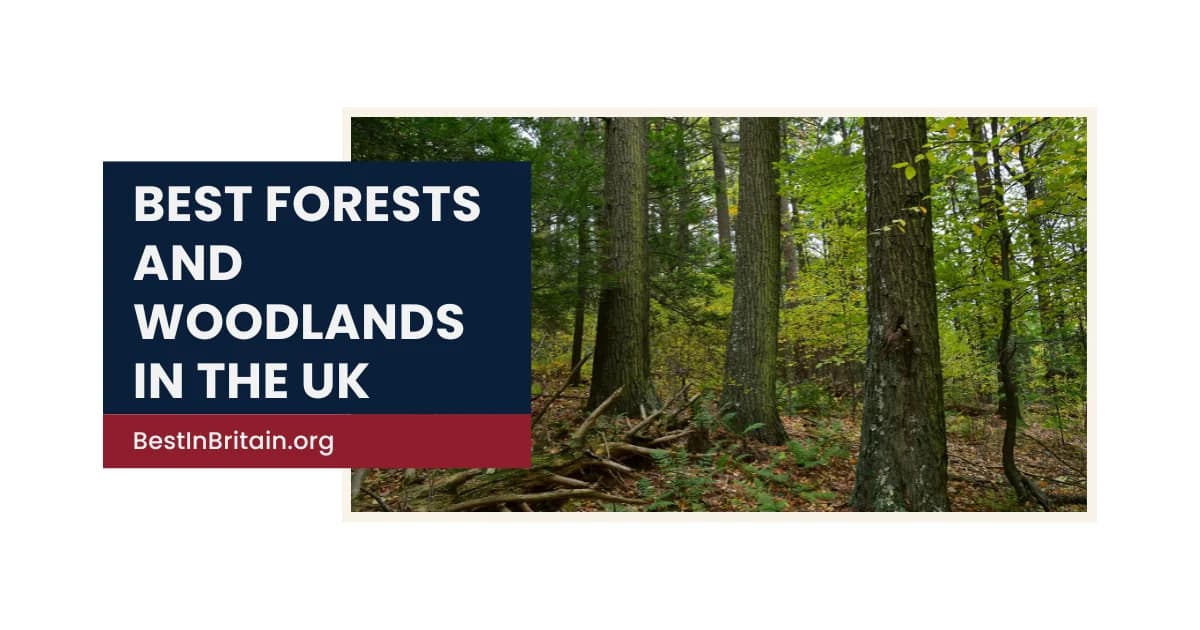
The best forests and woodlands in the UK range from ancient royal hunting grounds and Caledonian pinewoods to vast working forests, coastal woodland and modern forest parks. The New Forest, Sherwood and Epping are especially strong for ancient trees and cultural history; Glen Affric and Rothiemurchus offer some of the clearest experiences of native Caledonian pinewood; while Kielder, Galloway, Coed y Brenin and Dalby stand out for scale, cycling and outdoor adventure.
The United Kingdom’s forests and woodlands are far more varied than they first appear. Ancient oak woods, pine forest, productive plantations, royal hunting grounds, coastal woodland and recreational forests all reveal a different relationship between people, trees and the wider landscape.
Some places in this guide are best known for quiet walks beneath old trees. Others offer mountain biking, wildlife watching, sculpture, waterfalls, dark skies or long days exploring tracks that disappear into open country. Several are actively managed working forests, while others protect woodland that has survived for centuries.
This guide brings together 20 of the best forests and woodlands in the UK across England, Scotland, Wales and Northern Ireland. It is an editorial selection rather than a ranking by size, and it focuses on the quality of the landscape, the character of the woodland, ecological and historical interest, and whether the place offers enough depth to justify a dedicated visit.
The strongest woodland visits are often the ones where the forest is allowed to feel like more than an attraction. A path beneath old beech trees, the sound of a river through a pinewood or the sudden appearance of open moorland can matter just as much as a visitor centre or famous viewpoint.
Best UK forests and woodlands at a glance
| Forest or woodland | Location | Best for | Character |
|---|---|---|---|
| New Forest | Hampshire, England | Ancient trees, wildlife and easy walking | Ancient woodland, heath and grazed commons |
| Forest of Dean | Gloucestershire, England | Heritage, walking and varied scenery | Ancient woodland and working forest |
| Kielder Forest | Northumberland, England | Scale, cycling, dark skies and red squirrels | Large working forest and reservoir landscape |
| Sherwood Forest | Nottinghamshire, England | Ancient oaks and cultural history | Veteran oak woodland |
| Glen Affric | Highlands, Scotland | Native pinewood and mountain scenery | Caledonian pinewood and lochs |
| Rothiemurchus | Cairngorms, Scotland | Wildlife and ancient pinewood | Native pine forest, lochs and rivers |
| Galloway Forest Park | Dumfries and Galloway, Scotland | Remoteness, dark skies and multi-day exploring | Large forest park and open country |
| Coed y Brenin | Gwynedd, Wales | Mountain biking and active visits | Upland working forest |
| Newborough Forest | Anglesey, Wales | Forest, coast and red squirrels | Coastal pinewood and dunes |
| Glenariff Forest Park | County Antrim, Northern Ireland | Waterfalls and dramatic woodland walks | Gorge woodland and forest park |
If you are choosing between them, start with the experience you want. Ancient woodland and veteran trees are the main draw at Sherwood, Epping, Ashridge and the New Forest; Glen Affric and Rothiemurchus are stronger for native pinewood; Kielder and Galloway suit visitors looking for scale and remoteness; while Coed y Brenin, Dalby and Thetford are better suited to active days involving cycling or family trails.
How we selected the best forests and woodlands in the UK
This guide does not rank forests by size alone. Kielder and Galloway are enormous landscapes, but a smaller ancient woodland can be equally important and far more rewarding for a particular type of visit.
Our editorial assessment considers:
- Woodland character: Ancient trees, native woodland, plantation forest, mixed habitat or distinctive tree collections.
- Landscape quality: How the woodland relates to rivers, lochs, coast, mountains, heath or open country.
- Wildlife and ecology: The importance of the habitat and the chance to understand how the woodland functions.
- Cultural and historical depth: Commoning, forestry, mining, estate history, folklore or long-established woodland management.
- Ways to experience it: Walking, cycling, wildlife watching, family trails, viewpoints and longer outdoor routes.
- Sense of place: Whether the forest feels distinctive rather than interchangeable with another woodland destination.
- Visitor depth: Whether the place supports several hours or a full day of meaningful exploration.
- Responsible access: Whether visitors can experience the landscape without treating sensitive woodland as a theme park.
That approach explains why the list includes both ancient forests and modern plantations. Sherwood, the New Forest, Epping and Glen Affric matter because of old trees and ecological continuity. Kielder, Thetford and Coed y Brenin show how working forests can also provide recreation, habitat and large-scale landscape experiences.
Best forests and woodlands to visit in England
1. Explore the New Forest

Business details
Address
Hampshire, England
Best for: Ancient woodland, wildlife, cycling and gentle walks
Visit details:
- Open forest and common land are accessible throughout the year
- Visitor centres, campsites and attractions use separate schedules
- Seasonal car park closures and local restrictions protect sensitive habitats
Price: Free landscape access, with charges for parking and selected activities
The New Forest is not a single dense woodland but a remarkable mosaic of ancient trees, heathland, wetlands, open lawns and grazed commons. That variety is what gives it such a strong identity.
Ponies, cattle and donkeys roam freely under a historic commoning system, while veteran oaks and beeches support fungi, insects and wildlife that depend on old woodland. Villages such as Brockenhurst, Lyndhurst and Beaulieu make useful starting points, but the quieter forest roads and walking tracks reveal far more than the busiest roadside clearings.
The New Forest is especially rewarding for visitors who enjoy low-level walking, cycling and wildlife rather than dramatic mountain scenery. It can look gentle, but the landscape is ecologically complex and easily damaged by careless parking, feeding animals or leaving marked routes in wet areas.
A full day should combine one woodland walk with open heath or a village stop, allowing the contrast between habitats to become clear.
Pro tip:
Do not feed or approach the free-roaming animals. Walk beyond the busiest car parks and slow down on forest roads, where livestock can appear without warning.
2. Discover the Forest of Dean

Business details
Address
Gloucestershire, England
Best for: Woodland variety, heritage, walking and cycling
Visit details:
- The wider forest is accessible throughout the year
- Trails, cycle facilities and visitor sites use separate schedules
- Forestry work can temporarily divert routes
Price: Free landscape access, with charges for parking and attractions
The Forest of Dean is one of England’s largest ancient forests and one of its most layered woodland landscapes.
Royal hunting, shipbuilding timber, mining, quarrying and modern recreation have all shaped the forest. Old tramways, industrial remains and hidden valleys sit among broadleaf woodland, conifer plantations and viewpoints above the River Wye. Symonds Yat provides the famous panorama, but it represents only one corner of a much larger area.
The forest works well for almost every type of visitor. Families can use waymarked trails and activity sites, cyclists have long forest routes, and walkers can move into quieter woodland where the industrial history is less obvious at first glance.
What makes the Forest of Dean memorable is that it never feels like one uniform forest. The character changes between ridges, valleys, settlements and old working landscapes, giving repeat visitors a reason to choose a different part each time.
Pro tip:
Use one visitor hub as a starting point, then add a quieter heritage or riverside walk rather than trying to drive between every named attraction.
3. Experience Kielder Forest

Business details
Address
Northumberland, England
Best for: Scale, cycling, dark skies and red squirrels
Visit details:
- The forest and reservoir landscape are accessible throughout the year
- Visitor centres, forest roads and activities use separate seasonal arrangements
- Remote areas have limited mobile reception and services
Price: Free landscape access, with charges for parking, activities and the forest drive
Kielder is England’s largest forest and feels closer to a northern European wilderness than a conventional country park.
The forest surrounds Kielder Water and extends into open moorland, blanket bog and remote valleys. It is a working timber landscape, but also one of England’s most important red squirrel strongholds and a major destination for cycling, walking, public art and dark-sky experiences.
Its scale is the defining feature. Visitors who arrive without a plan can spend more time driving than exploring, because different trails and attractions are spread over a very large area. Kielder Castle, Tower Knowe and the reservoir shore each provide a different introduction.
The landscape is at its best when experienced slowly. A lakeside cycle, forest walk or overnight stay reveals far more than a quick loop through the main visitor sites. Clear nights can be exceptional, but darkness and remoteness also demand proper preparation.
Pro tip:
Choose one section of the forest for the day and download maps before arrival. Stay after dark only when you have warm clothing, navigation and a clear return plan.
4. Walk beneath the ancient oaks of Sherwood Forest

Business details
Address
Edwinstowe, Nottinghamshire, England
Best for: Ancient oaks, woodland ecology and Robin Hood history
Visit details:
- The woodland and public paths are accessible throughout the year
- The visitor centre and events programme use separate schedules
- Some ancient-tree areas are protected by barriers
Price: Free, with possible parking charges
Sherwood Forest is inseparable from the legend of Robin Hood, but its real significance lies in its ancient trees.
The Major Oak is the best-known landmark, yet the surrounding veteran oaks are the reason the forest deserves more than a quick folklore-themed visit. Their hollow trunks, dead wood and enormous crowns support a web of fungi, insects, birds and other wildlife that depends on trees being allowed to age naturally.
The surviving woodland is smaller than the vast medieval royal forest that once covered much of the region. That makes the remaining ancient habitat feel more valuable rather than less impressive. Short trails from the visitor centre are easy to follow, while longer walks create more distance from the busiest area around the Major Oak.
Sherwood is strongest as an introduction to ancient woodland ecology and cultural memory, not as a vast wilderness destination.
Pro tip:
See the Major Oak, but continue onto a longer trail and look at the less famous veteran trees. Never cross barriers or climb on ancient roots and trunks.
5. Explore Ashridge Estate

Business details
Address
Near Berkhamsted, Hertfordshire, England
Best for: Beech woods, bluebells, deer and Chiltern walks
Visit details:
- The estate and woodland paths are accessible throughout the year
- Visitor facilities and parking arrangements can change
- Seasonal crowd management may apply during bluebell displays
Price: Free landscape access, with parking charges in selected areas
Ashridge combines ancient woodland, chalk downland, commons and historic parkland across a remarkably large estate on the edge of the Chilterns.
Beech and oak woods create the classic woodland atmosphere, but the open slopes and long views from areas such as Ivinghoe Beacon prevent the landscape from feeling enclosed. Spring bluebells attract the largest crowds, while autumn brings strong colour and the sound of fallow deer during the rut.
The estate has more than enough paths for repeat visits, from short woodland circuits to long boundary walks. Its closeness to London and the surrounding towns makes it accessible, but also places pressure on roots, verges and sensitive habitats near the busiest parking areas.
Ashridge is most rewarding when visitors move away from Monument Drive and allow the route to include woodland, meadow and downland rather than chasing only the most photographed seasonal display.
Pro tip:
Visit bluebells without leaving established paths. For a quieter experience, choose one of the longer estate routes and begin away from the central visitor area.
6. Walk through Epping Forest

Business details
Address
London and Essex, England
Best for: Ancient woodland close to London and car-free walking
Visit details:
- The forest is accessible throughout the year
- Individual car parks, cafés and visitor sites use separate schedules
- Paths may become muddy or waterlogged after rain
Price: Free
Epping Forest is one of the most remarkable large woodlands close to a major European city.
Stretching from north-east London into Essex, it preserves ancient pollarded trees, ponds, open grassland and long woodland paths within reach of the Underground and local rail. The forest has a lived-in, accessible quality: commuters, runners, riders, naturalists and families all use the same broad landscape in different ways.
Its size is easy to underestimate. High Beach, Chingford, Wanstead and the northern forest offer distinct starting points, and a single visit should focus on one section rather than trying to understand the entire forest from a roadside stop.
The ancient pollards are particularly important. Their unusual forms are evidence of centuries of woodland management and create habitats that younger, more uniform forests cannot easily reproduce.
Pro tip:
Use public transport where practical and plan a point-to-point walk. After rain, expect deep mud away from the main surfaced routes.
7. Explore Thetford Forest

Business details
Address
Norfolk and Suffolk, England
Best for: Cycling, family trails and long lowland forest routes
Visit details:
- The forest is accessible throughout the year
- Visitor centres, activity sites and events use separate schedules
- Working forestry operations may close or divert trails
Price: Free landscape access, with charges for parking and activities
Thetford Forest is Britain’s largest lowland pine forest and one of East Anglia’s most useful outdoor landscapes.
Created largely during the twentieth century, it does not have the ancient character of Sherwood or the New Forest. Its strength lies elsewhere: long tracks, open rides, cycling, wildlife and the sense of space created by such a large continuous forest in a relatively flat region.
High Lodge is the principal visitor hub, but quieter areas provide a more reflective woodland experience. Breckland heath, sandy soils and patches of broadleaf woodland add variety, while rare species benefit from the combination of trees and open habitat.
The forest is an excellent example of how a productive plantation can also support recreation and conservation. Visitors should expect a working landscape, where timber operations and changing woodland structure are part of the story rather than an interruption to it.
Pro tip:
Use High Lodge for facilities, but choose a separate quieter walk if you want to experience the scale and stillness of the wider forest.
8. Visit Bedgebury National Pinetum and Forest

Business details
Address
Near Goudhurst, Kent, England
Best for: Conifers, tree collections and family forest activities
Visit details:
- The site opens daily with seasonal gate and facility hours
- The pinetum, forest trails and activity areas use shared access arrangements
- Parking charges apply
Price: ££
Bedgebury combines a major tree collection with a large recreational forest, giving it a broader appeal than a conventional arboretum.
The National Pinetum contains an internationally significant collection of conifers, allowing visitors to compare trees from very different climates and continents within one landscape. Beyond the collection, forest trails support walking, cycling, family activities and longer visits.
The contrast between curated specimen planting and working woodland is what makes Bedgebury distinctive. It can be enjoyed as a horticultural visit, an active day outdoors or a seasonal colour walk, depending on the route chosen.
Autumn and winter can be especially rewarding because conifers provide structure and interest when many broadleaf woods feel bare. Families often stay around the main activity areas, while visitors interested in trees should allow time to move slowly through the labelled collection.
Pro tip:
Do not rush through the pinetum on the way to the activity trails. The individual tree stories and changing forms are the reason Bedgebury is nationally important.
9. Explore Dalby Forest

Business details
Address
North York Moors, North Yorkshire, England
Best for: Mountain biking, viewpoints and mixed-ability groups
Visit details:
- The forest is accessible throughout the year
- Visitor centre, cycle hire and activities use separate hours
- Weather and forestry work can affect high-level routes
Price: Free landscape access, with parking charges
Dalby Forest occupies a broad landscape of valleys, ridges and woodland on the southern edge of the North York Moors.
It is best known for mountain biking, but the forest offers far more than purpose-built trails. Viewpoints open across the moors, family paths follow gentler valleys and quieter tracks lead away from the main visitor hub into a landscape that changes significantly with elevation.
Dalby is a useful choice for mixed groups because different levels of activity can begin from the same area. One visitor can take on a long cycle route while another follows a short woodland walk or uses the play and picnic facilities.
The forest’s polished visitor infrastructure can make it feel recreational first, but the larger landscape still provides genuine quiet once visitors move beyond the busiest zones.
Pro tip:
Choose a route based on ability rather than colour alone, and check the official trail status before travelling after storms or forestry operations.
Best forests and woodlands to visit in Scotland
10. Discover Glen Affric

Business details
Address
Near Cannich, Highlands, Scotland
Best for: Native Caledonian pinewood, lochs and mountain scenery
Visit details:
- The glen and forest trails are accessible throughout the year
- Road access, parking and route conditions vary by season
- Longer walks enter remote mountain terrain
Price: Free
Glen Affric is one of the finest surviving landscapes of native Caledonian pinewood in Scotland.
Pines, birch, lochs, rivers and mountain ridges combine in a glen that feels both wild and carefully restored. The woodland is not continuous in the way a plantation forest might be; open ground and water are essential parts of the landscape, creating long views and varied habitats.
Short routes near the main car parks offer immediate access to the forest and loch shores, while longer walks lead deep into remote country. This makes Glen Affric suitable for both a half-day scenic visit and a serious full-day hike.
The glen’s reputation comes from atmosphere as much as scale. Old pines rise from rocky ground, deer move across the open slopes and changing Highland weather can transform the light within minutes.
Pro tip:
Choose the length of walk before setting out and carry full hill equipment for routes beyond the main forest trails. Mobile reception is unreliable.
11. Explore Rothiemurchus Forest

Business details
Address
Near Aviemore, Cairngorms National Park, Scotland
Best for: Ancient pinewood, wildlife and loch walks
Visit details:
- The estate and main trails are accessible throughout the year
- Activities, cafés and guided experiences use separate schedules
- Wildlife-sensitive areas may have seasonal guidance
Price: Free landscape access, with charges for parking and activities
Rothiemurchus protects one of Scotland’s most celebrated areas of ancient Caledonian pine forest.
The woods sit beneath the Cairngorm mountains and surround lochs, rivers and open ground rich in wildlife. Loch an Eilein, with its island castle ruins, is the best-known introduction, but the wider estate rewards cycling, longer walks and guided nature experiences.
The forest feels ancient without being static. Fallen trees, standing deadwood and uneven generations of pine show a functioning woodland rather than a manicured collection. Red squirrels, crested tits and other specialist species depend on that complexity.
Its accessibility from Aviemore makes Rothiemurchus popular, yet the network is extensive enough to find quieter routes. Visitors who stay only at Loch an Eilein see a beautiful place, but not the full relationship between pinewood, river and mountain.
Pro tip:
Walk beyond the main loch circuit or join a guided wildlife experience. Keep dogs controlled, particularly around sensitive wildlife and livestock.
12. Experience Galloway Forest Park

Business details
Address
Dumfries and Galloway, Scotland
Best for: Remoteness, dark skies and large-scale forest exploring
Visit details:
- The forest park is accessible throughout the year
- Visitor centres, trails and seasonal services use separate schedules
- Remote roads and upland routes require advance planning
Price: Free landscape access, with charges for parking and activities
Galloway Forest Park is the largest forest park in Britain, covering more than 300 square miles of woodland, lochs, hills and open country.
Its scale creates several very different visitor experiences. Kirroughtree is known for walking and mountain biking, Glentrool provides loch and hill scenery, and Clatteringshaws offers broad water and mountain views. The park is also closely associated with dark skies, wildlife and a sense of remoteness unusual in southern Scotland.
Much of the forest is productive plantation, yet the landscape is increasingly understood as a mosaic of woodland, open habitat and water rather than a wall of trees. The long distances between visitor hubs mean the park should be explored by area, not treated as one attraction.
A night nearby can be more rewarding than a rushed daytime circuit, especially for visitors interested in stars, quiet roads and early wildlife activity.
Pro tip:
Choose one of the main forest hubs and build the day around it. Download maps and identify fuel, food and your return route before entering remote sections.
13. Walk through Queen Elizabeth Forest Park

Business details
Address
Loch Lomond and The Trossachs, Scotland
Visit details:
- The forest park is accessible throughout the year
- The Lodge, forest drives and activity providers use separate schedules
- Some forest roads are seasonal or charge separately
Price: Free landscape access, with charges for parking and selected activities
Queen Elizabeth Forest Park brings together forests, lochs and mountains in the heart of the Trossachs.
Rather than being one compact woodland, it covers a broad area that includes Loch Ard, Aberfoyle, Loch Katrine and the eastern shores of Loch Lomond. Visitors can choose accessible paths, gravel cycling, waterfall walks, forest viewpoints or longer routes towards the hills.
The Lodge Forest Visitor Centre provides the easiest introduction, particularly for families and first-time visitors. The Three Lochs Forest Drive offers a more accessible way to see the landscape, while Loch Ard supports quieter walking and cycling.
The park’s strength is the way woodland frames water and mountain scenery. It rarely feels like a forest isolated from its surroundings; trees, lochs and ridges constantly appear together.
Pro tip:
Use The Lodge for orientation, then choose either Loch Ard or the Three Lochs Forest Drive rather than trying to cover the whole park in one day.
14. See the seasonal colour at Faskally Wood

Business details
Address
Near Pitlochry, Perthshire, Scotland
Visit details:
- The woodland is accessible throughout the year
- Events and temporary installations use separate dates and booking arrangements
- Parking can become extremely busy in autumn
Price: Free landscape access, with charges for selected events
Faskally is smaller than Scotland’s great forest parks, but few woodlands create a stronger seasonal impression.
The forest surrounds Loch Dunmore and contains a varied collection of trees planted during the nineteenth century. Reflections, sheltered paths and autumn colour make it particularly photogenic, while accessible routes allow a wide range of visitors to experience the woodland.
Its fame is closely tied to autumn and seasonal light events, but Faskally is worth visiting at quieter times too. Spring foliage, calm summer mornings and winter structure all reveal a more peaceful woodland than the event-period image suggests.
Because the forest is compact, visitors can take time to notice individual trees, water reflections and small changes in the landscape rather than approaching it as a long-distance hike.
Pro tip:
Visit on a weekday morning outside major event times for the quietest experience, and continue to nearby Pitlochry or Loch Tummel for a fuller day.
Best forests and woodlands to visit in Wales
15. Explore Coed y Brenin Forest Park

Business details
Address
Near Dolgellau, Gwynedd, Wales
Best for: Mountain biking, waterfalls and active forest days
Visit details:
- The forest park is accessible throughout the year
- Visitor centre, trails and activity facilities use separate schedules
- Forestry work and weather can affect individual routes
Price: Free landscape access, with parking charges
Coed y Brenin is one of Wales’s most important forest destinations and a landmark in the development of UK mountain biking.
Its trail network crosses steep valleys, rivers, old mine workings and mixed woodland beneath the mountains of southern Eryri. Cycling remains central to its identity, but walking trails reveal waterfalls, giant Douglas firs and the industrial history hidden within the forest.
The visitor centre makes the forest accessible to families and first-time visitors, while more demanding routes allow experienced walkers and riders to spend most of the day away from the busiest areas. Accessible trails also provide genuine woodland and riverside experiences rather than a token circuit near the car park.
Coed y Brenin feels like a landscape with several stories happening at once: productive forestry, outdoor sport, habitat, mining heritage and mountain scenery.
Pro tip:
Choose your trail before arriving and check live closures. Walkers should use the dedicated walking routes rather than accidentally joining fast cycle descents.
16. Discover Gwydir Forest Park

Business details
Address
Around Betws-y-Coed and Llanrwst, Conwy, Wales
Visit details:
- The forest park is accessible throughout the year
- Individual trailheads and lakes have separate access arrangements
- Forestry operations can temporarily divert paths
Price: Free
Gwydir Forest Park spreads across the hills around Betws-y-Coed and the Conwy Valley, linking lakes, old mines and mountain views.
It does not have one dominant centre. Instead, places such as Llyn Crafnant, Llyn Geirionydd, Hafna and the woodland above Betws-y-Coed provide different entrances into the forest. That dispersed character makes it especially rewarding for repeat visits.
Mining once shaped much of this landscape, and remains of workings, tracks and buildings still sit among the trees. Lakes soften the industrial history, while views towards the mountains of Eryri remind visitors that the forest belongs to a much larger upland setting.
Gwydir is ideal for visitors who prefer exploration over a heavily managed attraction. The trade-off is that facilities and mobile reception are more limited away from the main villages.
Pro tip:
Choose one lake or heritage area for the day and carry an offline map. Do not attempt to link distant trailheads simply because they appear close on a map.
17. Walk through Hafren Forest

Business details
Address
Near Llanidloes, Powys, Wales
Visit details:
- The forest is accessible throughout the year
- Waymarked walking routes begin from the main access area
- Heavy rain can make riverside and upland paths wet or difficult
Price: Free
Hafren Forest lies around the upper River Severn and offers one of mid Wales’s strongest combinations of woodland and water.
The source of the Severn is reached by a longer trail through forest and open upland, while shorter routes follow rivers, cascades and the dramatic boardwalk to Severn-Break-its-Neck waterfall. The landscape feels remote without requiring a major mountain expedition.
Much of Hafren is managed forest, but the riverside corridors, open ground and regenerating habitats create greater variety than a uniform plantation. The sound of water is a constant feature, particularly after rain.
The forest suits visitors who want a proper walk rather than a collection of attractions. Facilities are limited, and weather can make the upland route to the river source much more demanding than expected.
Pro tip:
Choose between the waterfall routes and the longer source-of-the-Severn walk before setting out. Carry food, waterproofs and navigation for the upland trail.
18. Explore Newborough Forest and Warren

Business details
Address
Anglesey, Wales
Best for: Combining forest, beach, dunes and red squirrels
Visit details:
- The forest and beach landscape are accessible throughout the year
- Vehicle access and parking arrangements can change seasonally
- Tides affect safe access around Ynys Llanddwyn
Price: Free landscape access, with parking charges
Newborough is one of the most unusual woodland destinations in the UK because the forest stands directly beside dunes, salt air and a broad Anglesey beach.
Tall pines create sheltered walking and cycling routes before the landscape opens suddenly onto views across the Menai Strait towards the mountains of Eryri. Ynys Llanddwyn adds lighthouse ruins, coastal history and one of Wales’s most memorable tidal landscapes.
The forest itself was planted in part to stabilise shifting sand, making its relationship with the coast central to the story. Red squirrels now live within the woodland, while the neighbouring dunes and shore support very different wildlife communities.
A visit feels most complete when it includes both trees and coast. Staying entirely in the car park and beach area misses the quiet interior tracks, while a forest-only route misses the dramatic moment where woodland meets the sea.
Pro tip:
Check the tide before walking to Llanddwyn and use marked trails through the dunes. Avoid disturbing red squirrels or leaving food behind.
Best forests and woodlands to visit in Northern Ireland
19. Walk through Tollymore Forest Park

Business details
Address
Bryansford, County Down, Northern Ireland
Best for: Riverside woodland, old estate features and Mourne scenery
Visit details:
- The forest park is open throughout the year
- Walking, camping and activity arrangements use separate schedules
- Vehicle and camping charges may apply
Price: Free on foot, with vehicle and camping charges
Tollymore is one of Northern Ireland’s most atmospheric forest parks.
The Shimna River runs through mature woodland beneath stone bridges, arches and rocky outcrops, while the Mourne Mountains rise close beyond the trees. Giant redwoods, old estate planting and riverside paths give the park a richer visual character than a straightforward commercial forest.
Several waymarked routes allow visitors to choose between a short family walk and a longer exploration of river, forest and foothills. Film and television exposure has increased interest, but the woodland’s architecture and relationship with the Mournes are strong enough to stand independently.
Tollymore works particularly well in mixed weather because the trees provide some shelter while the river and mountain atmosphere remain dramatic. Autumn colour and high water can be beautiful, though wet rocks demand care.
Pro tip:
Follow one of the longer river routes and look beyond the most photographed bridges. After rain, keep away from slippery rocks beside fast water.
20. Explore Glenariff Forest Park

Business details
Address
County Antrim, Northern Ireland
Best for: Waterfalls, gorge walking and dramatic woodland scenery
Visit details:
- The forest park is accessible throughout the year
- Trails, camping and seasonal facilities use separate arrangements
- Steps and gorge paths can be slippery after rain
Price: Free landscape access, with parking and camping charges
Glenariff is often called the Queen of the Glens, and the forest park provides the best way to understand why.
Woodland descends into a deep river gorge where waterfalls, bridges and boardwalk sections create one of Northern Ireland’s finest forest walks. The upper viewpoints look across the glen towards the sea, connecting the enclosed woodland with the wider Antrim landscape.
The Waterfall Walk is the headline route, but it should not be reduced to a sequence of photo stops. The changing vegetation, sound of the river and repeated transition between high forest and gorge are what make the walk memorable.
The return includes sustained climbing and numerous steps, particularly after descending into the gorge. Visitors expecting a flat park stroll can be surprised by the physical effort.
Pro tip:
Allow enough time for the complete Waterfall Walk and wear footwear with good grip. Visit after rain for stronger falls, but expect more difficult surfaces.
Best UK forests and woodlands by type
Best for ancient trees
Sherwood Forest, Epping Forest, Ashridge Estate and the New Forest are among the strongest choices for veteran trees, ancient woodland structure and visible evidence of long-term woodland management.
Best for native Caledonian pinewood
Glen Affric and Rothiemurchus provide the clearest experiences in this guide of Scotland's native pinewood landscape, with lochs, rivers, open ground and mountain scenery forming part of the habitat.
Best for mountain biking
Coed y Brenin and Dalby are especially strong for purpose-built mountain-bike trails, while Kielder and Thetford offer extensive cycling options across much larger forest landscapes.
Best for wildlife
Kielder and Newborough are important red squirrel landscapes, while Rothiemurchus and Glen Affric support wildlife associated with native Scottish pinewood. Wildlife sightings are never guaranteed and are best approached quietly.
Best for waterfalls and rivers
Glenariff, Hafren, Tollymore and Coed y Brenin combine woodland with rivers, waterfalls or gorge scenery and are particularly rewarding after wet weather when conditions remain safe.
Best for a family day out
The New Forest, Thetford, Bedgebury, Dalby and Queen Elizabeth Forest Park combine accessible trails or visitor facilities with enough variety for different ages and activity levels.
Best for remote forest landscapes
Kielder, Galloway Forest Park and Glen Affric offer the strongest sense of scale and remoteness in this guide. They require more route planning than compact woodland attractions.
How to plan a woodland visit
Begin by choosing a specific trailhead. Large forests such as Kielder, Galloway, Gwydir and Queen Elizabeth Forest Park cover too much ground to be treated as one destination on a navigation app. Decide which walk, lake, visitor centre or activity you want before setting out.
Check official alerts on the day. Forestry operations, storm damage, wildfire risk, flooding and habitat work can close paths with little notice. A route that appears permanently marked on an old blog or map may no longer be open.
Footwear depends on the forest and season. Surfaced family trails may be suitable for ordinary shoes, while riverside paths, upland forests and ancient woodland can become deeply muddy. Waterproof footwear is particularly useful in Glenariff, Hafren, Gwydir and the Highland forests.
Autumn is not the only rewarding season. Spring brings bluebells, birdsong and fresh leaves in broadleaf woods. Summer provides long evenings and shade. Winter reveals tree structure, fungi and open views that disappear behind foliage during the warmer months.
Wildlife sightings should never be guaranteed. Kielder and Newborough are important red squirrel landscapes, while Rothiemurchus and Glen Affric support species associated with native pinewood. Seeing them depends on patience, timing and luck. Quiet behaviour improves the chance far more than pursuing animals off the path.
Dogs should be controlled around livestock, nesting birds and sensitive wildlife. The New Forest, Rothiemurchus, open parts of Ashridge and several Scottish forests contain grazing animals or habitats where an uncontrolled dog can cause serious disturbance.
Frequently asked questions
What are the best forests to visit in the UK?
The New Forest, Forest of Dean, Kielder, Sherwood, Glen Affric, Rothiemurchus, Galloway Forest Park, Coed y Brenin, Tollymore and Glenariff are among the strongest all-round forest destinations in this guide. The right choice depends on whether you want ancient trees, wildlife, cycling, waterfalls, mountain scenery or a quieter woodland walk.
What is the best ancient forest to visit in England?
The New Forest, Sherwood Forest and Epping Forest are all strong choices for ancient woodland character. Sherwood is especially notable for veteran oaks, while the New Forest combines old trees with heathland, wetlands and a living commoning system.
Which UK forests are best for walking?
Glen Affric, Rothiemurchus, the Forest of Dean, Ashridge, Gwydir, Hafren, Tollymore and Glenariff all offer rewarding walking, but the character varies considerably. Some are suited to gentle woodland circuits while others lead into remote or upland terrain.
Which UK forests are best for cycling?
Coed y Brenin and Dalby are particularly well known for mountain biking. Kielder, Thetford and Queen Elizabeth Forest Park also provide extensive cycling opportunities across larger forest landscapes.
Which UK forests are best for wildlife?
Kielder and Newborough are important red squirrel landscapes, while Rothiemurchus and Glen Affric support wildlife associated with native pinewood. The New Forest is notable for free-roaming ponies, cattle and donkeys, although these animals should never be fed or approached.
When is the best time to visit a UK forest?
Spring is strong for bluebells, fresh foliage and birdsong; summer offers longer daylight and shade; autumn brings colour, fungi and seasonal wildlife activity; and winter can reveal tree structure and open views. The best season depends on the forest and the experience you want.
Are UK forests free to visit?
Many forests and woodland landscapes are free to enter, although parking, visitor attractions, cycling facilities, forest drives, events or activities may carry separate charges. Always check the official site before travelling.
Do I need a car to visit these forests?
Some forests are much easier by car, particularly large or remote landscapes such as Kielder, Galloway and Glen Affric. Epping Forest is one of the strongest options for public-transport access, while several other sites can be reached from nearby towns with additional planning.
Choosing the right forest for your visit
The New Forest, Sherwood and Ashridge are strongest for ancient trees and visible cultural history. Glen Affric and Rothiemurchus offer the clearest experience of native Caledonian pinewood. Kielder and Galloway suit visitors looking for scale, remoteness and multi-day outdoor experiences.
Coed y Brenin, Dalby and Thetford are particularly good for active visits involving cycling or family trails. Faskally, Bedgebury and Loch an Eilein within Rothiemurchus reward visitors interested in seasonal beauty and individual trees. Tollymore and Glenariff combine woodland with rivers, stonework and waterfalls.
Final thoughts
The best forest is ultimately the one that matches the experience you want. A family activity day, a serious mountain-bike route, an ancient-tree walk and a quiet wildlife morning are all valid woodland visits, but they should not be judged by the same standard.
The most memorable approach is to slow down. Forests reveal themselves through small changes in sound, light, ground and vegetation. A walk becomes far richer once the trees are treated not as a backdrop, but as the reason for being there.
Related guides
Business Services
20 best islands in the UK to visit for a memorable escape
Discover the best islands across the United Kingdom, from the Hebrides and northern archipelagos to Welsh coastal islands, English island escapes and dramatic island landscapes in Northern Ireland.
Updated 25 September 2026
Business Services
25 best coastal walks in the UK for unforgettable sea views
Discover the best coastal walks across the United Kingdom, from dramatic clifftop routes and island paths to sandy bays, historic headlands and some of the finest sections of Britain’s long-distance coast trails.
Updated 9 July 2026

Business Services
25 best gardens in the UK for a memorable visit
Discover the best gardens across the United Kingdom, from great botanical collections and formal historic gardens to experimental planting, woodland gardens and outstanding landscape design.
Updated 30 June 2026

Business Services
15 best road trips in the UK for an unforgettable journey
Discover the best road trips across the United Kingdom, from Scotland’s North Coast 500 and Wales’s mountain routes to coastal drives through Cornwall, Northern Ireland and some of England’s most scenic landscapes.
Updated 28 June 2026
Business Services
30 best walks and hiking routes in the UK for unforgettable landscapes
Discover the best walks and hiking routes across the United Kingdom, from famous mountain climbs and dramatic ridges to national trails, moorland paths, lakeside routes and accessible scenic walks.
Updated 27 June 2026

Business Services
Best painters and decorators in Edinburgh
A practical guide to Edinburgh painters and decorators for interior painting, exterior work, wallpapering, period properties, commercial projects and complete renovations.
Updated 3 August 2026
Know a business we should consider?
Send us the details and our editorial team will review whether it fits a future guide.
Submit businessWriter profile
George Davies
Regional and city guide desk researcher
George researches location-led guides, city roundups, regional comparisons, attractions, and practical local recommendations.
Editorial Trust Standard
Independent ReviewIndependent Research
Featured rankings are editorially determined. Commercial partner listings are strictly labeled as Sponsored or Featured.
Public Register Audit
Listings are cross-checked against public regulatory registries, Companies House filings, and published fee schedules.