
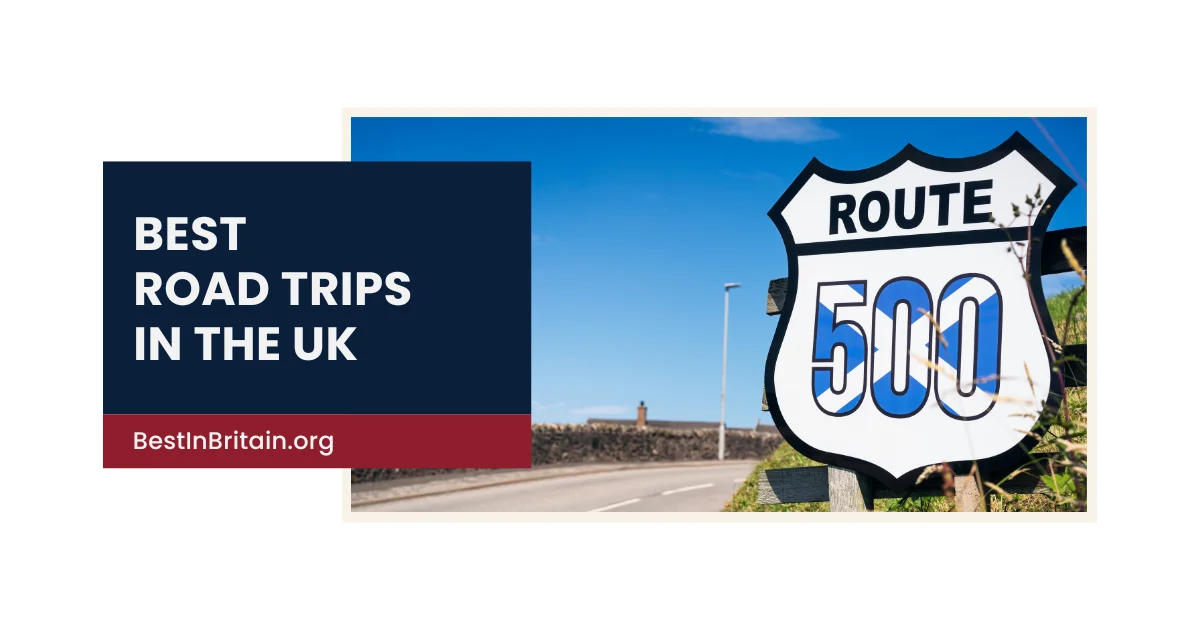
The United Kingdom is compact enough for short road trips but varied enough to make every region feel different. Coastal roads, mountain passes, historic villages, islands and national parks can all be connected into memorable journeys without crossing an international border.
The strongest road trips are not simply the roads with the best views. A good route links landscapes, communities, walks, attractions and overnight stops without forcing travellers to spend the entire day behind the wheel. Distances that appear short on a map can take much longer on single-track, rural or coastal roads.
This guide brings together 15 of the best road trips in the UK. It is not a rigid ranking. Instead, it focuses on routes with a clear identity, worthwhile stops and enough depth to justify travelling slowly across Scotland, England, Wales and Northern Ireland.
The best road trips in the UK
1. Drive the North Coast 500
Route: Inverness and the northern Highlands, Scotland
Trip planning:
- Recommended duration: 7 to 10 days
- Approximate route length: 516 miles
- The route is accessible throughout the year, but some services are seasonal
Estimated cost: £££
The North Coast 500 circles the far north of Scotland through Wester Ross, Sutherland, Caithness and Easter Ross.
Its strongest sections combine mountain passes, sea lochs, white-sand beaches, fishing settlements and the open landscapes of the north coast. Applecross, Torridon, Durness, Smoo Cave, John o’ Groats and the east-coast castles all add different experiences.
The route is often marketed as a five-day drive, but rushing it creates congestion and leaves little time for walking or local businesses.
Pro tip:
Allow at least a week, drive clockwise or anticlockwise based on accommodation, and never block passing places on single-track roads.
2. Follow the Causeway Coastal Route
Route: Belfast to Derry-Londonderry, Northern Ireland
Trip planning:
- Recommended duration: 3 to 5 days
- The main route follows the north and east coasts
- Attractions, ferries and seasonal services use separate timetables
Estimated cost: ££
The Causeway Coastal Route links Belfast with Derry-Londonderry through some of Northern Ireland’s most dramatic coastal scenery.
Carrickfergus Castle, the Glens of Antrim, Cushendun, Ballycastle, Carrick-a-Rede, the Giant’s Causeway, Dunluce Castle and the beaches around Portrush create a route rich in both natural and historic stops.
It can be driven quickly, but the best experience comes from staying along the coast and allowing time for walks and smaller villages.
Pro tip:
Use three or more days and include at least one inland glen or cliff walk rather than moving directly between the headline attractions.
3. Explore the North Wales Way
Route: Mold to Holyhead, North Wales
Trip planning:
- Recommended duration: 3 to 5 days
- Approximate route length: 75 miles, excluding detours
- Road and attraction access varies by season
Estimated cost: ££
The North Wales Way links historic towns, castles, mountains and the coast between north-east Wales and Anglesey.
Conwy, Llandudno, the northern edge of Eryri and the Menai Strait create the strongest central section, while Anglesey adds beaches, lighthouses and Beaumaris Castle. The route is short in mileage but dense in worthwhile stops.
Its value lies in combining culture and scenery rather than covering a great distance.
Pro tip:
Use at least three days and resist adding every major mountain attraction in Eryri to the same itinerary.
4. Drive the Coastal Way through west Wales
Route: Aberdaron to St Davids, Wales
Trip planning:
- Recommended duration: 5 to 7 days
- Approximate route length: 180 miles
- Seasonal traffic and narrow roads can increase journey times
Estimated cost: ££
The Coastal Way follows Cardigan Bay between the Llŷn Peninsula and St Davids.
Aberdaron, Porthmadog, Harlech, Barmouth, Aberystwyth, New Quay, Cardigan and the northern Pembrokeshire coast provide a mixture of beaches, castles, wildlife and Welsh-speaking communities. Mountain views accompany much of the northern section.
The route deserves several overnight stops because the coast is far more rewarding on foot than through a windscreen alone.
Pro tip:
Choose two or three bases and use them for local walks and excursions rather than changing accommodation every night.
5. Cross Wales on the Cambrian Way
Route: Cardiff to Llandudno, Wales
Trip planning:
- Recommended duration: 5 to 7 days
- Approximate route length: 185 miles
- Mountain weather and winter conditions can affect sections
Estimated cost: ££
The Cambrian Way runs north through the centre of Wales, connecting Cardiff with Bannau Brycheiniog, the Cambrian Mountains and Eryri.
It is a strong route for travellers who want to understand the contrast between south Wales, the rural heart of the country and the mountains of the north. Reservoirs, market towns, industrial heritage and high landscapes create a more varied journey than a simple scenic drive.
The central roads are slower and more remote than the mileage suggests.
Pro tip:
Plan short driving days and leave flexibility for poor mountain weather, especially in the central and northern sections.
6. Take the Atlantic Highway through Devon and Cornwall
Route: Barnstaple to Newquay, England
Trip planning:
- Recommended duration: 3 to 5 days
- Main route length is roughly 70 miles, with longer coastal detours
- Summer traffic can significantly increase journey times
Estimated cost: £££
The Atlantic Highway follows the A39 through north Devon and Cornwall, linking broad beaches, surfing towns and rugged coastline.
Barnstaple, Bideford, Clovelly, Bude, Tintagel, Port Isaac and Newquay all sit on or near the route. The best sections require leaving the main road for coastal villages, beaches and walking routes.
The road itself is not continuously beside the sea, so the quality of the trip depends on thoughtful detours.
Pro tip:
Choose a small number of coastal stops each day instead of attempting every famous village between Devon and Newquay.
7. Drive through Glencoe and the Great Glen
Route: Glasgow to Inverness via Glencoe, Scotland
Trip planning:
- Recommended duration: 3 to 5 days
- Approximate direct distance: 180 miles
- Weather can affect mountain roads throughout the year
Estimated cost: ££
The road from Glasgow to Inverness through Loch Lomond, Rannoch Moor, Glencoe and the Great Glen is one of Scotland’s classic journeys.
The route moves from wooded lochs into open moorland, steep mountains and the long line of lochs leading towards Inverness. Fort William, Glenfinnan and Loch Ness provide substantial detours and overnight options.
It is possible to complete the drive in one day, but doing so misses most of what makes it worthwhile.
Pro tip:
Spend one night around Glencoe or Fort William and include a proper walk rather than stopping only in roadside lay-bys.
8. Explore the Lake District by road
Route: Cumbria, England
Trip planning:
- Recommended duration: 3 to 5 days
- Routes vary according to the chosen lakes and valleys
- Mountain passes can close or become difficult in poor conditions
Estimated cost: £££
A Lake District road trip works best as a connected series of valleys rather than a complete circuit.
Windermere, Coniston, Langdale, Keswick, Derwentwater and Ullswater all offer different landscapes, while passes such as Kirkstone and Honister provide dramatic connections. Boat trips and walking routes should form part of the itinerary.
Traffic can become severe when visitors repeatedly cross the park to collect distant landmarks.
Pro tip:
Choose one northern and one southern base and leave the car parked for part of each day.
9. Drive through the Cotswolds
Route: Gloucestershire, Oxfordshire and neighbouring counties, England
Trip planning:
- Recommended duration: 3 to 4 days
- Route length depends on the selected villages and towns
- Narrow roads and weekend traffic can slow progress
Estimated cost: £££
The Cotswolds offer a slower road trip through honey-coloured villages, market towns and rolling farmland.
Broadway, Chipping Campden, Stow-on-the-Wold, Bourton-on-the-Water, Burford and Cirencester provide the best-known route, but smaller villages and countryside walks create the strongest moments.
The area is easy to underestimate because distances are short, yet constant stopping and limited parking consume time.
Pro tip:
Visit one famous village early each day, then spend the afternoon on quieter roads and footpaths.
10. Follow the South West 660
Route: Dorset, Devon, Cornwall and Somerset, England
Trip planning:
- Recommended duration: 10 to 14 days for the full route
- Approximate route length: 660 miles
- The route is divided into shorter stages that can be driven independently
Estimated cost: £££
The South West 660 connects the coast of Dorset, Devon, Cornwall and Somerset through a long series of scenic stages.
The route includes the Jurassic Coast, south Devon, Cornwall’s southern and western edges, the Atlantic coast and Exmoor. It is much broader than the Atlantic Highway and works best as a major touring holiday.
Trying to complete all 660 miles quickly undermines the purpose of the route.
Pro tip:
Select one or two sections for a short trip, or allow two weeks for the full circuit with regular rest days.
11. Drive the Snow Roads Scenic Route
Route: Blairgowrie to Grantown-on-Spey, Scotland
Trip planning:
- Recommended duration: 2 to 4 days
- Approximate route length: 90 miles
- Winter weather can make the highest roads difficult or temporarily impassable
Estimated cost: ££
The Snow Roads cross the eastern Cairngorms through some of Britain’s highest public roads.
Glenshee, Braemar, Ballater, Tomintoul and the surrounding mountain landscapes create a compact but dramatic route. Castles, distilleries and short walks provide reasons to stop beyond the viewpoints.
The route’s name is a reminder that weather can change rapidly, particularly outside summer.
Pro tip:
Check road conditions before departure and stay overnight rather than treating the high passes as a quick shortcut.
12. Tour the Northumberland coast and Hadrian’s Wall
Route: Northumberland, England
Trip planning:
- Recommended duration: 4 to 6 days
- The itinerary combines coastal and inland routes
- Tidal access and heritage-site hours require planning
Estimated cost: ££
Northumberland supports one of England’s most varied road trips by combining castles, beaches, Roman history and dark skies.
Bamburgh, Lindisfarne, Alnwick and the coastal villages form the eastern section, while Hadrian’s Wall, Kielder and the central uplands provide a very different inland journey.
The two areas should not be forced into a single rushed weekend.
Pro tip:
Spend at least two nights near the coast and two inland, checking Holy Island’s safe causeway times before travelling.
13. Explore the Yorkshire coast and moors
Route: North Yorkshire, England
Trip planning:
- Recommended duration: 3 to 5 days
- Route length depends on coastal and moorland detours
- Seasonal traffic affects Whitby and smaller coastal villages
Estimated cost: ££
This route links York or Helmsley with the North York Moors and the Yorkshire coast.
Rosedale, Goathland, Whitby, Robin Hood’s Bay, Staithes and Scarborough create a strong mixture of moorland, heritage railway scenery and fishing villages. The route is particularly atmospheric during heather season and in changing coastal weather.
The narrow roads around the villages make frequent short stops more practical than ambitious daily mileage.
Pro tip:
Use one inland base and one coastal base, and take the heritage railway for part of the journey if time allows.
14. Drive the Ards Peninsula and Mourne coast
Route: County Down, Northern Ireland
Trip planning:
- Recommended duration: 2 to 4 days
- Route length varies according to coastal detours
- Ferry and attraction schedules should be checked in advance
Estimated cost: ££
A County Down road trip offers a quieter alternative to the Causeway Coast.
The Ards Peninsula, Strangford Lough, Portaferry, Castle Ward, Newcastle and the Mourne Mountains create a route of sea loughs, small towns, historic estates and mountain views. A short ferry crossing between Portaferry and Strangford adds variety.
The route is compact but should not be reduced to a single fast loop.
Pro tip:
Use the Strangford ferry and stay near the Mournes for at least one night to experience both the lough and mountain coast.
15. Tour the Norfolk and Suffolk coast
Route: East Anglia, England
Trip planning:
- Recommended duration: 4 to 6 days
- Route length depends on the chosen coastal towns and Broads detours
- Tides, seasonal traffic and wildlife restrictions can affect plans
Estimated cost: ££
The coast of Norfolk and Suffolk creates a gentler road trip through dunes, marshes, fishing towns and broad beaches.
Wells-next-the-Sea, Holkham, Blakeney, Cromer, the Norfolk Broads, Southwold and Aldeburgh provide the main sequence. Wildlife reserves, food and walking matter more here than dramatic mountain driving.
The route’s flat landscape and short distances encourage travellers to move too quickly.
Pro tip:
Use several small bases and include boat, walking or cycling experiences so the trip is not spent entirely in the car.
How to plan a road trip around the UK
The United Kingdom looks compact on a map, but rural roads make travel slower than many first-time visitors expect. A day that includes 150 miles through the Highlands, rural Wales or the Cornish coast can feel much longer than the same distance on a motorway.
Build itineraries around experiences rather than mileage. Two or three hours of driving per day is usually enough when the route also includes walks, castles, beaches, meals and scenic stops. Longer transfer days can be useful, but they should not become the pattern for the whole trip.
Accommodation should be reserved early on remote routes. The North Coast 500, Isles and Highlands, Cornwall, Pembrokeshire and the Causeway Coast have limited capacity during summer. Booking everything at the last moment can create unnecessary driving between available rooms.
Fuel and charging require extra planning in rural areas. Keep a reasonable fuel reserve and identify reliable charging points before entering remote sections. Mobile signal may be limited, so download maps and essential booking information.
On single-track roads, use passing places correctly and allow faster local traffic to pass. Never park in a passing place, gateway or on fragile roadside ground. Motorhomes and large vehicles should avoid routes they cannot navigate confidently.
Weather can change the order of the trip. Mountain passes, coastal roads and ferry crossings may become difficult or unsafe, while heavy rain can affect paths and attractions. Keep one flexible day in longer itineraries.
The best road trips also support the places they pass through. Buy food locally, use independent accommodation, stay overnight and avoid treating small villages as free photo stops. Tourism creates the greatest value when visitors spend time as well as fuel.
No single route is best for every traveller. The North Coast 500 and Cambrian Way suit those seeking major landscapes; the Causeway Coast and Northumberland combine scenery with history; the Cotswolds and East Anglia reward slower village travel; and the South West 660 is best for an extended touring holiday. The strongest choice depends on available time, confidence on rural roads and how often you are willing to leave the car behind.
Related guides
Business Services
20 best islands in the UK to visit for a memorable escape
Discover the best islands across the United Kingdom, from the Hebrides and northern archipelagos to Welsh coastal islands, English island escapes and dramatic island landscapes in Northern Ireland.
Updated 25 September 2026

Business Services
20 best forests and woodlands in the UK for a memorable escape
Discover the best forests and woodlands across the United Kingdom, from ancient royal hunting grounds and Highland pinewoods to mountain-biking forests, wildlife reserves and peaceful woodland walks.
Updated 17 July 2026
Business Services
25 best coastal walks in the UK for unforgettable sea views
Discover the best coastal walks across the United Kingdom, from dramatic clifftop routes and island paths to sandy bays, historic headlands and some of the finest sections of Britain’s long-distance coast trails.
Updated 9 July 2026

Business Services
25 best gardens in the UK for a memorable visit
Discover the best gardens across the United Kingdom, from great botanical collections and formal historic gardens to experimental planting, woodland gardens and outstanding landscape design.
Updated 30 June 2026
Business Services
30 best walks and hiking routes in the UK for unforgettable landscapes
Discover the best walks and hiking routes across the United Kingdom, from famous mountain climbs and dramatic ridges to national trails, moorland paths, lakeside routes and accessible scenic walks.
Updated 27 June 2026

Business Services
Best painters and decorators in Edinburgh
A practical guide to Edinburgh painters and decorators for interior painting, exterior work, wallpapering, period properties, commercial projects and complete renovations.
Updated 3 August 2026
Know a business we should consider?
Send us the details and our editorial team will review whether it fits a future guide.
Submit businessWriter profile
George Davies
Regional and city guide desk researcher
George researches location-led guides, city roundups, regional comparisons, attractions, and practical local recommendations.
Editorial Trust Standard
Independent ReviewIndependent Research
Featured rankings are editorially determined. Commercial partner listings are strictly labeled as Sponsored or Featured.
Public Register Audit
Listings are cross-checked against public regulatory registries, Companies House filings, and published fee schedules.